WHEN Should We Eat?

WHEN Should We Eat?

Time to Eat

Time to Eat!

There is a growing body of research that supports the old saw about doing breakfast like a king, lunch like a prince, and dinner like a pauper. Along with its impact on sleep, circadian rhythms, and so on, the mounting evidence suggests that we handle food better when we eat early too. A meal eaten in the morning doesn’t cause as big an insulin release as that very same meal eaten in the evening. Having lower insulin levels present at bed time allows our body to get into recovery mode more rapidly. And likely with greater potential for weight loss.

Last week, I had the good fortune to meet up with an old work buddy that I hadn’t seen for a while. He looked pretty trim. While he and I have battled the bulge for as long as we’ve know each other, to my wry eye, he never really put on very much weight! And when he puts his mind to it, I’m guessing he wins far more willpower-dependent dietary battles than I do too.

We didn’t get an opportunity to speak about diet during our get together but we emailed back and forth later. Turns out that he’s been using an “eat early” fasting strategy. Doing a more restrictive version of something our grandmothers might have recommended: eating a large breakfast, a small lunch, but no dinner. And he is quite adamant about eating nothing after 5:00pm. But he also mentions that, while this dietary approach has worked best for him over time, it is beginning to feel like a losing battle. His parting comment was this …

I know, it’s brutal … and the plan will start cracking over holidays, during birthdays and tradeshows!!!

I get that!

My friend’s program is essentially an 18:6 fasting regimen, done the right way up. I have gone through periods doing something similar. However, I do my eating in the evening! Mine is more like a 20:4 schedule where I skip breakfast and lunch, then I eat dinner, with seconds, sometimes thirds, and more often than I should, dessert. But all in a four hour block between 6:00pm & bedtime. Did my upside-down version work?

Despite the added insulin it might produce, and even with that shot of the fat storage hormone coming at the worst time of day, it did. I like eating in the evening and that’s what I mostly choose to do. Could I have lost more weight, or at least more rapidly, doing it my friend’s way?

Probably.

But I generally don’t find my way of eating to be brutal!

And that might be a bigger deal than just about any other when it comes to long term adherence to a diet. There are so many ways we can derail ourselves that we should take advantage of all the bright spots. Imperfect though they might be.

As it happens, I have a celebratory work lunch on the menu later today. While I’m happy with my coffee and cigarette for breakfast, maybe I’ll stop eating after lunch today. Just to see how I fare. And to feel, just briefly, how my friend might feel all at time.

There is nothing like variety when it comes to diet and weight loss! 🙂

Stress & Weight Gain

Stress & Weight Gain

Hunt & Gather

Hunt & Gather!

I seem to need a little stress in my life to overcome procrastination. I loudly proclaim how much I detest deadlines. They are never far enough out to allow me to get things done, perfectly, before the due date pops up on my calendar. But the reality is that I seem to need deadlines to get stuff done. Maybe hard deadlines aren’t the best choice when it comes to diet and weight loss.

A little stress may have some motivational value. But too much stress is not constructive. And it doesn’t look like it helps me much, when it comes to hitting a goal on the scale. Quite the contrary, it can promote weight gain. My recent adventure with fasting illustrates the point well. I’ll save the actual numbers for the month-end review (one of those deadlines I like so much!) but I can tell you that I lost a big chunk of weight during my four-day fast. Yes, of course there was water loss. But I know there was fat loss too. By some twist of fate, I found myself under some heavy-duty stress during the fast. And it increased immediately following the fast. It was nothing to do with the fast, it was just a perfectly timed little stress-storm, coming from both the work and home fronts.

Among other things, stress produces a hormonal cascade of cortisol and adrenaline to help us do what our ancestors had to do in times of stress. Back in our caveman days, some might have grabbed a spear and went out to do battle with the saber-toothed tiger. While others made the choice to run away, hoping they weren’t the slowest runner in the group! It’s the fight or flight response. The hormonal rush gives us a big sugar boost, to meet that high energy demand, in times of stress.

Today, in times of stress, we tend to grab the tub of ice cream and plonk ourselves on the couch for comfort. And no, I didn’t totally lose it after the fast … I only ate my homemade, no-added-sugar ice cream! I actually ate almost-kinda-somewhat reasonably well in those days following the fast. But I tried to handle my stress by stuffing my face, while lying on the couch. This isn’t the best way to handle stress. I got away with it for the first couple of post-fast days, but the scale punished me badly for a few days after that.

I really do know better. But the stress burden somehow prevented me getting out. And I didn’t even have to worry about battling any saber-toothed tigers. Just a leisurely little walk by the water would have done wonders.  That’s not what I did, of course. And as I indulged in my awful, modern, couch-based, stress-handling technique, I restored about 75% of the fasting losses.

I’m just going to make believe that it’s mostly water gain! And that doesn’t count, right!?!?

Do as I say. Not as I do! 🙂

A Lifetime Achievement Award

A Lifetime Achievement Award

Greek Salad Fast Breaker

Was so looking forward to eating that I forgot to take the pic before diving in! Oops!

I gave myself a lifetime achievement award yesterday … and the reward was one of my childhood favourites: egg ‘n’ chips for dinner, three fried eggs and the entire basket of French fries. All for me! This was followed by an utterly decadent blueberry ice-cream, with chocolate. Then I ate the rest of the chocolate bar!

Why this self-bestowed award?

Because I did my longest fast ever. At 89 hours, I was mere hours short of having not eating anything … zero, nada, nothing … for 4 full days. I had absolutely nothing but water, carbonated water and coffee the entire time. This all came about from doing the one day fast I spoke of in the last post. I’m not sure what came over me but, having done the one day, I just felt compelled to go for the second. Somehow, that managed to turn into this four-day thing.

So how did it feel?

Day 1 was, as you might expect, a day of thinking about not eating. Which meant I was only thinking about eating! The first half of Day 2 was about the same. But by the afternoon of the second day, there were no hunger pangs. No desire to eat. Not even when smelling and seeing the curry fried rice, the pulled pork sandwiches, and who know what else I had to watch everyone else eat during that time. Once my body started supplying its energy needs from my very ample storage depots, the feeling was … one of almost ecstasy, freedom, liberation, I don’t know. But it was something that left me feeling unshackled. And I was bright, alert and doing everything I had to do. And no, I wasn’t irritable and grumpy. Though you might need to get some external corroboration on that last one!

Due to the attendant water and electrolyte losses, I was adding pink Himalayan salt to my coffee on the 2nd and subsequent days. This will sound crazy but you should try your favourite coffee with a little salt and some heavy cream, it’s really good! Or maybe not if you’re already eating the high-salt diet that comes along with eating processed foods. Though perfect for the first two days, I was sneaking in a little cream by the 3rd day. By mid-morning on the 4th day, I was feeling a little light-headed. I did a couple of salted coffees but it wasn’t working. I decided to break the fast and have lunch. I had intended to have bacon and eggs at a local diner, though I hadn’t quite decided on whether or not to have the home fried potato too. But as we took our seats, a ginormous Greek salad was delivered to an adjacent table and I switched to that. The bacon was still on my mind though, so I added a side order of bacon to be crumbled atop it! The dinner and dessert we spoke of earlier followed later.

So what was the outcome?

From a weight standpoint, you’ll have to wait and see … I only log numbers at the end of each month! But I feel I have opened a new door with this longer fast. One not only with weight-loss potential, but with other potential health benefits too. Perhaps for the body and the mind.

Keeping Busy When Fasting?

Keeping Busy When Fasting?

One Pot Cooking - Beef Roast

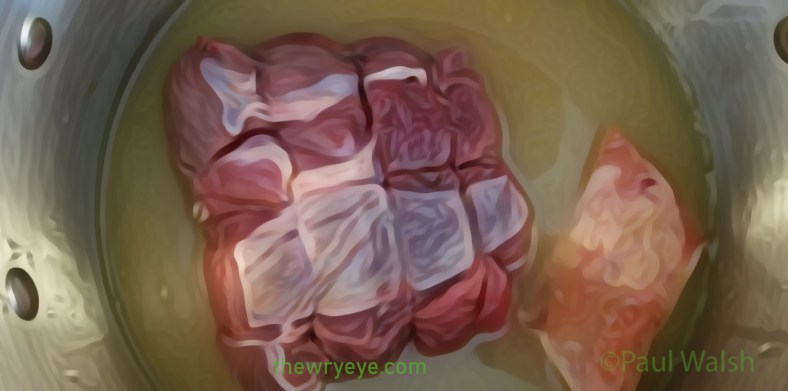
One Pot Cooking – Forgot to take a pic of the ham, oops! This is a beef roast that received similar treatment. Clean-up is a breeze! The fat is in there because of the Omega 3 content in grass-fed beef. And it’s so tasty!

I thought I’d try a fast day at the weekend. My fast days are typically shortened when I give in to temptation and eat dinner in the evening. That’s not all bad but, every now and again, I would like to do a full wake cycle fast. Aside from weight loss, there are supposed to be all sorts of health benefits associated with fasting and I wanted some of that. I started out the day committed, very committed. But then don’t I always! 🙂

I knew I needed to keep busy and watching soccer on TV is not keeping busy. Knowing you can’t eat is exactly what triggers thinking about food. Almost non-stop. It’s the old story about what happens when someone tells you to not think about the elephant! I wondered if I could turn that around and use it to get a positive result.

And so, I decided to spend my free time cooking!

I had a nice ham in the fridge. Pasture raised pork, what could be better? I’m not a fan of clean up so most of my cooking happens in a single pot or pan. One Pot Cooking has been a thing for me since my school years. I browned a chopped onion and half a dozen cloves of garlic in olive oil first. Tossed in the ham and covered it with two liters of organic chicken broth (what can I say, again it was all I had to hand, that’s bulk buying for you), a little rosemary, salt and pepper. Now I had some food to focus on!

This thing bubbled along its merry way for about 4 hours before I lifted it out and put it on a plate to settle. It was falling off the bone tender and it smelled so delicious. While everyone else enjoyed their meal, I was eyeing up the pot of liquid. A few more chopped onions, three diced potatoes, and a bag of frozen peas later, the pot was bubbling again. A tablespoon of curry powder and another of coriander, along with a couple of habanero peppers from the garden, and my nose told me I was done. When it had done its thing, a few minutes bouncing the hand blender off the bottom of the pot gave me this luxuriously thick, heavy soup. I added back some of the shredded ham to finish it off.

What do you think I did next?

I apportioned the whole pot to a set of containers and stuck ’em all in the freezer. Along with the rest of the ham.

But I made it through one complete fast day without anything other than coffee and water. The answer to the opening question is that to avoid eating on a fast day … I cook!

Attaboy Paul!!!


Free Meter for Weight Loss

Free Meter for Weight Loss

Blood Glucose Monitor

It doesn’t hurt. Really!

Blood glucose monitors are devices that we tend to associate with diabetics. According to the CDC, in 1958, about 1% of the US population were diagnosed with what was then called Adult Onset Diabetes. Nowadays, the number is approaching 10% & it’s no longer just adults being diagnosed. This is along with the many more of us that are undiagnosed, or pre-diabetic. With the growing number of Type 2 diabetics, the shelves of our pharmacies display a huge range of these things, like they are the latest best-selling tech gadget for health. Even if we are fortunate enough to have avoided a diagnosis of diabetes, these monitors can be a useful tool to help us keep it that way. Along with being a useful tool to gain some insight on the impact of the foods we eat.

Many of us have impaired our natural feedback loops when it comes to eating. A diet overloaded with sugar and refined starch puts us on the path to obesity. Staying on that path can lead to metabolic syndrome and Type 2 diabetes. Checking our blood sugar levels periodically can help us identify how far down the road we are. And the results can provide some added motivation to change things. If you haven’t used a glucose monitor before, you’ll be fascinated to see what different foods do to your blood glucose levels. That big rib steak wasn’t so bad, was it? But, man, you should have seen my numbers after that pizza! And those cookies were off the chart!

While the correlation isn’t perfect, there is generally some decent relationship between blood glucose levels and insulin when it comes to carbohydrates. Among other things, insulin is released to prevent our blood sugar getting too high. While insulin first stores this energy into our muscles and liver, for more immediate use, it then stores the excess in the long term storage areas … our bellies and our bums! In other words, along with all the wonderful things it does, insulin is the fat storage hormone. This too is wonderful. But if we’re already obese, this probably isn’t what we’re looking for.

A meter won’t cure our obesity. But if you knew that a bagel or a muffin sent your blood sugar soaring, while a bacon and egg breakfast didn’t, how might you consider ordering your next morning meal? And how about that mid-morning snack of healthy yogurt that has 15g of sugar? Did you ever wonder what that might do to your blood sugar level? Keeping our blood sugar levels in the normal range is a good thing. The longer these levels are normalized, the less opportunity there is for storing more fat. A meter can help identify what foods increase our blood sugar so that we can think more carefully when choosing our next snack. An ongoing barrage of sweet treats throughout the day tends to maintain elevated insulin levels. And that may keep us in fat storage mode for the duration. That’s probably not where we want to be if we are hoping to lose weight.

In Canada, the manufacturers offer a “free” monitor with the purchase of a large box of 100 strips. Insurers may also cover the costs of meters and strips if you have a prescription. Most manufacturers have apps that link to their monitors now too. That can be good information to take along to your next doctor’s appointment.

A glucose monitor can be a relatively inexpensive tool to help us understand how our bodies interact with different foods. And it can help us reconstruct our diet to better achieve our goals.

I’d like to think that, one day, I will have repaired my natural feedback loops to the point where I no longer need an external device to tell me what my body is doing.