
Compound Growth or High Yield?

Wish I’d stayed awake for that class!

Compounding confounds & confuses the best of us sometimes. It feels like having a bigger yield to DRIP should work better than waiting for the share price to grow, right? After all, turning on the DRIP on a higher yielding ETF means we’re buying far more shares with every dividend or distribution payout. And that’s true, we are buying more shares with a bigger yield. But that does not mean that it outpaces the compound growth that happens within the share price of a lower yielding fund. Compounding is compounding, regardless of where it occurs. And in a growth stock, or in an ETF filled with growth stocks, the compounding is done by stealth, inside the share price. Not via a distribution. And that does not take away its compounding power. It may even add to it.

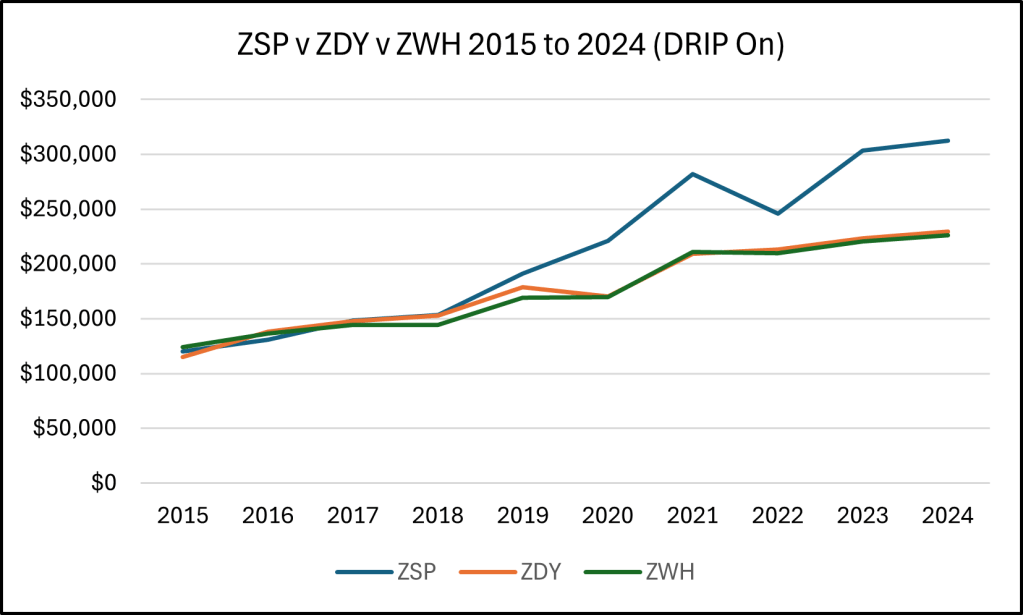
I’m a big fan of their funds, so let’s look at three from the BMO stable for this exercise. ZSP is their S&P 500® Index tracker, ZDY is BMO’s US Dividend ETF, & ZWH is the BMO US High Dividend Covered Call ETF. Here’s what the total returns look like for each, with DRIP on …

I like all three of these funds. ZSP has the lowest yield, typically ranging from about 1.5 to 2%. ZDY has generally floated between 2.5 & 3.5% over the years, while ZWH targets about 6%, give or take a little. The old adage holds true, it’s tough to beat the index fund. ZSP turned $100k into almost $313k over this timeline. ZDY managed to deliver an end value of almost $230k, while ZWH finished at just over $226k. That’s a very respectable comparative return for a covered call ETF.

Despite the positive performance of all these ETFs, the lowest yielding ETF provided the greatest total return. Okay so we know this already, eh? But the confusion tends to increase when we get around to talking about selling shares for income. That strikes fear into the heart of every retiree, even those who can do the math. After all, we’re selling off some of our little geese that lay those golden eggs for us, eh!
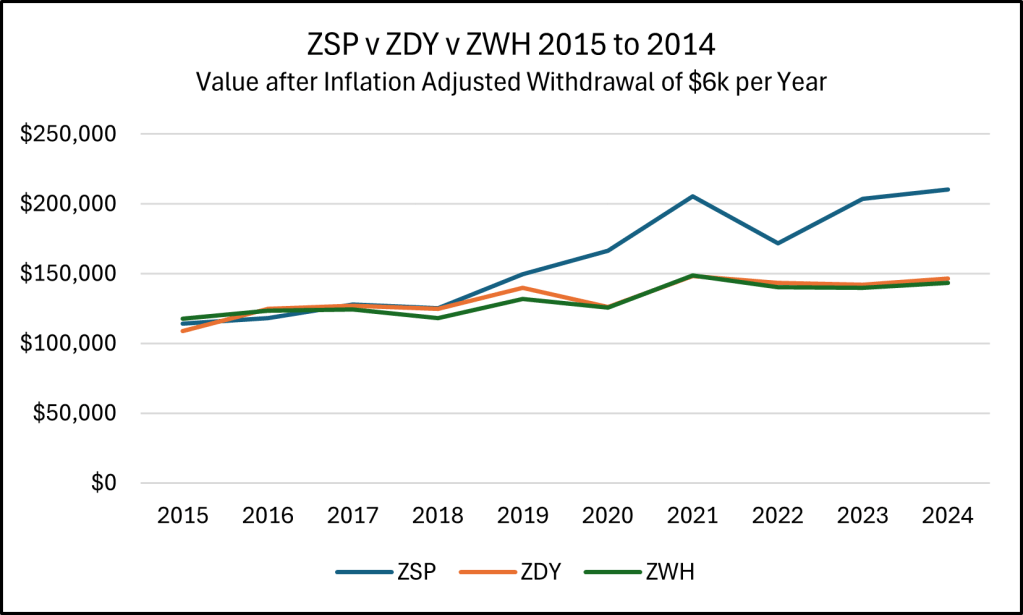
Here’s what that looks like for these three ETFs …

To level the playing field, I used a $6k withdrawal in Year 1 for all three funds, & adjusted for inflation annually in the following years. What remains is each fund’s value after an identical withdrawal. That withdrawal rate approximately matches the higher average distribution rate available from ZWH. ZWH is the only fund of the three that could have avoided selling shares to supply that level of income over this time. However, despite having to sell more shares, the end value of ZSP is $210k. That is significantly more than the $146k remaining in ZDY, & the $143k in ZWH. Despite having to sell more shares to meet the income requirement, the lower yielding funds did better over these years.

Compound growth is just as magical as compound interest or DRIP-driven compound growth. Perhaps it’s even more magical because it doesn’t feel right that you could continue to do better with an ever-declining share count. For better or worse, numbers don’t really care about our feelings!

While the index fund won out over this timeline, there is the potential to have market conditions where a covered call fund might do better. You’ll notice that the ZSP line dips below that of ZWH in 2015 & 2016. Had those market conditions prevailed, ZWH might have continued to lead. They didn’t & ZSP took the lead again. And it stayed ahead through to 2024. While the past doesn’t predict the future, the general tendency for growth in the market suggests that a more growth oriented index fund is likely to outperform over the long haul. Even the bigger downdraft of the index ETF in 2022 wasn’t enough to drag it back down to the level of the other two. During the accumulation phase, it’s all about building the biggest portfolio before retirement. In the decumulation phase, it’s all about portfolio survival!

SOME WORDS OF CAUTION!
This comparison is done over a very short, but generally successful, period of performance for the American markets. I started with a $6k withdrawal rate for this example, to approximate the 6% yield of the highest yielding ETF. But I do not think this is an appropriate withdrawal rate to use for retirement planning. There are reasons why professionals use the 4% Rule in Monte Carlo simulations. It allows for a better hypothetical portfolio survival rate under a greater variety of market conditions. In addition, they may even introduce some additional curtailment or flexibility guidelines to a retirement plan, so that a portfolio survives better during down periods. The caution here is that converting everything to high yield funds in retirement might not provide the best outcome if there are tough times ahead. No question, there are times when it may have worked well. But there is greater exposure to catastrophe if things don’t work so well going forward.
For example, things would have looked very different for a retiree trying to do this starting in the year 2000. Even with an index fund. I used SPY to look at this &, starting with a $6k withdrawal. The portfolio would have gone to zero by 2012. If the withdrawal started at $4k, or 4% of the original portfolio, it will still be delivering income today.
Would a covered call ETF have fared better then? I don’t know, many of today’s funds weren’t around back then. They are too new to assess how they might navigate turbulent markets like those of the lost decade. But having a big yield doesn’t always protect the value of the underlying assets. Choose your retirement strategy with great caution.

If you want to learn more about all this from the ground up, I’d like to suggest that you check out Double Double Your Money, available at your local Amazon store.

Important – this is not investing, tax or legal advice, it is for entertainment & educational purposes only. Data may not be accurate, check the current & historical data carefully at each fund’s website. Opinions are my own, so do your own due diligence & seek professional advice before investing your money.

Investing for Retirement – Canada vs USA

Beavering away to make money!

This isn’t quite hockey but, regardless of the sport, we like to beat our neighbours to the south on the field of battle! When it comes to investing, it’s tough to beat the national teams of either country. And low-cost index funds for both the US & Canadian markets are a bit like the national investing teams. The outstanding performance of the American S&P 500® index in recent years has been impressive. Recency bias might suggest we stick with the winner. However, there are no guarantees that it will work the same way going forward. At least not for the potentially shorter timeframe that some retirees might need it to. People loved this American index in the 90s too. In January 1994, if you had invested a million dollars in SPY (the SPDR® S&P 500® ETF Trust from State Street Global Advisors), with all distributions reinvested, it would have turned into more than $3.6 million by August of 2000. That’s pretty astounding growth, eh? Who wouldn’t want a piece of that action!

Imagine Andy retiring in January 2000. He’s got a million dollars to invest for retirement &, based on its recent performance, he sticks it all into SPY. His sister, Anita, prefers to stick with Canada & she puts a million into XIU, the iShares® S&P/TSX 60 Index® ETF. They both have some government pension income but they need their investment portfolio to provide an additional $40k a year for a comfortable retirement. That’s conveniently aligned with the withdrawal rate of Bill Bengen’s 4% Rule. This rule is more a guideline, but the idea is to plan on the money lasting ’til Andy & Anita move on from this earth. While $40k is 4% of the portfolio in the first year, they both want to increase that income every year by just enough to keep pace with inflation. In addition, rather than run the portfolio down to zero, they would both prefer to leave a little something for their heirs. With both siblings retiring at the start of the new millennium, let’s see how that plays out.

Fortunately, both portfolios have survived up to today & they are both enjoying their golden years. More importantly, they were both able to withdraw an increasing amount each year, in line with inflation. Most recently, they were both able to withdraw almost $73k for living expenses in 2023. The strategy worked for both funds. Today, the value of Andy’s American portfolio is a hair under $326k. While Anita’s Canadian portfolio is worth a little over $1.5 million. Andy’s portfolio showed a money weighted rate of return of about 3.34%. Anita’s was 6.06%. You can get some further insight on MWRR (Money Weighted Rate of Return) here. As a side note on the potential benefits of diversification, a portfolio of 50% allocated to each of these index funds, & rebalanced annually, would have a portfolio value just short of $1.1 million today.
But the end result is interesting, eh! Who’d have thought that the less diversified, less growth oriented, Canadian market fund would have outperformed one of the best indices on the planet?

That’s just one snapshot in time, however, & it included SPY taking a bigger hit when the dot-com bubble burst in 2000. And it took another huge hit with the financial crisis that occurred around 2008. That’s a great example of the sequence of returns risk that retirees worry about. If the first few years of retirement are bad, the longer term outlook might not be as rosy. At least not for the kids hoping for a big inheritance!

Things can look different with even a short change in the timeline though. If the guys had invested their million dollars at the start of 2002, for example, Andy’s portfolio value would be worth $2.3 million today. While Anita’s would be at $2.46 million. The 50/50 portfolio would be just over $2.5 million. Just missing the worst of the dot-com bubble bursting made a big difference to the relative performance of SPY over this slightly later timeline. Missing the dot-com crash made a huge difference for the American fund.

For this final example of a traditional balanced portfolio, I used a 40% allocation to FBNDX, the Fidelity® Investment Grade Bond Fund, as this is one of the older bonds funds available for comparison. The remaining 60% was equally divided between SPY & XIU. The annual income remained the same for all three since January 2000, & the balanced portfolio is worth just over $1.2 million today. That compares to the $326k for SPY & the $1.5 million for XIU that we looked at previously. If we look at the 2002 start date, the resulting values are $1.7 million for the 60/40 portfolio, $2.3 million for SPY, & $2.46 million for XIU. The bonds helped when things went off the rails for SPY, but the bond allocation hurt the long term returns once we got past the dot-com bubble bursting.

That’s all just history though. And it’s difficult to interpret what’s going on today in light of that history. Is the American index overvalued? Maybe, but that doesn’t mean it can’t go up more. And there may, or may not, be another lost decade in sight for the American index during our retirement years. Will the Canadian index continue to do it’s boring trudge upward? Possibly. But that’s not guaranteed either. They could both continue to go up. Or down. Some crazy event might impact one or both markets in the future. Would adding some developed & emerging market diversity help? Again, possibly, but there are no guarantees. Despite bonds taking a dive at the same time as the markets in 2022, is there a place for bonds in a portfolio? I think there is. Does a cash position make sense with today’s higher interest rates? Again, I think it probably does. Particularly for those going into retirement. But in what proportion is anyone’s guess & the allocation may be more appropriately decided on based on individual risk tolerance. There are studies that suggest that stocks are less risky than bonds over the long haul. But if the long haul data is looking at a 50 or 100 year time period, that may not help a retiree with a 20 or 25 year retirement span. Especially if a major event hurts market returns during the early decumulation years.

With investing there are always more questions than answers. And the answers will be different for each of us. There are a wide range of solutions offered to help with such problems these days. There are relatively low-cost, all-in-one, asset allocation ETFs now, for example. These are ETFs consisting of globally diversified equities, combined with a weighted allocation to bonds, based on the investor’s risk tolerance. But it’s also possible to make a case for buying such funds individually, rather than in the all-in-one basket. Some retirees prefer income generating assets. Other prefer to leave it all in the hands of a professional money manager. There is no one way to do this. And the vagaries of time and the markets will always produce different results over different timelines.

I wish there was one right answer to this question. But the purpose of this post is more about using the lessons of history to counter the influence of recency bias. While betting big on the currently successful US index may pay off, doing that has delivered some hurt in the past. In other words, if you can tolerate the potential pain, you may achieve the gain you want. Though you may have to live longer to appreciate the results! Asset allocation & diversification can be of value in mitigating those effects. For better or worse. A younger investor with the right risk tolerance may be in a position to take on more risk. Older investors, maybe not so much.

If you want to learn more about all this from the ground up, I’d like to suggest that you check out Double Double Your Money, available at your local Amazon store.

Important – this is not investing, tax or legal advice, it is for entertainment & educational purposes only. Data may not be accurate, check the current & historical data carefully at each fund’s website. Opinions are my own, so do your own due diligence & seek professional advice before investing your money.

Covered Call & Leveraged ETFs

The Ballast & Boost of Covered Calls & Leverage!

It’s generally accepted that it’s tough to beat the performance of low-cost, index-tracking ETFs. After fees, most actively managed professional funds don’t beat the indices over the long haul. While we can get lucky from time to time, most DIY investors can’t beat the indices either. We can however, have our heads turned by an attractive income stream. High yield ETFs have found new life since the covid lockdown. The whole work from home thing had many of us wanting to carry on working from home forever. If we could figure out how to get our investment portfolios paying as much as our day job, we could call it quits & be totally done with working for a living, eh?

Traditionally, you could build an income stream with a portfolio of dividend stocks or with some dividend yielding ETFs. Covered call writing can boost the distribution of an ETF beyond the dividends of the holdings. For investors who need an income stream, it’s an attractive proposition. You get a bigger income stream, without the hassle of selling shares for income. And you might not have to worry about selling shares in a down market. The negative thing about it is that you often lop off some of the upside with a covered call strategy. Selling a call means that you’ve made a few extra bucks, but you now have a contract to sell your shares at an agreed price. If the stock goes beyond that strike price, your shares are called away & the option buyer gets to buy them at a lower price than they are then worth. You’ve lost some of the upside. In general, these covered call ETFs will underperform an ETF that just holds the same stocks for growth. But so long as the underlying value of the covered call portfolio continues to grow, some people are okay with that. Instead of paying a financial advisor to give you a monthly cheque, you’re just letting the ETF manager use some of the upside to pay for the service. Some think that a covered call ETF will protect them when the market drops. That’s often not true. Other than the extra option premium we get, these ETFs can crash every bit as far & as fast as a regular ETF holding the same stocks. In general, covered call ETFs are more likely to underperform over the long haul. Though some are better than others, so you do need to compare before taking the plunge.

Fund managers are good business people. They know a good opportunity when they see it. They watched the enthusiasm for covered call ETFs growing & they realised that they could make it more appealing with the even bigger income stream that is available through the use of leverage. Leverage is borrowing money to invest in more shares. While borrowing cash for stocks can be an intimidating proposition for an individual, it’s a lot easier if the fund manager does all that for you inside the ETF. You can now find many ETFs advertising the enhanced yield that comes from using modest leverage. Those are marketing words with a lot of allure. Who doesn’t want “enhanced” yield? And nobody should fear “modest” leverage, right? You can see the appeal of the marketing message, eh?

But how well does this combined approach work?

The covered call bit is pretty straightforward, but let’s look at the effects of leverage. Since many of the new funds are too new to have any worthwhile history to examine, let’s start with a Canadian index fund instead. Canadians love Blackrock’s iShares S&P/TSX 60 Index ETF, XIU. If you invested $10k in XIU back at the start of January 2000, with all dividends reinvested, you’d be sitting of a portfolio worth $47,757.00 today. If Grandma had loaned you enough money, at a zero percent interest rate, to apply a 25% leverage ratio to your investment, you would have $65,269.00 today.
Oh yeah, baby! Gotta love that leverage thing, eh!

Now what if Grandma had offered to loan you the leverage money at a 7.2% interest rate? Would you have taken her up on it?

If you had, your portfolio would be worth only $42,487.00 today. That’s a lower return than just investing in XIU without leverage. I think Grandma suckered you! I cheated a bit here to make a point. That 7.2% is the current prime lending rate. Interest rates were lower for much of that time & you’d have fared better with lower cost leverage. But if you were to get your own leverage by applying margin within your brokerage account, you might pay even more today. Check the margin rates at your brokerage. Fund & ETF managers can get better rates than we can, of course, but their fund returns will be negatively impacted by higher interest rates too. It all adds to the costs involved with managing these funds. These numbers won’t be on the front page of the ETF brochure. You’ll often have to dig into the multi-page downloadable documents (prospectus & financial statements) to see what these costs are. You’ll also find the TER (Trading Expense Ratio) here. I know, I know, I hate that small print stuff too. But once you dig, & with today’s higher rates, it’s not difficult to find a fund like this with a real total expense ratio of 2% or more. Let’s be real, the size of the fee doesn’t matter if the performance is good enough to pay for it. But if it’s not, we might do better with an advisor charging 1% to put us into low cost index funds & letting them do all the work to make sure we have an income stream every month. I’ve taken some liberties with this simple example here, but what’s the takeaway?

Going into one of these ETFs can be a bit like putting a donkey into a horse race. Generally, the low-cost index funds are the race horses. Active management adds more cost & doesn’t always add more return. Adding a covered call strategy is like putting bricks on the back of the donkey. They slow our ass down! Adding leverage is like using helium balloons to compensate for the drag of the load of bricks. How well a fund manager balances the bricks & the balloons over time will determine the fate of the investment. As will the fees charged for doing all that work. Interest rates have an impact too. The value of leverage goes down when interest rates go up. And leverage increases volatility. When the underlying investment goes up, leverage will make it go up further. When it goes down, leverage makes it go down further. The investor’s ability to handle that volatility is important too. It’s no surprise that leverage works best with assets that show consistent growth in a low interest rate environment. Check the history of total return when comparing one of these high yielding ETFs against a simple equity ETF. New funds lack history & it’s nice to see if a fund has proven itself over time. And during different market conditions. While past performance does not predict future results, it’s always worth taking a look at past performance before you place a bet with your retirement money.

Doing this comparison is even more critical if all the distributions are being pulled out for living expenses. A fund that consistently declines in asset value, as distributions are removed, is far more likely to provide a declining income stream over time. Try out the tools at Portfolio Visualizer for these comparisons. It gives a great snapshot of performance differences between funds. And it can show the history of the income stream. A declining income stream over time might not work well for an early retiree with a long time horizon.

While index investing is often recommended for investors with a long time horizon, there is an undeniable attraction to a nice income stream at any age & stage of the investing journey. But, starting out, be a little careful about how much of your portfolio is allocated to high-yield funds. Having great underlying holdings isn’t always enough. That does not mean that these funds don’t have a place in some portfolios. Just be careful with your choices!

There is another post on Canadian Banks for Dividend or Covered Call Income? if you want to read more on a comparison of the covered call approach.

If you want to learn more about all this from the ground up, I’d like to suggest that you check out Double Double Your Money, available at your local Amazon store.

Important – this is not investing, tax or legal advice, it is for entertainment & educational purposes only. Opinions are my own, so do your own due diligence & seek professional advice before investing your money.
What is Your Return on Investment?

What is CAGR? And how does that compare to TWRR & MWRR? Isn’t it all just about the gains on your investment at the end of the day? How should you measure the performance of your portfolio?
We typically start out looking at the “profit” (or loss!) on our investments. We like to see that our portfolio is in the black. However, that isn’t enough. Being up 50% is always good. But it’s better if we’re up 50% in a fewer number of years.

CAGR (Compound Annual Growth Rate)
CAGR is one of the simplest measures of annual growth. You toss a bunch of money into the market & check its value after a few years. You use a little formula that tells you what the average annual growth rate was over that period. Your investment may have bounced up & down during that time, but CAGR gives you one easy number to look at. It’s a simple way to compare the historical performance of one investment against another. You can even calculate the CAGR of your house appreciation. Or you can use an online calculator like this one here. If you bought your house for $100k twenty years ago & it’s worth $300k today, your house appreciated at an annualised rate of about 5.6%. Now you can compare the returns on your house against your investments in the stock market!
But this only works for static investments. If you have cashflows, in or out, the numbers get thrown off & CAGR may not be so useful.

TWRR (Time Weighted Rate of Return)
TWRR & CAGR will be the same if there are no external cashflows, either into or out of the fund. In the real world, money is moving in & out of funds all the time. So fund managers & portfolio managers use some fancy math to calculate the TWRR to show the comparative performance of their ETFs. They use TWRR precisely because it eliminates the effects of the those cashflows. It’s trying to come up with a number that’s like CAGR, but for a portfolio that changes all the time. Because of this way of calculating return, TWRR makes it easy to compare funds against each other & against benchmarks. It only compares the performance of the investment choices. It doesn’t look at the return impact of funds flowing in & out.

MWRR (Money Weighted Rate of Return)
While TWRR eliminates the effects of inflows & outflows, MWRR deliberately looks at the impact of the size & timing of those cashflows. It wants to show the positive & negative impacts of when we add or remove money from a portfolio. The size & timing of the inflows & outflows means that the TWRR & MWRR percentage returns can be different. Sometimes significantly. An investor who moves money in or out will have an MWRR that is different from the TWRR for the same portfolio. If our investor times the market right & invests a large amount at a market low during the measurement period, his MWRR will be higher than his TWRR. And it should be, he got it right & made more money. That’s why it’s call Money-Weighted. The end value of his portfolio will be bigger as a result. The investor who sold some shares at the low is at the other end of the spectrum. He sold low, lost some money, & there was less money left in the portfolio to benefit from the recovery going forward. His MWRR will be much lower than the other guy. As will his end portfolio value. MWRR shows those differences on an annualised return basis. Since it’s removing the effects of cashflows, the TWRR for both investors will be exactly the same. But I know whose shoes I’d rather be in!

What does it all mean?
Remember that TWRR removes the influence of cashflows. It only shows the performance of the investment choices. In other words, both our investors made good investment choices (assuming they were beating the market!), but they managed their cashflows differently. And MWRR shows that difference in performance because of that cashflow management feature of the formula. The loser sold at the wrong time & had less value left in the account to benefit from the subsequent growth. His MWRR was lousy. The other guy bought more at the right time & he had even more money in play to capitalise on the growth that followed the market lows. His MWRR was great.
And no, it can’t help you time the market going forward. It just shows how well, or how poorly, your crystal ball worked in the past.
If no money moves in or out during the measurement period, CAGR, TWRR, & MWRR will all be the same.

About 6 years ago, the CSA (Canadian Securities Administrators) implemented guidelines for portfolio managers to provide performance reports based on MWRR for their clients. While fund managers need to use TWRR for real world comparison purposes, the MWRR is more real for individual investors. For DIY investors, some brokerages have performance tools that will show you both TWRR & MWRR over different timelines. When you are reviewing your performance, it might be good to know what kind of returns you’re looking at. Check out the performance tools on your brokerage account. Or, if you have an advisor managing your investments, talk to them about how your returns are reported.

Knowing the TWRR of your own portfolio is great for comparing the performance of your choices to that of an index fund or any other strategy ETF you think might be suitable for you. If you’re putting in hours of work & worry trying to beat the market, this metric might help you decide if it’s been worth all the extra effort. If you sat on some cash in the past, maybe waiting for an opportune crash to invest, the MWRR may help you see how well (or poorly) the timing of your money decisions worked in the past.
On the other hand, if you are happy with your portfolio’s TWRR & are investing small amounts regularly, you probably don’t need to worry about the MWRR deviating too much from that.

Of course, these are just a few ways of comparing performance. When it comes to investing, we all have our behavioural characteristics too. It might not be that we want to chase the highest return. There are investors who will sacrifice some growth in favour of lower volatility. Some favour investments that throw off dividends & distributions. We all have different tolerance levels for fixed income investments. And so on. But knowing the TWRR & MWRR on a portfolio can add something to the evaluation mix for us too.

If you want to learn more about all this from the ground up, I’d like to suggest that you check out Double Double Your Money, available at your local Amazon store.

Important – this is not investing, tax or legal advice, it is for entertainment & educational purposes only. Opinions are my own, so do your own due diligence & seek professional advice before investing your money.

Canadian Banks for Dividend or Covered Call Income?

Dollars & Dividends

We love our dividends in Canada. If dividends are so great, why not go for the even greater yields available with covered call ETFs? Maybe we can toss all our investments into covered call ETFs & retire early? That sounds great!
But does it work?

Maybe!

Every investing strategy has its fan base. But at the end of the day, it all comes down to how the numbers work for the individual investor. And covered call ETFs can work for some investors.

However, some features of covered call writing can be less appealing. The notion of covered call ETFs having lower volatility, for example, may be true. But volatility is a measure of an investment going up, as well as down. In general, covered calls will limit upside. If a growing stock is called away, you lose some of the upside. As investors, we don’t mind volatility if it means our investment is going up. We only fret when it goes down. Hand in hand with that is the idea that covered call writing offers some downside protection. You’ll notice the wording in the description of many funds says something like downside protection may be limited to the returns provided by the covered call premium. That’s marketing speak for “we can crash as hard as anything else but you’re at least getting that juicy covered call premium along the way”. Unfortunately, during times of growth or recovery, the capped upside often means that the growth of a covered call fund doesn’t match that of a fund holding the equities directly.

Let’s take a look at an example using only Canada’s big banks. The five largest banks in Canada all started paying dividends in the 1800s. That’s a little too far back to look at, but if you’d invested $100k in an equal-weight holding of the Big 6 banks back in January 2000, that portfolio would have grown to almost one & a half million dollars today! Investing in the large cap American or Canadian market index funds would only have returned under half a million over that time. Of course, nobody would risk going all in on just the Canadian banks. Right!?! But this kind of performance is why Canadians like their banks.

To compare the different investing strategies, I’ll use BMO’s ZEB & ZWB here. Both ETFs are designed to track the Solactive Equal Weight Canada Banks Index. And both funds are managed by BMO Global Asset Management, one of Canada’s largest ETF providers. ZEB just holds the banks. ZWB holds the same banks, but adds a covered call strategy to about 50% of the portfolio to generate a bigger income stream. These ETFs have a relatively short shared history, so we’re only looking at returns over an 11.5 year period up to the middle of this year here.

Accumulation
During the accumulation years, all dividends & distributions are reinvested, that’s the “DRIP ON” scenario in the table below. This shows the Total Return, with dividends reinvested, from a $100k investment directly in the bank stocks. And it compares that to the same $100k investment in ZEB & ZWB.

It’s probably no surprise that directly investing in the stocks produced the greatest return. The direct investment was rebalanced semi-annually, to match the index tracking guidelines used by the ETFs. While ZEB does all that work for us, the fees charged by the fund cause a little drag on the returns. Since covered call writing lops off some of the upside potential, it’s also not a surprise to see ZWB trailing the pack here. It’s CAGR & Best Year are poorer. But, it’s worth noting that it’s Worst Year is slightly worse than the other two. Fund managers do warn that covered call funds “may” provide downside protection. Sometimes, that might only be by the amount of the covered call premium. But it’s not a guarantee. Since ZWB had the biggest drop of the three, the covered call strategy didn’t provide much of a safety net during the covid crash of March 2020. It’s possible that longer periods of sideways, or slightly down, markets could have allowed ZWB to produce a better relative performance. All in all though, it’s a pretty good performance for all strategies. That’s the accumulation picture. Next we’ll look at what happens when we start spending the income.

Spending the Money
Things change when we retire & need to spend some of our savings every year. All sorts of new challenges come up. The ideal scenario for many retirees is to have their investments generate enough dividends & distributions for them to live on. No worries about having to sell shares in a down market, & so on. Here’s how these three investments deliver on the income front.

This table shows the picture for an investor who retired in 2012 & sucked out all the dividends & distributions for living expenses along the way. The holder of ZWB would have had more income over the 11.5 year period. Though overall, perhaps not the best value, since the value of the underlying portfolio didn’t grow as much as the other two. If an emergency situation forced the sale of some shares to raise capital, the other two approaches had far bigger portfolio values to draw from. Aside from the income, the positive thing about all these results is that the underlying assets continued to appreciate. All these ETFs show positive CAGR. And this is with all the dividends & distributions taken out. BMO’s limited covered call strategy, over this timeline, worked well. Any income investment that shows negative CAGR for the underlying assets (with DRIP off) might be an exposure for a retiree with a longer time horizon. The portfolio value would decline over time & that will have an impact on the income stream over the long haul too. There is one other exposure here & that is the impact of inflation. If we adjust the End Value of the portfolios in the above table, the Big 6 & ZEB are worth an inflation-adjusted amount of about $150k. The End Value of ZWH, in 2012 dollars, is just under $95k at the end. This isn’t quite accurate, as the inflation adjustment comes from US inflation data, not Canadian. But it still shows the importance of having a portfolio capable of staying ahead of inflation.

Here’s what the income streams look like for these investments …

While ZWB starts out with a far greater annual income than the other two options, it shows more variability than the other two. Variability of income from year to year can be an issue for some retirees. Perhaps more importantly, the other income streams are catching up as time goes by. Direct investing shows a more consistent upward trajectory, even without any additional investment or DRIP. And this is exactly what you’d hope for with a portfolio of dividend-growth stocks. The dividend growth is what grows the income stream. That can be very important for an investor with a longer expected time horizon in retirement. Early retirees should watch out for this.

The Canadian banks generally do well over time. For portfolio growth & for growth of income. But now it’s down to personal choice. Do you prefer to trade some long-term portfolio value for the bigger income stream of the covered call approach early in retirement? Or do you like the more consistent growth of the income stream that comes from a portfolio biased towards dividend growth? There are a lot of factors that go into individual decisions. For a young investor with a long time horizon, total return is probably going to be more important than the size of the income stream starting out. It might also be more important for an early retiree. Or for a healthy retiree with a longer life expectancy. Things like leaving an inheritance, planning for home care or a retirement home, & so on, all factor into the decision making process too. Regardless, the Canadian banks have been a pretty solid investment over time & they look good in all these scenarios. Of course, as you’ll find noted on every fund’s webpage … past performance is not indicative of future results! We can’t just assume an investment will continue to do well in the future because it’s done well in the past. The banks have been great performers historically. But not all stocks or funds perform as well as the banks did here. Be sure to compare your choices for total return & income growth. And not just the size of the yield!

If you want to learn more about all this from the ground up, I’d like to suggest that you check out Double Double Your Money, available at your local Amazon store.

Important – this is not investing, tax or legal advice, it is for entertainment & educational purposes only. Opinions are my own, so do your own due diligence & seek professional advice before investing your money.