Beat the Market in 2023

Beating which Market!?!

Happy New Year to all & here’s to our collective success in beating the market this year. Of course, we can’t all beat the market, we need some losers to lose money so we can be winners. But in the best tradition of reading great free advice on the internet, let me tell you that while beating the market is a big deal, it’s not that hard to do.
(Make sure you don’t stop at the first chart, there is a twist to this tale! ๐Ÿ˜œ)

If you’d stuck a thousand bucks into these three ETFs back at the end of 2013, & reinvested the dividends along the way, you’d have beaten “the market” with any of them. Check out the chart below, the two BMO ETFs & the Vanguard Canada ETF all beat the American index tracker. Seems like a no-brainer, eh?
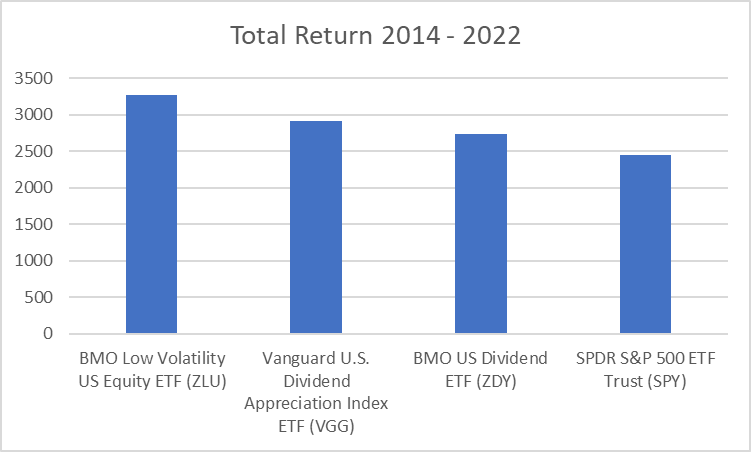
Of course, making a decision from this one chart would not be wise. And you’re seeing it on the internet, for cryin’ out loud! Instead, we’d have to do our due diligence, eh? Maybe read the marketing blurb on the fund’s website. Find a few online buddies that have invested in it & that want you to invest in it too. Ignorance, like misery, loves company. That is not doing due diligence!
Now look at that same chart but, this time, with Vanguard’s VFV replacing SPY & you get this …
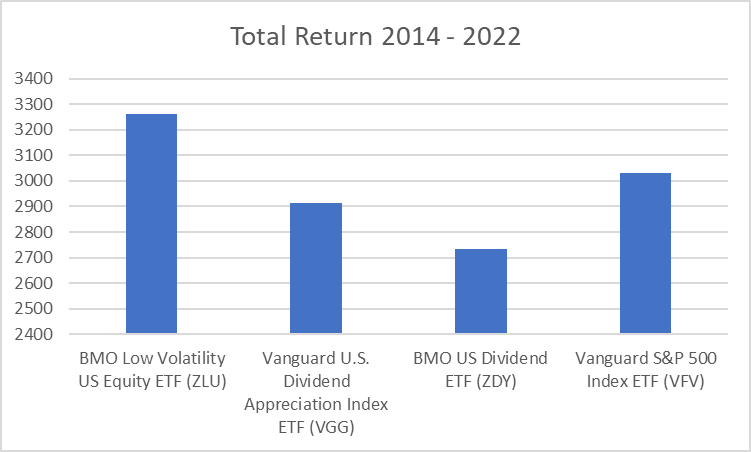
What’s going on here? Both SPY & VFV track the same index. Yet VFV is doing way better. It’s because we were comparing red apples to green apples in the first chart. SPY is in US dollars. Back at the start of this comparison, the Canadian dollar was strong for the first couple of years. The original investment in SPY was in US$, while the original investment in VFV was in Can$. As the Canadian dollar weakened over the years, VFV benefitted from holding US stocks, priced in US dollars. VFV is getting a numeric advantage because one US dollar is buying more loonies today. That makes VFV’s numbers bigger. But the benefit is only in the numbers, not in the value when compared to the current exchange rate. In fact, SPY would do a little better because of its lower fee structure. However, for a Canadian investor to buy SPY, there would be a currency exchange cost to consider too.

Only ZLU beat the index in both cases, so just buy that one, right? No, it’s not that simple. While all these ETFs are good, they only work as part of an overall investing strategy. They each hold differing numbers of stocks, with different sector exposures. They have different yields & costs. They are all focused on US stocks. Are they cheap or expensive relative to history & expectations? Besides, who knows what happens going forward. And 9 years is not a long time in investing cycles.
Which of these you choose for part of your portfolio depends on your investing philosophy. If you don’t have a personal investing philosophy, it’ll be tougher to build an investing strategy that will work with your fears & needs. This will be different for everyone. But once you know who you are as an investor, & what you are trying to achieve, you will find it easier to invest in things that might have a better chance of delivering for you. And, sometimes, that might mean we don’t need everything we hold to beat the market all the time.

This year, as with all prior years for a long time now, my new year’s resolutions include losing weight, exercising, & saving more.
Along with developing an investing philosophy that I’m comfortable with! ๐Ÿ˜œ

Best of luck for 2023. I hope it’s a good one for all of us.
Lies, Damned Lies, & Compound Growth

The Power of Compound Growth

Compound growth (or losses!) can be confusing. When it comes to compounding, using quick mental arithmetic to make investing decisions can be detrimental to our financial health. If we don’t take the time to understand the power of compound growth, to feel its power, we might not even find the motivation to start saving & investing. That might prove to be a costly oversight down the road. And it’s very difficult to compensate for those lost years later. Life really is too short.

Try this little brain teaser …

If someone offered you a penny to work all day, would you do it?
No, eh!
What if they asked you to work for a full month but, this time, they offered you a penny for the first day of the month & then promised to double the previous day’s pay for you, every day, ’til the end of the month?
If you think this is a trick question, you’re right. But without grabbing a calculator, how much to you think you’d be owed at the end of the month? Take a stab at picking a number now & I’ll share the calculations further down.

Ever since Jack Bogle gave us the low-cost index fund, there has been widespread support for retail investors, particularly younger investors with a long time horizon, to follow that path. Even the inimitable Mr. Buffett recommends low-cost, index-tracking funds for most of us. After taking fees into account, there aren’t too many actively managed funds that can beat the market index over time. The market has grown by about 10% annually for a century or more. If it works like that going forward, a kid saving $100 a week from age 20 to 65 might have a portfolio worth almost four million dollars by retirement. That’s the power of compounding. If the kid invests in an equivalent high-fee fund that reduces that annual growth rate to 8%, the portfolio would be worth a little over two million come retirement day. That’s the power of compounding in reverse! Fees of “only” 2% eliminated almost 50% of the end value. Fees compound too. Just not in favour of the investor.

The magic of compound growth is tough to visualize with any degree of accuracy. I need a tool or a calculator to compare investing returns over time. Particularly when it comes to comparing a growth investment against one that pays a dividend that gets reinvested. While past performance may not be replicated going forward, historical performance can make for some interesting comparisons. And those real comparisons will probably be very different to guesstimates based on my mental arithmetic. Our heads don’t do compounding well. But compounding might do well for us. If we allow it enough time to work it’s magic. Play with a compound growth calculator. It might encourage you to get started. Once you understand the power of compounding, you should be motivated to get started right away. Compounding takes time & patience. But you’ll never truly get to appreciate its value if you don’t start early enough.

What if you’re old already? I know that story all too well. Each investor has a different risk tolerance, level of knowledge, savings rate, & so on. Even two investors with very similar investor profiles may invest in very different portfolios. Compounding doesn’t care. It will do whatever it can with our investments, with whatever time is available. Based on your investing style, plug in the numbers for your timeline, with your expected rate of return. See if the possible outcomes are close to where you’d like to be by retirement day. If not, you might need to save more, sooner, to get there. Or maybe you’ll see that financial freedom is not too far away for you. A compound growth app might be one of the best games to have on a mobile device!

Does your head do compounding well? What number did you come up with from the opening question?
At the end of the first week, you’d be due about a buck & a quarter. Not even enough for a cup of coffee these days. Pretty awful, eh! By the end of the 2nd week, that would jump to $164. Hardly earth shattering. The 3rd week, however, would be almost $21k. Yes, twenty one thousand dollars. Things are improving now. At the end of the 4th week, the number would be almost $2.7 million. And only three days later, at the end of the 31st day, it would be almost $21.5 million.
The total wages due on that penny starter wage, by the end of the 31st day of the month, would be almost twenty one & a half million dollars. Now, that’s some kind of compounding!
How close was your guess!?!

I like the calculator at the Ontario Securities Commission website here. The graph of results here shows a great image of how the power of compounding works better over time. Go play!

Important โ€“ this is not investing advice, it is for entertainment & educational purposes only. Do your own due diligence & seek professional advice before investing your money.

Market Crash Lessons

What Next?

I’m trying to encourage my kids to save & invest while they are young. As usual, Dad’s advice turns to muck pretty much right off the bat. The markets tanked. I tell them, with great confidence & authority, that it’s just noise. To keep on saving & investing. That they’re just buying the good stuff on sale now. Listen to Dad.

There are lots of experts out there with advice on how to handle market losses. I must admit, I’m not one of them. I failed my biggest test back during the dot-com crash. I sold off all but one of my holdings then. The only one I held onto went to zero. All the stocks I sold would have made me money. Had I held onto them! What do you think I learned from that experience?

Stay out of the market, it’s just a lottery? Yeah, I did that for a while. Too long a while. But no, that’s not it … the lesson I seem to have learned is to be afraid of selling anything!

Nowadays, rather than chase what’s hot, I buy what’s not. Most of my investments are in bigger, bluer, dividend-growth companies. Or in ETFs that hold companies like that. But that doesn’t make a downward spiral any more enjoyable. Turns out big blue-chips can go down too. I have the same dilemma today: I don’t know if I should sell, hold, or buy more. Not knowing, I do what I do best … nothing! My stocks just sit there, showing red, & I do nothing. The automatic DRIP adds new shares on dividend pay days. I don’t need to do anything with that either.

I have neither the quant skills nor the psychic ability to figure out what happens next in the market. Instead, I’m trying to get more comfortable just doing nothing. It reminds me of the few times in my career where the future of my employment was at risk. When I lost my jobs back then, I had no other sources of income. But I survived. Between the individual stocks & ETFs I own today, I own little pieces of hundreds of companies. What are the chances they’ll all fire me at the same time & kill the dividends? Pretty slim, I think.
What are the chances that they’ll all go to zero? While there are no guarantees, that’s pretty unlikely too.

For a lazy & conflicted investor like me, it was almost a relief when I came round to thinking that doing nothing might be best. I still worry every time I see the market drop further. I wish I could just stop looking. I can’t. But, so far, I’m sticking with the do nothing strategy.

Only time will tell if if I can keep on doing that. And if that was the right thing to do. Especially for the sake of my kids! ๐Ÿ˜œ

Hurricane Investing

Sunset After Fiona

We were very fortunate during Hurricane Fiona & suffered no loss or damage. Our power went out around 5am yesterday but it was back on again, just shy of 6pm, the same day. There are still hundreds of thousands of people without power, & worse, in Atlantic Canada. I hope things get back to normal for everyone quickly. Here, I’m looking at my small challenges of yesterday from an investing perspective.

My power is delivered by a division of Emera (EMA) & they had proactively engaged the assistance of power workers from neighbouring provinces & states in anticipation of the challenges that Fiona would bring to our doorstep. Fortis (FTS) was similarly preparing for events in PEI & Newfoundland. My Telus (T) cellphone remained my only source of information throughout the day & I was able to pick up the latest news from CTV Atlantic on my phone. CTV Atlantic is owned by the media division of BCE Inc. (BCE). A division of that company delivers my internet & cable TV services too. My home is heated by natural gas that comes from a division of AltaGas (ALA) & Enbridge (ENB) also has natural gas delivery infrastructure on the east coast. I filled up ahead of time but, during less stressful times, my local gas station is also a good stop for a coffee & a sandwich at the Circle K convenience store. This is operated by Alimentation Couche-Tard (ATD). Most of us gassed up ahead of the hurricane. Canada’s energy & pipeline companies (CNQ, SU, TRP & many more) all keep us moving. Emergency workers & us regular folk all need to be able to get to those in need, to family & friends, during & after an event like this. Though all the supermarkets in the immediate vicinity were closed, we found a Sobey’s about fifteen minutes away that was open & fully functional. Sobey’s is owned by the Empire Company (EMP.A). There were very few coffee shops open &, even in normal times, everyone is always desperate for a coffee. Those few Timmy’s that still had power had long lineups. Very long lineups! Tim Horton’s is part of Restaurant Brands International (QSR). While it’s always useful to have some cash, all the bank cards seemed to be working at any location with power. The banks (RY, BNS, TD, BMO, NA, CM) were doing their thing during the hurricane too.

Insurance providers, healthcare businesses, construction companies all have a part to play at times like this but I’ll stop now, you get where I’m coming from, eh? Sometimes, the companies we complain about during “normal” times are the ones we depend on when times get tough. I used to complain about paying the price for the products or services that these companies provide. But I moan a whole lot less when I truly need them. And, as a shareholder, the perspective changes too. I tend to complain less when I own a piece of the business. That doesn’t mean we can just buy shares in any company we like, any time we like. Nor does it mean that we can just buy shares in any company that we complain about. While many of these companies fulfill needs that are important to how we live our lives, we still need to figure out if the company offers value to us as an investment going forward.

Fiona made me think a little differently about some of the stocks in my portfolio. I don’t directly own shares in all those mentioned above, but I do hold many of them. And it wouldn’t surprise me if the missing ones are in an ETF I own.

Fiona is finally moving on. Thankfully. Here’s hoping the recovery process goes well for all those impacted by her passage. Stay safe out there.

Important – this is not investing advice, it is for entertainment & educational purposes only. Do your own due diligence & seek professional advice before investing your money.

Growth vs Income Investments

Crypto, NFTs, or Boring Old People’s Stuff!?!

A lot of new investors have found their way into the stock market since the pandemic started. My own kids included. It’s interesting to see the different strategies that these new investors are drawn to. I’m not surprised by their interest in the latest hot stocks. I’m not even surprised by their interest in crypto & NFTs. But I am surprised at how many are looking at high yielding funds. Some of the allure here seems to be wrapped up in visions of early retirement. I think I understand that one!

Are high yield funds a good approach towards achieving early financial independence? Are these funds good choices for those already retired?

I picked two funds that are popular with income investing groups to compare against the market. I wasn’t cherry picking here, I just went with a couple that are popular with some of the groups & blogs I follow online. Overall it came out as I expected, but there were some surprises in the detail. And the devil is always in the detail! For fun, I threw one of Canada’s big banks into the mix. Both fund selections are closed-end funds with high yields. The American-listed fund currently has a yield around 20% & the Canadian-listed one is about 10%. The bank’s dividend is a little over 4.2%.
Those are very different yield numbers but, let’s be real here, it’s hard not to like a 20% yield!

Usually, it’s older investors who are attracted to yield. There is a lot of psychological comfort in retiring with a portfolio that generates enough yield to live on. Without having to sell shares. Younger investors who dream of early retirement are usually more focused on growth. Once the target portfolio size is reached & retirement beckons, it’s then the focus switches to income. That seems to make sense. But some young investors, still in the accumulation stage, are buying these high-yielding funds long before they need an income stream. They are reinvesting the distributions during the accumulation phase & that makes for great income stream growth …

Income Stream with Dividends & Distributions Reinvested

That’s pretty cool, eh? The big yielding funds are crushing the bank’s income stream. And all three are growing the income stream very nicely. But that’s with all the dividends & distributions getting reinvested. When you retire, whether you do that at a young age or at 65, the income stream is now used to cover living expenses. In other words, the dividend reinvesting may stop.
This is what happens to the income stream when you stop reinvesting the distributions …

Income Stream with Dividends & Distributions Removed for Living Expenses

That’s a very different picture now. The distribution from the very high yield fund is dropping with each passing year, the distribution from the Canadian fund is flat, & the income stream from the bank is increasing year by year. In 2022, based on the performance up to now, the bank will likely surpass the income stream from both funds.

Which of these would you like to have as part of your portfolio going into retirement?

Let’s look at something that might be more important for the young investor … portfolio growth.

Here is the CAGR (Compound Annual Growth Rate) of the investments, compared to a low-cost ETF that tracks the S&P 500ยฎ index. This one shows the annual growth with all distributions reinvested. To be honest, none of these are too shabby, eh!

And this one shows the growth when the distributions are not reinvested.

In either scenario, going left to right, the better the return. When the distributions were reinvested, the lower yielding options still provided better returns. How could this happen? The US fund had a declining share price over those years. The Canadian fund share price finished 2021 slightly above the share price at the start of 2010. The bank & the index ETF provided the bulk of their returns from growth. I’m not suggesting that any of these investments are better or worse. That will depend on individual needs, which can also change over time. A young investor, with a long investing horizon, will usually have different requirements than an older investor going into retirement.

Even individual retirees will have slightly different needs. One retiree might maintain a growth focus on his personal investments because he has a decent DB pension. Just to maintain a standard of living, another might need a growing income stream to keep ahead of inflation, the big bank might appeal here. While a third might want to maximize income during the early retirement years, so high yield could be more important for this investor. Maybe her husband wants to go nuts travelling while they still can!
It’s possible that you’ll find any or all of the above investments in all three retirees’ portfolios. Though likely in different proportions.

I didn’t compare the results for other funds or stocks, nor did I look at the results over different time periods. When comparing investments, it’s worth checking from a variety of angles. It’s much more than comparing simple share price returns. Total return considers the share price appreciation (or not!) & the dividend income. Beyond that, consider the returns with & without dividends reinvested. This exercise is just one example of why these comparisons are important. Understanding the implications of different investments can help develop a stronger investing strategy. One that might better match what you are trying to achieve. But every contender for a spot in a portfolio should probably be reviewed from a total return perspective. Investigate & evaluate. Carefully!

For a young investor that can tolerate the roller-coaster ride of the market, over the timeframe this example covers, it looks like the advice of Messrs. Buffett & Bogle came out ahead. The index tracking fund provided the greater total return.

Important – this is not investing advice, it is for entertainment & educational purposes only. Do your own due diligence & seek professional advice before investing your money.