
The Best American ETFs for Canadians

Decisions, Decisions!

If I lived in the US, I would probably split my US exposure between the Schwab US Dividend Equity ETF (SCHD) & the Vanguard Dividend Appreciation Index Fund ETF (VIG).

Why?

For a few reasons. The first is because I like dividend-growth stocks & both those ETFs focus on companies that have the potential to create a growing income stream. Dividend-growth companies appear to hold up better than growth stocks when the markets crash. Because I’m a bit of a chicken, I tend to I favour ETFs with lower volatility than the market. The goal of choosing lower volatility investments is to take away some of the market downside when bad things happen. When a conservative investor seeks to avoid volatility, what we really mean is that we don’t want our stuff to go down. We don’t mind volatility to the upside, of course! But lower volatility ETFs usually knock off some of the highs too. These two ETFs, however, are great performers. One slightly lags the market, while the other has a slight beat. Both provide that level of performance with less volatility than an S&P 500 Index® ETF. Since 2012, they had better annual performance than the market in the worst years & their biggest drawdowns were less severe than those of the market too. The bottom line is they have provided good performance over time. And they offer the potential for reduced anxiety during the bad times. My kind of investing.

While we can buy these ETFs in Canada, there are pros & cons to a Canadian investing through the US exchanges. Some combination of laziness, currency exchange costs, & a desire to avoid additional tax reporting headaches has many Canadian investors favouring Canadian-listed ETFs for their American exposure. Can we do that & get the results provided by ETFs like SCHD & VIG. Let’s take a look.

There are ETFs from all the big providers, like Blackrock®, BMO Global Asset Management, Vanguard Canada, Horizons & others, that provide US market exposure solutions for Canadians. In Canadian dollars. An easy choice for one of the contenders is the Vanguard US Dividend Appreciation Index ETF (VGG). This one is easy because it holds just VIG, the very same US ETF mentioned above. Of course, the expense ratio (fee) is higher in Canada, but we’re used to that, eh! I would like a Canadian-listed equivalent to SCHD, but there really isn’t anything doing exactly what SCHD does up here. BMO’s ZDY is vaguely similar but the BMO Low Volatility US Equity ETF (ZLU) looks interesting too. With all the online chatter about high yield ETFs in recent years, I had to include one of those for comparison & I went with the BMO US High Dividend Covered Call ETF (ZWH). I think this is one of the better ones in this space & it merits inclusion to see if all the talk about the downside protection that this strategy offers is really true.

Let’s cut to the chase …

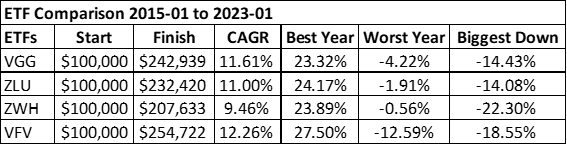
For the market benchmark comparison, I’m using Vanguard Canada’s S&P 500 Index® ETF (VFV). With everything in Canadian dollars, the variable exchange rate noise doesn’t confuse the comparison. Here we see the results of 100k invested in each of the ETFs at the start of 2015. ZWH was launched in 2014 so the data (courtesy of portfoliovisualiser.com) for this comparison starts in 2015.
What do you think of those results?

As is often the case, the low-cost market index fund wins out for total return. Over a long lifetime of investing, that 1.26% difference between the annual returns from ZLU & VFV, for example, could be huge. If you can tolerate the volatility, Mr. Buffett’s advice is looking good, the low-cost market index fund is the winner. But for more fearful investors, the lower volatility choices might help keep them in the market during times of steep decline. Jumping in & out of the market in response to market fluctuations can be a wealth killer for investors. For that reason, my choices would be VGG & ZLU in this instance. They don’t come as close to market returns as the two American ETFs we looked at earlier. But they’re good enough for me & I think I’d manage a better night’s sleep with those in my portfolio. I must be honest here, I was taken aback by how well ZLU has performed over the past 8 years. Can it sustain this level of performance? I have absolutely no idea. But I am impressed. ZWH was also surprisingly good. Though it shows the best “Worst Year” performance of the four, it had the biggest drawdown of the group, at 22.3%. That would have been a heart-stopper for me. Yet it managed to recover from that big drawdown to post pretty decent results over time. That’s a good outcome. Its total return over the period, however, lags the other two, so I would probably choose those instead. In retirement, when an income stream might be more important, ZWH might earn a place in a portfolio for some.

There’s a lot more under the hood here. Along with deciding on a US portfolio allocation percentage, an investor should consider the diversity of each fund for that US exposure. There are tax implications for US-listed vs Canadian-listed American equities in different accounts, sheltered & not. And so on. This post isn’t about any of that, it’s just an example of tailoring a portfolio to suit an investor profile that might be more, or less, risk tolerant.

What do you do for your US exposure?
And be sure to let me know if you have a suggestion for a better alternative than those above.

Important – this is not investing, tax or legal advice, it is for entertainment & educational purposes only. Opinion are my own, do your own due diligence & seek professional advice before investing your money.


Investing Ignorance is Bliss but …

It may be expensive.

In Café Veritas!

I chatted with another older (we’re not really that old yet!) guy at my local coffee shop this morning. My coffee shop is great for that kind of thing. There’re always a couple of people within earshot that are happy to chat while we sip our morning brew. And I like to chat!

Anyhow, the conversation shifted from Christmas shopping to the state of the economy & the gloomy expectations for a recession in the new year. That led to us talking about how our portfolios were performing this year. I knew how my portfolio was performing year to date, to two places of decimal. He, on the other hand, had absolutely no idea how his portfolio was doing. He thinks he’ll get something in the mail in the new year, but his advisor told him he was doing okay when they last spoke. Since I’m tinkering with the allocations in my own portfolio, I was curious about what his advisor was recommending. My coffee buddy didn’t know. When I asked about what he was invested in, he told me it was with a professional & he really didn’t know exactly what it was in. Was it stocks, bonds, ETFs, or mutual funds? He was almost sure, maybe, that it was mutual funds. But he’s been with this guy for years. He trusts him. He’s a really nice guy. And he does great things for him. Besides, my coffee companion knows nothing about all this investing stuff. Nor does he have any idea how much he is paying for the service.

While I have no idea if he was being frank with me, if that’s the true level of his understanding, it’s a potential exposure to paying more & getting less. It’s totally okay to invest with the help of an advisor, they can bring value in all sorts of ways. But you shouldn’t do it blindfolded. The difference between a portfolio fee of 0.2% & 2.2% sounds small, it’s only 2% after all, but it can be huge over time. Given the historical market returns of about 10%, a kid with $50k invested by age 30 could see their portfolio grow to a value of about $1.6 million by age 65. Without any additional saving. Drop that rate of return to 8% because of fees every year & the portfolio would be worth about $800k at retirement. That 2% reduction means that a full 50% of the potential return goes towards fees.
A retiree planning to live by the 4% rule has to make up an additional 2% to cover fees like that.
Fees matter.
Of course, if the advisor is outperforming by at least as much as the fees being charged, that’s great. That could be exceptional value. But if not, the fees might be a potentially significant overhead.

I was just there for a coffee, so I didn’t get into it any further. I don’t want to be the guy that nobody wants to talk to in the coffee shop!

When you get your annual statement this year, slow down & look at it. Compare your asset allocations to some of the ETFs that are available on the market today. Chances are pretty good that you’ll find an ETF that matches the asset allocation in your managed portfolio. The traditional 60:40 split between stocks & bonds is replicated by all the big providers in Canada, for example. BMO has ZBAL, iShares offers XBAL & the Vanguard one is VBAL. For fees around 0.2%, these ETFs might compare very favourably against a mutual fund that does the same thing. But charges a significantly larger fee of 2%, possibly more. Or compared to an advisor that is charging 2% to put a similar portfolio together for you.

Look I’m not for a minute suggesting that you drop your advisor. Advisors bring all sorts of good things to the party too. They can structure a portfolio to minimize taxes, help with decumulation strategies, provide guidance when the markets crash, & so on. But you should learn enough to have a discussion with your advisor on the cost & value of having the advisor manage your portfolio. Performance and fees are important. They should both be part of the conversation during your annual portfolio review. Who knows, you might even be offered a discount on the fees being charged. And even if you don’t, you’ll at least have an improved understanding of the cost & value of the advice you are paying for.

Knowledge is always useful. Even when it undermines the sense of bliss a little.

Important – this is not investing, tax or legal advice, it is for entertainment & educational purposes only. Do your own due diligence & seek professional advice before investing your money

Work From Home Investing

Stocks only go UP! Right!?!

This is a different topic for The Wry Eye, but I thought I’d share one of the silly things I’m playing with during my work from home experience: investing! Investing & weigh-loss have a lot in common. Both require dedication, patience, & a proven methodology. I can only hope I’ll do better with investing than with my recent weight-loss efforts, or I’ll be in real trouble! 😜
If you do some investing, let me know. Maybe we’ll swap more stories on this subject.

During the early stage of the pandemic restrictions, I moved a small, professionally managed portfolio into a self-directed account. I meant to do it years ago, but I never got around to it. The market slump in March woke me up. Unfortunately, it took weeks to get my money moved across, so I missed buying the lows. By the time I got to trade, things were on the way back up & I was too scared to invest it all at once! I worked it back into the market over the next several months.

My returns over the over past six months beat the advisor’s by a chunk. That sounds great, but it wasn’t very much money to begin with, so we’re not talking early retirement here. To be fair, the advisor had been working within my very conservative guidelines. And I got what you might expect from that guidance: very conservative returns. I have no idea why my guidelines were so conservative. And that’s the story of my investing history; half the time, I have no idea what I’m doing, nor why I’m doing it that way! My recent success was even more surprising because I was not buying the high-flying, stay-at-home, rampant tech stocks. I made most of my returns with pretty conservative stocks & boring ETFs. And now, it was all with lower fees.

I got so cocky about it all that I used a tiny portion to bet on small oil stocks, precious metals ETFs, & Bitcoin! Believe it or not, I made money on most of those too. Yes, I had a few losses, but mostly I was winning. I wondered what would happen if I did this with my real savings? Would I crush it? Maybe early retirement really was in the cards!?!
And right there, I knew it was time to stop! I sold off the stuff I didn’t understand & put the proceeds into a boring ETF.

Now that I’m an expert investor (🙄😜😁), I’ve started “educating” my kids!

It’s funny how some things are falling into different perspectives during the pandemic. I am fortunate to still have a job, but none of us knows what happens next. I’m building a list of those things I’ve left long undone. This could be a great opportunity to get some of those tasks ticked off the list.

TGIF!
Have a great weekend & PM me with your hot stock tips! LOL

PS … I am not suggesting that you go into the stock market, none of this is investing advice, this post is purely for entertainment. I’m having fun with it, but I also have some investing experience to lean on. Always seek professional advice before making your investing decisions!