Diversification – Is One ETF Enough?

Too many eggs or too many baskets?

Short of having a stock picking crystal ball, most investors agree that diversification is a positive thing for our portfolios. We have old sayings like “don’t put all your eggs in one basket” to remind ourselves of the value of spreading risk around. We generally think that more is better when it comes to being diversified. But that depends on how you look at things.

Considering only the equity portion of our portfolio, we have some fantastic solutions in Canada with globally diversified all-equity ETFs. BMO has ZEQT, RBC iShares offers XEQT, & Vanguard Canada manages VEQT. Other Canadian institutions, including TD, Mackenzie, Fidelity, etc., all have their versions or something similar. Global X & others offer income-focused covered call & leveraged variants, with similar global diversity. BMO created their T Series ETFs for income seekers who prefer to avoid covered call & leverage strategies. Do your due diligence on whichever of these strategies might work best for you, but they are all globally diverse solutions. And that’s the real message here.

Any one of these funds provides something close to the maximum market-weighted diversity obtainable in the global public markets. It just doesn’t feel like that when you stick all your money into one ETF. If you’ve switched from stock picking to index investing, going from 50 stock holdings to just one ETF, then one lonely ticker symbol in a portfolio does not look like diversification, does it? But it is. For many investors, it may be the optimal way to get diversification. These funds are holding ten thousand companies, give or take, from all around the world. And here’s the kicker: buying any ETF that is less diversified than these ETFs actually reduces the balance of market-weighted diversification!

If you buy an additional financial ETF, for example, you are overweighting banks & financial institutions in your portfolio, relative to their respective market weights. All the holdings in any additional ETF are already contained in, & appropriately weighted in, the all-equity ETF solutions. Same if you buy a tech ETF. Or an ETF that would add weight to a region, such as Canada, the US, or international. If you disagree with the weightings in the all-equity ETFs, either by sector or geography, then by all means rebalance the weights by buying additional ETFs. But adding an extra ticker symbol to your holding by buying your favourite Canadian bank ETF does not increase the diversification offered by these all-equity funds. It just overweights stocks that were already correctly weighted in the single ETF solution. Despite how scary it might look, one might be enough. Rather than being a single basket, it’s more a basket of baskets. With about the right number of eggs in each of those baskets.

That said, there may be other elements of diversification to consider.

It may make sense to diversify with ETFs from more than one provider. The global stock exposure is approximately the same across most of these funds, but that’s not the diversification angle here. Who knows what might happen down the road, maybe a data center goes off line for our favourite fund provider. If some unimaginable thing happens, & we’re all in on that company’s ETF, we might be stuck redeeming those funds. Even if only temporarily. However unlikely that possibility, there might be a justification for holding very similar funds from other providers too. Splitting holdings across ZEQT & VEQT, for example, might be a reasonable thing to do.

Or, depending on the use for various accounts, it might be useful to hold similar funds, but with different strategies, across different accounts. Young investors, or retirees planning a legacy, might use a vanilla all-equity fund in the TFSA account, for example. While retired investors with an income bias might prefer to hold higher yielding variants that employ covered calls & leverage in a RRIF account. Still others might prefer the T Series type, like ZEQT-T, for income. Maybe even some of both. But you get the idea: it’s a mix & match thing. But this is for diversification by investing style across accounts with different goals. It’s not significantly diluting or changing the balance of the global diversification offered by any of the market-weighted solutions.

So by all means, go buy something different for fun, function, or fund manager diversification.
Or by design, if you feel modifying sector or geographic allocations will suit your needs better.
But be aware of what you’re doing if you’re only doing it because you just can’t bear to look at one or two ticker symbols in each account.

If you want to learn more about saving & investing, please check out Double Double Your Money, available at your local Amazon store.

Important – this is not investing, tax or legal advice, it is for entertainment & conversation-provoking purposes only. Data may not be accurate. Check the current & historical data carefully at any company’s or provider’s website, particularly where a specific product, stock or fund is mentioned. Opinions are my own & I regularly get things wrong, so do your own due diligence & seek professional advice before investing your money.


Santa Claus Rally & Predictions for 2026

Seasons Greetings to All!

The big guy delivered some good days leading into the holiday. But even without the little Santa Claus rally at the end, 2025 was a great year for investors. Globally diversified investors were finally rewarded for investing outside the US markets. This time last year, who would have guessed that the Canadian market would have topped the performance charts?

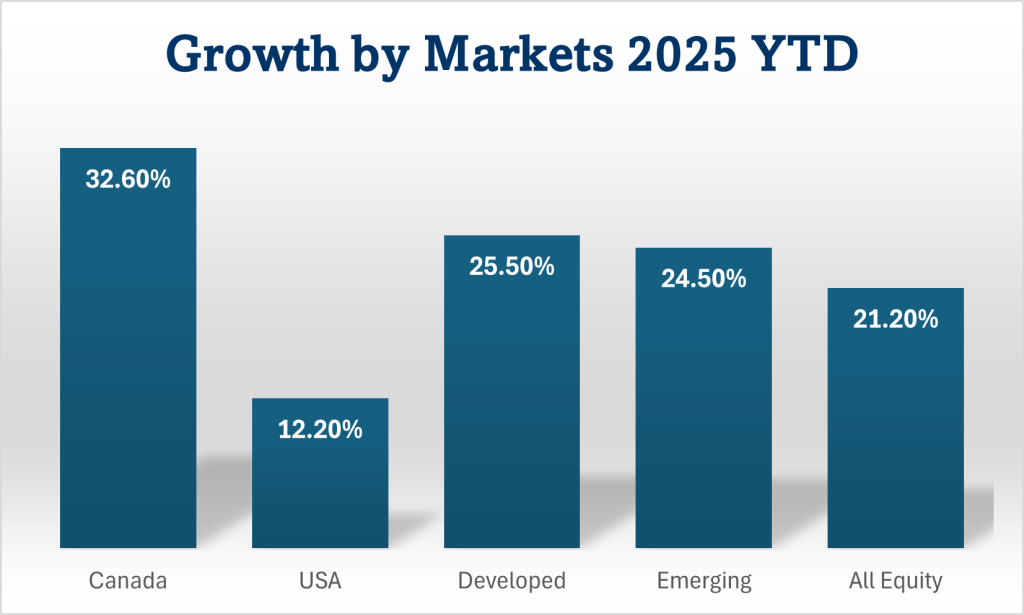
Here’s what market performances around the world were like up to now in 2025 …

This chart is built by comparing popular broad market ETFs that trade in Toronto. All dividends & distributions are reinvested to maximise total return. The last column is one of the popular all-equity ETFs that are globally diversified. It hold chunks of all the other columns in this chart, with a serious overweight to the world’s biggest market, the US. And the Canadian market is also overweighted, especially compared to its size. Because we all love a bit of home country bias, eh! The US market has outperformed in recent years. Starting out, I would not have guessed that 2025 was going to be the year where it lagged. And it would have been an even bigger stretch to imagine that Canada was going to come out on top. As usual, the pundits & talking heads are all over which markets are going to do well next year. Is it possible they only get it right accidentally!?!

My prediction for 2026 is that I’ll probably be better off if I put any spare couch-cushion-cash I find into one of the all-in-one ETFs that matches my asset allocation goals. Of course, I am prone to thinking I know better from time to time. And while I can occasionally get lucky, I mostly screw up when doing my own stock, sector, or market picking! 🤪

Thank you for joining me here throughout the year, I guess we’re all done for 2025. And here’s hoping the world is a nicer, kinder place in 2026.
May whatever light that lights your way shine ever brighter this holiday & beyond!

Best wishes,

Paul

If you want to learn more about saving & investing, please check out Double Double Your Money, available at your local Amazon store.

Important – this is not investing, tax or legal advice, it is for entertainment & conversation-provoking purposes only. Data may not be accurate. Check the current & historical data carefully at any company’s or provider’s website, particularly where a specific product, stock or fund is mentioned. Opinions are my own & I regularly get things wrong, so do your own due diligence & seek professional advice before investing your money.

Investing is so Exciting, eh!

Going to the Moon?

When I assumed control of my own portfolio during the pandemic, nobody told me how exciting it was going to be. Buying & selling stocks & ETFs, watching the numbers go up & down, checking out colourful little charts & graphs, it’s all great fun. Way more fun than getting fake coins for completing a crossword puzzle app on my phone. I must have missed my game time though, because I bought some crypto. Now I could carry on watching fake coins on an app, just like before. But without having all the pressure of figuring out which letters I needed to make a word. Crypto wasn’t that much fun though. I didn’t get the idea behind this game. So I sold them & bought these other stocks where you can win dividend coins. Every now & then, these coins just tumble in out of nowhere. Even when you have no idea what you’re doing. It’s great!

Investing is a fun game. I’m still learning & I don’t know all the rules yet. Is it better to own single stock warriors or little ETF armies? What does it mean when the numbers turn red? Am I trying to get the squiggly line to go up or down? Are we supposed to make mountain shapes with the lines? I think the overall objective of the game is to beat “the Market”. The Market is like the evil empire & if you beat the market, you get treasure.

That should be easy, no!

Why?

Because social media & 24 hour stock market channels provide an endless supply of expert advice now. And it’s free. What other game do you play that has it’s own TV channels? It’d be crazy not to take advantage of all that free wisdom, right? Though I must admit, they’re messing with my head a bit. One says buy this, the other says not. Next week, they both reverse what they said last week. Is this some clever gaming strategy? It takes a while to get used to a new game. To understand all the tricks & sly moves that get you ahead. But I have noticed that if you buy anything that a rich & famous person buys, you usually get a great result. Right now, I’m trying to figure out how to buy the right armour & weapons stocks before the famous guy does. That’s a good strategy, right?

It’s the same with all these games though. Kids learn much faster & play much better than us slightly older folk. Kids were getting rich buying these funny game company stocks. And that silly fake-money coin. While I was still trying to work out what to do with those dividend coins. I also didn’t know what bonds were. Was that like some kind of protective potion that you could drink when your stock warriors were under attack? Experts say older people should have a lot of bonds.

Anyway, I was too busy learning about how to attack the market with my stock icons, so I was late to the game buying a few bond ETFs. I know I should have spent more time looking into the powers of the bond potion but, so far, they blow. I’ll just park them in the corner for now & worry about them later. Though most of my stock icons are pretty boring too. All the exciting icons are with the high-flying gamers. This year however, they seem to be flying below my boring stocks. I’m guessing this is another strategy I haven’t figured out yet. Maybe they fly below to look for weak spots in the underbelly of my stodgy stocks? I might pick up a few of those high-flyers now. I don’t know what else to do with those dividend coins.

Back when I had advisors, the market would usually beat me. Except, sometimes, when I lost money. In years when I lost coins, they’d tell me that we (meaning the advisor & me) didn’t lose as much as the market. And that this was a very good thing. It was, I agreed. When the market was up, I didn’t think it was quite so good when the market beat “us”. But I learned that was normal & that we weren’t trying to beat the market. I’m good with that too. But I can’t believe I used to pay advisors to do all this fun stuff for me. They were having all the fun playing the game & I was paying them to play for me. It’s almost like paying someone to go out & have a nice dinner for you. And on you!

Now I have all the fun myself. I’m pretty sure I won’t beat the market either. But it costs me nothing extra to play now. And I can try to not lose as much as the market when things are down. Though I know I’ll miss those fireside consolation chats I had with my advisors when things sucked. Gaming solo can be lonely.

If I lose all my coins, I’m truly shagged. But I gotta say … so far … it’s been a whole lotta fun using a little money learning how to play the game.

Let’s see if I’m still enjoying the game as much by the time the next heroic bull emerges to battle the market.

Game on! 😜

10 Ways to be an Expert Investor on Social Media!

Pennies & Nonsense!

#10 … Post links to recently announced company results. If you can get off the mark early here, this makes you look smarter than the rest of the pack.

#9 … Quote well-known, high-visibility investing superstars. Often! And you can’t go wrong citing investing legends like Warren Buffett & Jack Bogle.

#8 … Criticise those well-known investing superstars who have hit a slump. They fell into a hole that you didn’t. You’ll look way smarter for having avoided the dumb mistake that the superstar didn’t.

#7 … Cite highbrow investing papers that say most experts cannot match market performance, most of the time. The softly veiled implication being that maybe you can!

#6 … Sound really confident about your recent investment. Justify it with musings on the balance sheet, book value & cashflow. But make sure it doesn’t look like you’re pumping the stock. Classic desperate expert mistake.

#5 … Pump crypto! Nobody has a clue what’s going on with this crap. And you can’t really be criticised for holding a belief in crypto as the new gold. That’s kinda like saying you can’t be feeling what you’re feeling. That’s a big no-no with investing snowflakes these days!

#4 … Talk about having a well-diversified portfolio. Maybe even recommend an ETF or two. Especially one that dilutes your home country bias. Unless, of course, you are really kicking the market’s ass with a focused strategy.

#3 … And if you do have that winning strategy to brag about, go ahead … brag. If you dare! But be ready to run for cover when your red hot portfolio cools. The pack will smell any lack of expertise & will socially annihilate those who screw up.

#2 … Be obscure. Use a whole bunch of big, financey, investy-sounding words. But combine them in phrases that are totally circular, meaningless, & nonsense. Like one of those touchy feely new-age books. Nobody will have a clue what you’re on about. And that makes you sound really clever. You might even be a new-age financial guru!

#1 … One of the best ways to be an expert is to circle jerk with other experts. Get some buddies who are all pumping the same philosophy & stocks that you are. When you & your buddies are all sharing the same stuff, the increase in noise makes it all seem so real. Who knows, you might even move the needle on that penny stock that you want to break even on!

Okay, I’m just having a little fun here. There are some really great investors online. Many of them sharing really good information. My problem is that I can’t figure out how to sort the good ones from the bad. And is it true that I won’t know who the real winning stock pickers are ’til years later??? When it’s all too bloody late! 😜

Who are your go-to financial gurus on social media? I’ve been unfollowing a bunch recently & I need to add some new ones. Send me your winningest gurus. And maybe a few funny ones too! 😉😁

Dividends are like Financial Vitamins for my Portfolio!

Financial Vitamins

None of this is investing advice. In fact, I might be the worst investor you’ll ever meet. Back in the late 90s, I got caught up in the dot-com fever & became an “investor”. Along with my collection of hot stocks, my advisor at the time talked me into a few sedentary holdings. One of them was BCE Inc. (BCE). My favourite growth stock at the time was Nortel, an iconic Canadian tech company that was at the heart of the internet revolution. When the bubble burst, I sold off BCE & kept Nortel. Nortel went to zero. Had I held on to my boring telco shares, from January 1st, 2000, a 10k investment in BCE would be worth over 70k today. With the dividends reinvested. That’s an annualised return of about 9.3%. And it handsomely beats a low-cost S&P 500 index tracking fund (worth almost 47k today), over that same timeframe, by about 2% a year. That comparison includes reinvesting the fund’s (lower) dividends too.

Ignoring those dividends, just looking at the share price growth, BCE is only worth a little over half the index fund after the 21 years. Reinvesting the dividends added more than 50k to the total return. That’s quite the vitamin pill!

Fast forward 20 years & I’m working from home. During a pandemic. I surface from my basement office at lunchtime & I turn on BNN Bloomberg. The parent company of BNN Bloomberg is BCE, go figure. 😂

Anyway, I get hooked. And this becomes part of my new routine. This time, however, I manage to resist the lure of the hot stock brigade. Okay, I admit that I made a few bucks on a brief dalliance with a bitcoin ETF! I know, I know … I would have done really well if I’d stuck with it. But instead, I start looking at big, boring, dividend-paying & dividend-growing companies. I’m too old to be sweating the gyrations of the growth sector every day.

Ironically, I’m a BCE shareholder again! 🤪

I wonder if I can stay the course during the next market crash? Will I have the bottle to battle the next bear? I have no idea how this will look 20 years from now. But if it works out, & if I don’t spend it all along the way, I’m sure our kids (or maybe my favourite charity! 😜) will be grateful.

Remembering all those who served & those who continue to serve, especially in our family, on this Remembrance Day.