
The big guy delivered some good days leading into the holiday. But even without the little Santa Claus rally at the end, 2025 was a great year for investors. Globally diversified investors were finally rewarded for investing outside the US markets. This time last year, who would have guessed that the Canadian market would have topped the performance charts?
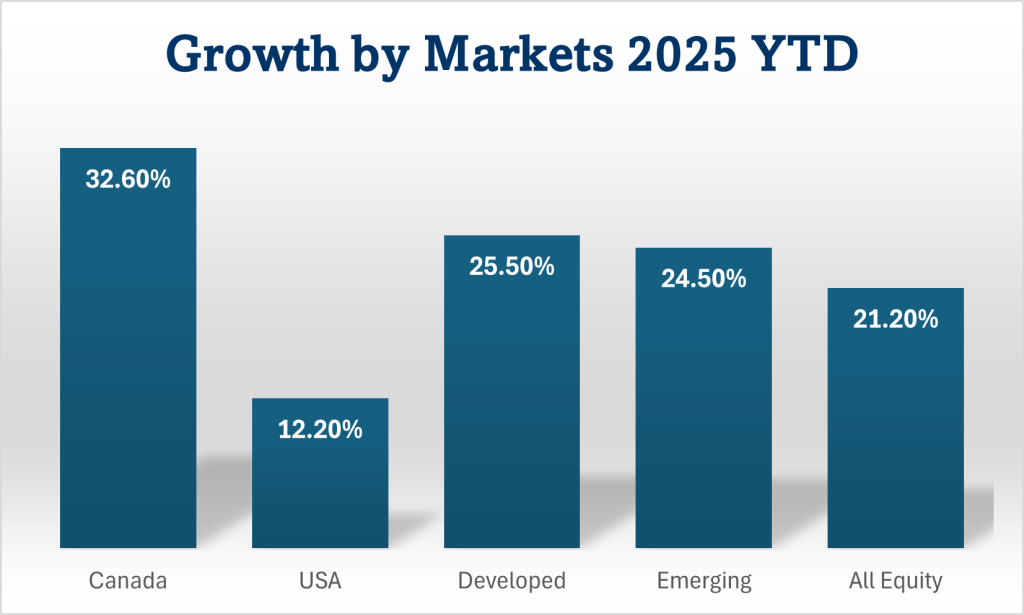
Here’s what market performances around the world were like up to now in 2025 …
This chart is built by comparing popular broad market ETFs that trade in Toronto. All dividends & distributions are reinvested to maximise total return. The last column is one of the popular all-equity ETFs that are globally diversified. It hold chunks of all the other columns in this chart, with a serious overweight to the world’s biggest market, the US. And the Canadian market is also overweighted, especially compared to its size. Because we all love a bit of home country bias, eh! The US market has outperformed in recent years. Starting out, I would not have guessed that 2025 was going to be the year where it lagged. And it would have been an even bigger stretch to imagine that Canada was going to come out on top. As usual, the pundits & talking heads are all over which markets are going to do well next year. Is it possible they only get it right accidentally!?!
My prediction for 2026 is that I’ll probably be better off if I put any spare couch-cushion-cash I find into one of the all-in-one ETFs that matches my asset allocation goals. Of course, I am prone to thinking I know better from time to time. And while I can occasionally get lucky, I mostly screw up when doing my own stock, sector, or market picking! 🤪
Thank you for joining me here throughout the year, I guess we’re all done for 2025. And here’s hoping the world is a nicer, kinder place in 2026. May whatever light that lights your way shine ever brighter this holiday & beyond!
Best wishes,
Paul
If you want to learn more about saving & investing, please check out Double Double Your Money, available at your local Amazon store.
Important – this is not investing, tax or legal advice, it is for entertainment & conversation-provoking purposes only. Data may not be accurate. Check the current & historical data carefully at any company’s or provider’s website, particularly where a specific product, stock or fund is mentioned. Opinions are my own & I regularly get things wrong, so do your own due diligence & seek professional advice before investing your money.

Financial planning is based on estimates & projections. It’s educated & data-driven guesswork. The return projection numbers are so precise that they run to two decimal places. Reality is not that predictable! Planning projections for equities have been about 6.5%, give or take, for the past few years. On a year by year basis, it’s been way off. Markets have done far better. They could have done far worse. But the projections generally work well, when considering average returns, over longer timelines. After the exceptional market returns of the 90s, a financial plan using 6.5% for projections might have been considered too conservative. But a 50/50 mix of the US & Canada would have returned an average of almost 8% annually, from 2000 up to today. Looking back, that 6.5% wouldn’t have been a bad number to create a plan with in 1999, eh? But things can get crazy over shorter time horizons. Especially when retirement withdrawals come into play.
Grumpy old guys & gals who retired in the last 10 or 15 years complain about not being able to draw down their big RRIF accounts fast enough. Their portfolios are growing faster than they can spend them down. While many of these retirees are probably brilliant investors, some just got lucky! They timed the start date of their retirement pretty much perfectly. The 50:50 US & Canada portfolio would have returned almost 12% annually since 2010. Almost double that 6.5% planning number. Now there’s nothing wrong with being lucky. But luck is not always good enough for retirement planning.
That same 50:50 portfolio would only have returned a little more than 2% annually from 2000 to 2009. An investor who went all in on the American market over that decade would have had a negative return. The US market lost money over that 10 year period. And that’s without withdrawing any retirement income from it. The really big question with financial planning going forward, especially for new or imminent retirees, is this … what will the next few years be like? Those early retirement years can matter. A lot. As we saw above, average return numbers work really well over the long haul. But a severe or protracted downturn in early retirement, like the 2000 to 2009 period, can make a real mess of a plan. Taking a big hit immediately after retirement can seriously impair income for all the years that follow. The message here is that we cannot assume that the high returns of recent years will continue. Planning must allow for these different outcomes.
Financial planning guidelines have to thread a needle with respect for a wide range of potential returns. And it’s wise to err a little on the conservative side of what the long term data say. Many recent retirees, & new financial advisors, have not experienced something like the lost decade back in the early 2000s. To varying extents, we are all influenced by recency bias. And recently, things have been great. But we may need to temper the optimism & plan a little more cautiously for the future. Especially if retirement is imminent. Despite our retired friend’s success over the past 5 or 10 years, thinking we can begin retirement & spend at a consistent 10% rate is very risky.
So if planning is just guesswork, should we ignore it? Absolutely not! Nobody can foretell what happens next, but that makes having a plan even more critical. The purpose is to figure out how to best use our money so that we can pay the rent & buy groceries all the way to the end. Plans include success rate estimates & simulations that show if the plan can survive the best & the worst combinations of market cycles. Plans can include fun things like bucket list travel & fancy cars. Along with some things we hope aren’t needed, like illness or meeting long term care needs. It’s important to have a plan that considers the many vagaries of retirement. It’s equally important to have regular plan reviews & revisions over the years to ensure things stay on track.
Getting a financial plan done professionally can be very expensive. If you are paying an advisor to manage your retirement, financial planning may, indeed probably should, be included as part of that service. A good financial plan is a crucial part of living a successful retirement. Even for those DIY folk with a good knowledge of what’s required, having another set of eyes review the plan may still make sense. Indeed, it may be worth having a plan done by more than just one professional advisor. I know, sorry!
DIY folk tend to be frugal by nature & some may not want to pay for a professional plan. I get that. But you could ask about getting a review of your DIY plan, or a freebie, or a demo plan from whatever institution you have your money at. Some financial institutions provide that service. Sometimes you just need to ask. Fortunately, more & more planning tools are becoming available for the DIY cohort nowadays. Maybe with AI, we’ll even get some apps for that! But until that perfect app arrives, & perhaps even afterwards, getting a professional financial plan done might matter for most of us. Planning, especially for retirement spending, is quite complex. If you are not using a professional to put a plan together, there are some tools available that may help. Check out some of the tools in this post DIY Financial Planning … An Update. I have used the Adviice platform mentioned there & there are others like Optiml & MayRetire that I haven’t played with yet. Doing our own planning on a spreadsheet usually carries a greater risk of error. Whereas these platforms are getting feedback from a wider public audience, which helps weed out the errors & improve the product over time. Some of them have an access path to professional planning services. It’s great to see tools coming onto the market for DIY financial planning. As they improve & get smarter, perhaps they’ll help the profession space to offer more competitive services too. But until that happens, we’re stuck paying more. And despite the high price, it’s worth the spend if it helps us avoid a bad outcome.
If you want to learn more about saving & investing, please check out Double Double Your Money, available at your local Amazon store.
Important – this is not investing, tax or legal advice, it is for entertainment & conversation-provoking purposes only. Data may not be accurate. Check the current & historical data carefully at any company’s or provider’s website, particularly where a specific product, stock or fund is mentioned. Opinions are my own & I regularly get things wrong, so do your own due diligence & seek professional advice before investing your money.
Many years ago we visited some Italian friends for dinner. That was the first time I realised that pasta wasn’t meant to have a couple of pounds of stew heaped on top of it. Pasta in our house was usually over-boiled spaghetti, buried under lots of meaty-tomatoey stuff. Sometimes, we tossed in a few tablespoons of curry powder. Or maybe some jalapeños. And left-over spuds were always a no-brainer addition. Look, I’m not saying I didn’t enjoy some of these concoctions. But I was totally taken aback by how much I truly enjoyed the far simpler pasta that we experienced at our friends’ house. Portfolios are a bit like pasta in that respect. Sometimes, we can get carried away by having too many ingredients to choose from. Simpler can be better.
BlackRock’s iShares XGRO (20% fixed income) & XBAL (40% fixed income) have been available as all-in-one portfolio solutions since 2007. The arrival of the all-equity ETFs boosted interest in these off-the-shelf portfolios. In 2019, Vanguard Canada launched VEQT, their all-equity ETF. In that same year, the iShares XEQT ETF & Horizons (now Global X Canada) HEQT were also launched. And in 2022 we got BMO’s ZEQT. These funds are globally diversified, with about 45% of the allocation going to the US, 30% to Canada, & the remainder going to International, which includes a small allocation to emerging markets. These ETFs hold 10,000, or more, different company stocks from around the globe. That is some kind of diversification! And according to Harry Markowitz, a Nobel Prize-winning economist, diversification is the only free lunch in investing. There are a bunch of academic papers that support this level of diversification. While there are minor squabbles about percentages, or how great the American market is, I think some of us could benefit from using the allocation model employed by these highly diversified ETFs. Of course, that won’t stop us trying to mess with a good recipe from time to time, eh?
My own portfolio has gone through changes over the years. I was a growth investor at one time. Later, a dividend growth investor. Over time, new ETFs made it easier to chase the next hot sector or geography, so I started adding some of those. It wasn’t long before my portfolio looked more like one of my mad Irish-Indian-Mexican, & only vaguely Italian, pasta dishes! I finally got around to doing pasta the Italian way. It took me a little longer to learn how to apply that same keep-it-simple philosophy to my portfolio. But both cooking & investing are a little easier now. I will, however, admit that I occasionally toss a little hot pepper, or a little hot stock, into the recipe too!
Regardless of your preferred investment philosophy, there’s probably an all-in-one solution out there for you now. Along with the 100% equity ETFs, if you want 20% bonds, there are the V/X/ZGRO ETFs. The V/X/ZBAL ETFs cover the 40% bond allocation model. And so on. If you want the fund managers to take care of selling shares for you for income, BMO now has the T Series ETFs, like ZGRO-T & ZBAL-T. These ETFs dispense monthly income at the rate of 6% annualised. Now this distribution is well supported by recent market performance, but you should consult a professional to see if that 6% spending rate is sustainable throughout a lengthy retirement. Global X launched some funds for the high income investor. In 2023, EQCL provided a covered call & leveraged ETF that pays out at about a 12% rate. This sounds like a dream ETF &, since it was launched, it has been. Along with the fantastically high distribution, the underlying share price has continued to grow. But a 12% withdrawal rate might not be a safe bet for anyone starting out with a long retirement horizon. To complement this, Global X also have a globally diversified ETF with only covered calls. And another with only some leverage. What’s your favourite flavour?
With any fund that deviates from just holding & compounding plain old company stocks, it’s worth comparing its total return performance against an equivalent regular version. Regardless of huge differences in yield, total return comparisons offer a very useful perspective on relative performance. This is important to review during different parts of the market cycle. Many of these new funds look good, but they’ve only been active during a period of generally great market growth. Or with some smaller shocks that recovered quickly. Comparisons of these newer funds over recent shorter timelines are not as useful. Be wary of overly optimistic expectations until there’s some history of performance during longer or more severe downturns. Maybe these funds will do well. But getting it wrong with overly optimistic expectations can wreak havoc with retirement planning.
So what’s the message here? Having a big, sloppy, messy set of investments can add work & stress to the job of managing a portfolio. It’s worth comparing such a portfolio to the far simpler portfolios like those asset allocation ETFs we talked about above. If you are confidently outperforming an equivalent all-in-one or asset allocation fund, & if you don’t mind the work, then carry on doing what you’re doing. But if the off-the-shelf ETF is beating your portfolio over the long haul, you might want to ask why. Could the simple recipe be worth considering?
Of course you absolutely should consult a professional before you start moving investments around. There are so many things that can go wrong. You don’t want to get hit with a big tax bill from selling off investments in a taxable account, for example. Nor from shifting things between tax sheltered or tax deferred accounts incorrectly. That’s a huge no-no. Professional assistance may be required to avoid these, & other, potential pitfalls. And finally, if a big, sloppy, messy portfolio is underperforming by a significant amount, it may even be worth paying a professional to manage things. DIY investing isn’t something we’ve sworn an oath of allegiance to! At the very least, it may be worth interviewing a few financial planners & advisors, to get a feel for what they might do differently for you. Even if you decide to continue with the DIY approach, these encounters can be very educational. They may even help you create a better plan. You’ve already got a financial plan though, right?
Okay enough with all that for now, can you guess what’s for dinner tonight! 😜
If you want to learn more about saving & investing, please check out Double Double Your Money, available at your local Amazon store.
Important – this is not investing, tax or legal advice, it is for entertainment & conversation-provoking purposes only. Data may not be accurate. Check the current & historical data carefully at any company’s or provider’s website, particularly where a specific product, stock or fund is mentioned. Opinions are my own & I regularly get things wrong, so do your own due diligence & seek professional advice before investing your money.
A tidy portfolio can deliver growth or income with less work!
Managing a bag of stocks & ETFs is difficult. The fund companies have come up with products that have the potential to take away much of this pain. The all-equity ETFs & the all-in-one asset allocation ETFs offer a complete portfolio, wrapped in a single ticker symbol. Of course, no matter how good these products are, there might be some emotional investing needs too. Investing is both mathematical and psychological, eh? So maybe a little tweaking is okay!
Owning an ETF like BMO’s ZEQT (or iShares XEQT, VEQT from Vanguard Canada, etc.) is probably a good core choice for many investors. An ETF like this is already globally diversified. It’s geographically weighted according to market size & importance. It includes what many consider to be a reasonable home country bias. It holds large, mid, & small cap companies. It’s a really big haystack that I think Jack Bogle would approve of. According to Nobel Prize winning economist, Harry Markowitz, diversification is the only free lunch in investing. These funds meet that bar too. And finally, it’s a simple approach that is a lot less work for a DIY investor.
Do you spend your time figuring out if you should be dumping some of the tech ETF, so you can buy more of the gold one? Or trying to figure out when you should be selling the US market off, in order to buy Europe & Asia? Are you trying to work out what to do with this week’s hot & cold stocks? Worried about sector ETFs that might be going in, or out, of favour? Surging or failing markets? It’s all quite stressful & time consuming, eh? Life is too short. Especially as we get older! An ageing brain needs some challenge. But not torture. The globally diversified funds have everything in there. Some stuff will go up, some will go down. These funds are diversified & that’s how they work. And there’s one other important point to simplicity: if there’s a chance that the investing manager of a couple might depart first, a decluttered portfolio might be greatly appreciated by the surviving partner. The simpler the investing solution in place, the better it’s likely to be.
Want bonds? Choose one of the all-in-one ETFs (ZGRO, XBAL, VCNS, etc.) with a bond allocation that matches your needs. These are very simple solutions for highly diversified, asset-allocated portfolios, & they come with built-in rebalancing. Some investors might prefer an all-equity ETF that is complemented by separate bond & cash-like ETFs. There are some good arguments for breaking out the bond & cash allocations. It’s a little extra work, but it may make sense for some.
Now different investors have different approaches, so it’s not just about growth & accumulation. Fortunately, there is often a simple solution for many of the other investing styles too. For example, an income investor that favours high yield funds can choose something like the EQCL ETF, from Global X Canada, for the equity portion of their portfolio. It’s very similar in asset mix to the all-equity configuration of ZEQT. But instead of focusing on growth, this fund uses covered calls & leverage to drive a far higher distribution. People are different. Some are happy to go for maximum growth & sell off shares for income. Others prefer that the fund company delivers a bigger income stream for them. Rather than selling shares, these people are more comfortable figuring out how much of the big distribution they need to reinvest, in order to sustain & grow that income stream. Some investors like to mix & match such strategies. There are those who use different strategies in different accounts, so one style will be used in the TFSA & another in the RRSP. If you are new to these income funds, note that there are some total return & tax characteristics that are different to the regular type. Take the time to learn before diving in. Though that suggestion applies to everything. And it should have previously applied to the messy portfolios we sometimes find ourselves with! LOL
BMO offers yet another approach with their T6 Series ETFs. These funds dole out a targeted 6% distribution with funds like ZGRO.T & ZBAL.T. Here the fund manager is delivering the extra income, primarily via return of capital, but without the investor having to manage the sale of shares. This is cool for those who think that the 4% Rule isn’t allowing them to spend as much as they’d like. But it’s not as biased towards the far higher distributions that come from some of the high yield funds. This is more of a middle ground for income seekers. Don’t assume that this 6% distribution is a given for an inflation beating income stream for a full retirement lifecycle, by the way. Read this post on the Safe Withdrawal Rate in Retirement on why that might not work all the time. Nonetheless, the T6 funds will take care of automatically delivering a higher monthly yield, based on the value of the underlying fund at the end of the previous year. You still need to pay attention to the variability of the income stream over time. There may be a need to reinvest a little extra when income goes up after a great year, for example. That might safeguard against an income drop if the markets go down the following year. If the fund is subject to successive down years, the income stream will decline too. No solution is perfect when we try to predict the future, eh? But the bottom line is that simpler solutions exist for most investing styles & strategies. And for varying levels of distributions. Regardless of the investing strategy that is preferred, it shouldn’t stop an investor exploring ways to tidy up a messy & confusing portfolio. Especially if it reduces stress, while improving visibility & returns. Decluttering can be both refreshing & potentially rewarding.
If you can’t get your head around having so few holdings, how about putting the BMO one (ZEQT) in the RRSP, the iShares one (XEQT) in the TFSA, & Vanguard’s (VEQT) in the non-registered. Each one of these is globally diversified. They own a little piece of everything traded on the public markets. These are all essentially identical. But I get it. I totally feel the need to spread it around the different fund companies myself! There is also something to be said for making the single ticker solutions the core of a portfolio. While leaving a smaller allocation available for some gambling on the side. Sorry, I meant some intelligent macro investing on the side to boost alpha! If you know you can do it well, or if you can afford the greater uncertainty of return for a small part of the portfolio, then it might be fun, no it’s still crazy, okay! 😜
One other consideration. If the current messy portfolio performance is seriously lagging that of a single ticker solution, ask why. There may be good reasons why. And good reasons to justify staying the course with existing investments. But if we can’t come up with good answers (that aren’t guesswork or wishful thinking!), then consider this … if a portfolio is consistently underperforming the single ticker ETFs by an amount that is significantly more than 1%, it might be better off in the hands of an advisor who only charges 1% to manage the portfolio. Even if all the advisor does is invest it all into ZEQT or VBAL & manage the financial planning & cashflows for the investor thereafter!
There is also one big caution with all this. Decluttering a portfolio isn’t like spring cleaning at home. Do NOT rush into selling a bunch of stuff without getting some professional tax & investing advice. A long-term holding in a non-registered account, for example, may have significant capital gains tax liability if sold off. It might bump income up to a higher tax bracket. It might generate income that exceeds an OAS clawback limit, & so on. There are many potential issues, so seeking professional help is often the best course. There can be other challenges with balancing different fund types across the different account types. If you don’t know how to manage all this, get some help. Even if you’re just not sure if you know enough to manage all this, get some help first!
If you want to learn more about saving & investing, please check out Double Double Your Money, available at your local Amazon store.
Important – this is not investing, tax or legal advice, it is for entertainment & conversation-provoking purposes only. Data may not be accurate. Check the current & historical data carefully at any company’s or provider’s website, particularly where a specific product, stock or fund is mentioned. Opinions are my own & I regularly get things wrong, so do your own due diligence & seek professional advice before investing your money.

It’s unfair to tarnish all retirees with that statement, some might be offering great advice. But I’d be a little more circumspect about advice from those retirees advocating for earlier retirement because of their recent success. Some of these well-meaning folk might be suffering from recency bias. What’s that?
Anyone retiring in the past 15 years, with big stock market exposure, has probably been pretty lucky. Or, as they might prefer to see it … they are brilliant investors! This is especially true if their portfolio was biased towards the US markets. S&P500 Index® funds have returned close to 14% annually. The tech heavy Nasdaq 100 Index® has done even better. I have to admit, some of them do look like investing geniuses!
Over the past decade & a half, it almost didn’t matter what strategy was employed. Just about any broad based American equity funds worked well. The growth investor did well & dividend investors did well. Investors who choose funds delivering huge yields via covered calls & partial leverage did well. They are all still doing well. Some of these retirees are mocking the old 4% Rule. As they sip frozen margaritas on a beach in the Caribbean! They are having a ball. And it’s hard to argue with success. But this might not apply to the next batch of retirees. And those with more limited finances need to be especially careful.
The 4% Rule is not a rule, it’s a rule of thumb. A guide only. But there are good reasons for its existence. Reasons that are at least broadly acknowledged by most. In a “normal” world, the safe withdrawal rate of 4% generally worked. In the “modern” world, it seems like you can haul out 12 or 13% every year & ride that gravy train all the way to the bank. Or the beach! That’s been the story for anyone retiring from 2010 onwards. The few blips we had along the way, like the one earlier this year, another in 2022, the 2020 downdraft for covid. They all repaired so quickly that nobody really noticed these as bad events. In fact, all those rapid blips did was reinforce the “buy the dip” philosophy. And, for those who didn’t panic, that has worked out very well.
But there will almost certainly come a time, where the dips will hurt a little more than these recent examples. There will be more enduring dips. And in such times, the 4% withdrawal rate may be more appropriate for managing retirement income risk. Ask anyone who retired in 2000. I’m not kidding, find an older retiree & ask. You probably won’t find them on social media! The experiences of more recent retirees is not how things always were. And while the good times are still rolling, they may not continue forever. In case you can’t track down one of those older retirees, read this post on the Safe Withdrawal Rate in Retirement.
If you were planning on saving a million bucks before retiring, but you’ve only made it to half a million so far, pause a minute. Think very, very carefully about taking any advice that suggests you can retire immediately on your half-sized stash. Some recent retirees may think it’s okay to use 10% withdrawals nowadays. Or maybe they suggest that you can buy a bunch of funds yielding 10, 12, or even 15%, & go enjoy life sooner. This might not be good advice. Remember the old investing disclaimer: past performance is not indicative of future returns? In fact, it’s more likely going to be the opposite. After such an amazingly good run of returns, it’s far more likely that future returns will not be as good.
Look, I don’t know what the future holds. Maybe these enthusiastic retirees are right. But for anyone on the threshold of retirement, or for those younger retirees with a longer retirement timeline, caution is warranted. I’m sure I would enjoy spending a little more after a really good year of returns. And I’d probably do that again the following year, if there was another good year in the bank. But I would not start out a full retirement cycle of 20 or 30 years with the expectation that 10% a year is going to be the norm. While it’s not a commandment, I would treat that 4% Rule of Thumb with a little respect. I sure hope that we might still enjoy some good years of 5 or 6% spending. Who knows, maybe even a little more than that from time to time. Actually, let’s be honest here, I’m really hoping that 10% thing holds up for my retirement, from beginning to end! But I’m not taking that optimistic hope to the bank for the long haul. It’s probably not going to work as a good financial planning number!
If you can’t figure this all out on your own, please see a qualified financial planner & step through the process carefully with them. They will help you figure out how much you need to save to retire. And how much you might be able to spend during retirement. I know it’s expensive to work with a financial planner, but it might prove to be money well spent. Rather than finding out that you got it wrong half way through retirement.
If you want to learn more about saving & investing, please check out Double Double Your Money, available at your local Amazon store.
Important – this is not investing, tax or legal advice, it is for entertainment & conversation-provoking purposes only. Data may not be accurate. Check the current & historical data carefully at any company’s or provider’s website, particularly where a specific product, stock or fund is mentioned. Opinions are my own & I regularly get things wrong, so do your own due diligence & seek professional advice before investing your money.