
Compound Growth or High Yield?

Wish I’d stayed awake for that class!

Compounding confounds & confuses the best of us sometimes. It feels like having a bigger yield to DRIP should work better than waiting for the share price to grow, right? After all, turning on the DRIP on a higher yielding ETF means we’re buying far more shares with every dividend or distribution payout. And that’s true, we are buying more shares with a bigger yield. But that does not mean that it outpaces the compound growth that happens within the share price of a lower yielding fund. Compounding is compounding, regardless of where it occurs. And in a growth stock, or in an ETF filled with growth stocks, the compounding is done by stealth, inside the share price. Not via a distribution. And that does not take away its compounding power. It may even add to it.

I’m a big fan of their funds, so let’s look at three from the BMO stable for this exercise. ZSP is their S&P 500® Index tracker, ZDY is BMO’s US Dividend ETF, & ZWH is the BMO US High Dividend Covered Call ETF. Here’s what the total returns look like for each, with DRIP on …
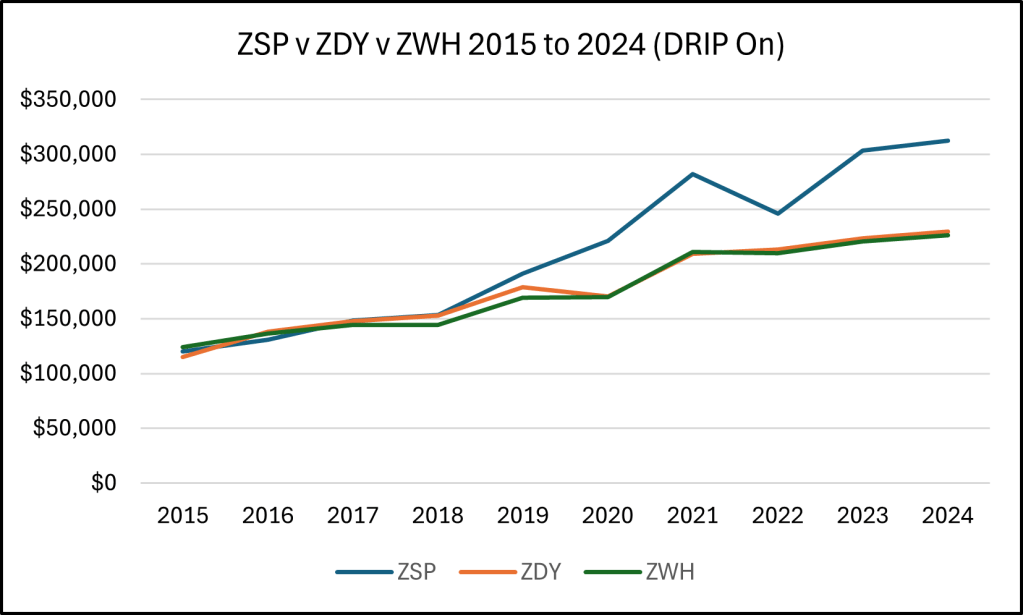
I like all three of these funds. ZSP has the lowest yield, typically ranging from about 1.5 to 2%. ZDY has generally floated between 2.5 & 3.5% over the years, while ZWH targets about 6%, give or take a little. The old adage holds true, it’s tough to beat the index fund. ZSP turned $100k into almost $313k over this timeline. ZDY managed to deliver an end value of almost $230k, while ZWH finished at just over $226k. That’s a very respectable comparative return for a covered call ETF.

Despite the positive performance of all these ETFs, the lowest yielding ETF provided the greatest total return. Okay so we know this already, eh? But the confusion tends to increase when we get around to talking about selling shares for income. That strikes fear into the heart of every retiree, even those who can do the math. After all, we’re selling off some of our little geese that lay those golden eggs for us, eh!
Here’s what that looks like for these three ETFs …
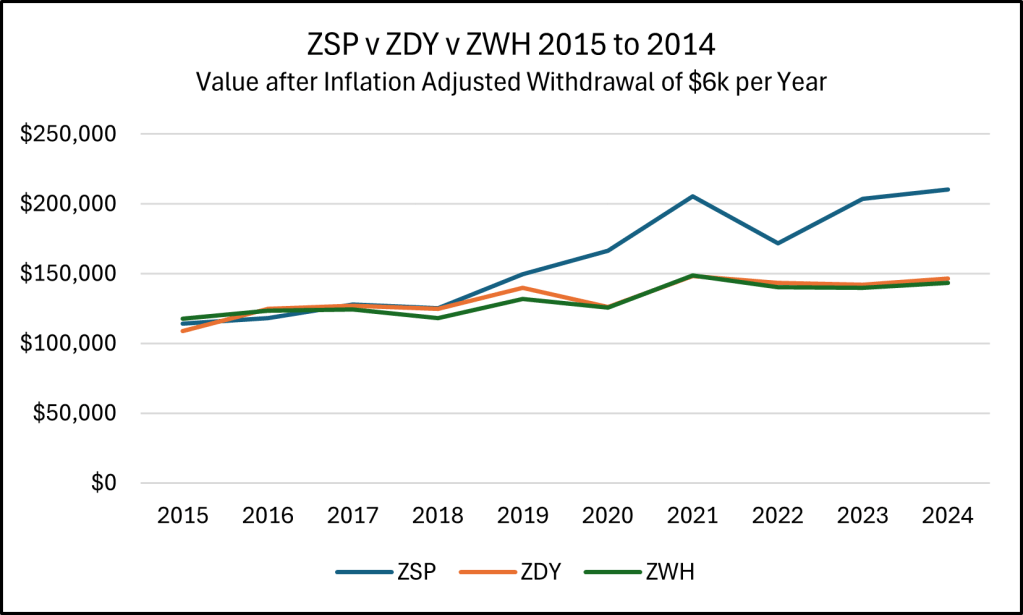
To level the playing field, I used a $6k withdrawal in Year 1 for all three funds, & adjusted for inflation annually in the following years. What remains is each fund’s value after an identical withdrawal. That withdrawal rate approximately matches the higher average distribution rate available from ZWH. ZWH is the only fund of the three that could have avoided selling shares to supply that level of income over this time. However, despite having to sell more shares, the end value of ZSP is $210k. That is significantly more than the $146k remaining in ZDY, & the $143k in ZWH. Despite having to sell more shares to meet the income requirement, the lower yielding funds did better over these years.

Compound growth is just as magical as compound interest or DRIP-driven compound growth. Perhaps it’s even more magical because it doesn’t feel right that you could continue to do better with an ever-declining share count. For better or worse, numbers don’t really care about our feelings!

While the index fund won out over this timeline, there is the potential to have market conditions where a covered call fund might do better. You’ll notice that the ZSP line dips below that of ZWH in 2015 & 2016. Had those market conditions prevailed, ZWH might have continued to lead. They didn’t & ZSP took the lead again. And it stayed ahead through to 2024. While the past doesn’t predict the future, the general tendency for growth in the market suggests that a more growth oriented index fund is likely to outperform over the long haul. Even the bigger downdraft of the index ETF in 2022 wasn’t enough to drag it back down to the level of the other two. During the accumulation phase, it’s all about building the biggest portfolio before retirement. In the decumulation phase, it’s all about portfolio survival!

SOME WORDS OF CAUTION!
This comparison is done over a very short, but generally successful, period of performance for the American markets. I started with a $6k withdrawal rate for this example, to approximate the 6% yield of the highest yielding ETF. But I do not think this is an appropriate withdrawal rate to use for retirement planning. There are reasons why professionals use the 4% Rule in Monte Carlo simulations. It allows for a better hypothetical portfolio survival rate under a greater variety of market conditions. In addition, they may even introduce some additional curtailment or flexibility guidelines to a retirement plan, so that a portfolio survives better during down periods. The caution here is that converting everything to high yield funds in retirement might not provide the best outcome if there are tough times ahead. No question, there are times when it may have worked well. But there is greater exposure to catastrophe if things don’t work so well going forward.
For example, things would have looked very different for a retiree trying to do this starting in the year 2000. Even with an index fund. I used SPY to look at this &, starting with a $6k withdrawal. The portfolio would have gone to zero by 2012. If the withdrawal started at $4k, or 4% of the original portfolio, it will still be delivering income today.
Would a covered call ETF have fared better then? I don’t know, many of today’s funds weren’t around back then. They are too new to assess how they might navigate turbulent markets like those of the lost decade. But having a big yield doesn’t always protect the value of the underlying assets. Choose your retirement strategy with great caution.

If you want to learn more about all this from the ground up, I’d like to suggest that you check out Double Double Your Money, available at your local Amazon store.

Important – this is not investing, tax or legal advice, it is for entertainment & educational purposes only. Data may not be accurate, check the current & historical data carefully at each fund’s website. Opinions are my own, so do your own due diligence & seek professional advice before investing your money.


Covered Call & Leveraged ETFs

The Ballast & Boost of Covered Calls & Leverage!

It’s generally accepted that it’s tough to beat the performance of low-cost, index-tracking ETFs. After fees, most actively managed professional funds don’t beat the indices over the long haul. While we can get lucky from time to time, most DIY investors can’t beat the indices either. We can however, have our heads turned by an attractive income stream. High yield ETFs have found new life since the covid lockdown. The whole work from home thing had many of us wanting to carry on working from home forever. If we could figure out how to get our investment portfolios paying as much as our day job, we could call it quits & be totally done with working for a living, eh?

Traditionally, you could build an income stream with a portfolio of dividend stocks or with some dividend yielding ETFs. Covered call writing can boost the distribution of an ETF beyond the dividends of the holdings. For investors who need an income stream, it’s an attractive proposition. You get a bigger income stream, without the hassle of selling shares for income. And you might not have to worry about selling shares in a down market. The negative thing about it is that you often lop off some of the upside with a covered call strategy. Selling a call means that you’ve made a few extra bucks, but you now have a contract to sell your shares at an agreed price. If the stock goes beyond that strike price, your shares are called away & the option buyer gets to buy them at a lower price than they are then worth. You’ve lost some of the upside. In general, these covered call ETFs will underperform an ETF that just holds the same stocks for growth. But so long as the underlying value of the covered call portfolio continues to grow, some people are okay with that. Instead of paying a financial advisor to give you a monthly cheque, you’re just letting the ETF manager use some of the upside to pay for the service. Some think that a covered call ETF will protect them when the market drops. That’s often not true. Other than the extra option premium we get, these ETFs can crash every bit as far & as fast as a regular ETF holding the same stocks. In general, covered call ETFs are more likely to underperform over the long haul. Though some are better than others, so you do need to compare before taking the plunge.

Fund managers are good business people. They know a good opportunity when they see it. They watched the enthusiasm for covered call ETFs growing & they realised that they could make it more appealing with the even bigger income stream that is available through the use of leverage. Leverage is borrowing money to invest in more shares. While borrowing cash for stocks can be an intimidating proposition for an individual, it’s a lot easier if the fund manager does all that for you inside the ETF. You can now find many ETFs advertising the enhanced yield that comes from using modest leverage. Those are marketing words with a lot of allure. Who doesn’t want “enhanced” yield? And nobody should fear “modest” leverage, right? You can see the appeal of the marketing message, eh?

But how well does this combined approach work?

The covered call bit is pretty straightforward, but let’s look at the effects of leverage. Since many of the new funds are too new to have any worthwhile history to examine, let’s start with a Canadian index fund instead. Canadians love Blackrock’s iShares S&P/TSX 60 Index ETF, XIU. If you invested $10k in XIU back at the start of January 2000, with all dividends reinvested, you’d be sitting of a portfolio worth $47,757.00 today. If Grandma had loaned you enough money, at a zero percent interest rate, to apply a 25% leverage ratio to your investment, you would have $65,269.00 today.
Oh yeah, baby! Gotta love that leverage thing, eh!

Now what if Grandma had offered to loan you the leverage money at a 7.2% interest rate? Would you have taken her up on it?

If you had, your portfolio would be worth only $42,487.00 today. That’s a lower return than just investing in XIU without leverage. I think Grandma suckered you! I cheated a bit here to make a point. That 7.2% is the current prime lending rate. Interest rates were lower for much of that time & you’d have fared better with lower cost leverage. But if you were to get your own leverage by applying margin within your brokerage account, you might pay even more today. Check the margin rates at your brokerage. Fund & ETF managers can get better rates than we can, of course, but their fund returns will be negatively impacted by higher interest rates too. It all adds to the costs involved with managing these funds. These numbers won’t be on the front page of the ETF brochure. You’ll often have to dig into the multi-page downloadable documents (prospectus & financial statements) to see what these costs are. You’ll also find the TER (Trading Expense Ratio) here. I know, I know, I hate that small print stuff too. But once you dig, & with today’s higher rates, it’s not difficult to find a fund like this with a real total expense ratio of 2% or more. Let’s be real, the size of the fee doesn’t matter if the performance is good enough to pay for it. But if it’s not, we might do better with an advisor charging 1% to put us into low cost index funds & letting them do all the work to make sure we have an income stream every month. I’ve taken some liberties with this simple example here, but what’s the takeaway?

Going into one of these ETFs can be a bit like putting a donkey into a horse race. Generally, the low-cost index funds are the race horses. Active management adds more cost & doesn’t always add more return. Adding a covered call strategy is like putting bricks on the back of the donkey. They slow our ass down! Adding leverage is like using helium balloons to compensate for the drag of the load of bricks. How well a fund manager balances the bricks & the balloons over time will determine the fate of the investment. As will the fees charged for doing all that work. Interest rates have an impact too. The value of leverage goes down when interest rates go up. And leverage increases volatility. When the underlying investment goes up, leverage will make it go up further. When it goes down, leverage makes it go down further. The investor’s ability to handle that volatility is important too. It’s no surprise that leverage works best with assets that show consistent growth in a low interest rate environment. Check the history of total return when comparing one of these high yielding ETFs against a simple equity ETF. New funds lack history & it’s nice to see if a fund has proven itself over time. And during different market conditions. While past performance does not predict future results, it’s always worth taking a look at past performance before you place a bet with your retirement money.

Doing this comparison is even more critical if all the distributions are being pulled out for living expenses. A fund that consistently declines in asset value, as distributions are removed, is far more likely to provide a declining income stream over time. Try out the tools at Portfolio Visualizer for these comparisons. It gives a great snapshot of performance differences between funds. And it can show the history of the income stream. A declining income stream over time might not work well for an early retiree with a long time horizon.

While index investing is often recommended for investors with a long time horizon, there is an undeniable attraction to a nice income stream at any age & stage of the investing journey. But, starting out, be a little careful about how much of your portfolio is allocated to high-yield funds. Having great underlying holdings isn’t always enough. That does not mean that these funds don’t have a place in some portfolios. Just be careful with your choices!

There is another post on Canadian Banks for Dividend or Covered Call Income? if you want to read more on a comparison of the covered call approach.

If you want to learn more about all this from the ground up, I’d like to suggest that you check out Double Double Your Money, available at your local Amazon store.

Important – this is not investing, tax or legal advice, it is for entertainment & educational purposes only. Opinions are my own, so do your own due diligence & seek professional advice before investing your money.
When to Avoid Dividends

The Fruits of Investing!

For a dividend investor, the answer is we never want to avoid dividends, right?
After the last post on Canadian-listed American dividend ETFs, I thought I’d provide an alternative view to one that might have suggested dividend-growth investing is the way to go.

Dividend-growth investing is very popular. I’m a fan myself. Primarily because it is a strategy that can work reasonably well for an investor with limited skills & ability to assess the potential of a stock to provide good returns. Using fewer & simpler metrics than it takes to properly evaluate a stock, it’s possible for a DIY investor to choose a portfolio of dividend-growth stocks that can perform reasonably well. And, being focused on a growing income stream, rather than on a falling share price, can help some of us ride out market downturns. The other great attraction of dividends is that as a portfolio grows, the income stream can grow &, one day, it may even match the income stream from our day job.
How cool would it be to have a portfolio that generates enough income to match your paycheque? Very cool, eh!
A retiree with a portfolio that provides a 4% yield on retirement day, might look forward to never having to sell shares. Selling shares for income can be a traumatic challenge for some retirees. And if the income stream continues to grow more than inflation, our retirees golden years might truly be golden. There’s a lot of good to be said about a portfolio of dividend-growth stocks.

But, in the world of investing, things are never simple!

Picking the right dividend-growth stocks still takes a lot of work. And it takes additional work to monitor & maintain a portfolio of individual stocks. Dividend-growth may still be a valid strategy for some. But it’s worth back-testing your stock portfolio against a dividend-growth ETF portfolio every now & then. Just to see if all the extra work produced enough extra reward. Of course the yield from such ETFs often don’t match that of a portfolio of hand-picked dividend-growth stocks. We like our bigger dividends, eh!
However, things can be different before & after retirement. And that raises some questions.


How many years ahead of retirement should we start building our dividend income stream?
Does it make sense to start early & just let the DRIP work for us ahead of retirement day?
Is it important for that income stream to grow before we retire?
But the really big question is this: should we even be focused on an income stream ahead of retirement?

Let’s take a look …

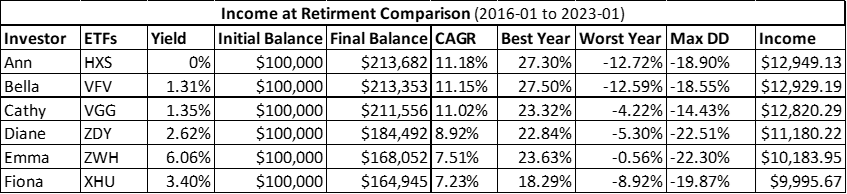
All our investors above put 100k into an ETF at the start of 2016, with a view to retiring at the end of January, 2023.
Ann & Bella are oblivious to dividends. They both followed the market index investing philosophy & went with S&P 500 Index® funds for part of their US allocation.
Ann chose Horizon’s HXS. This is a total return strategy that doesn’t pay any distribution. Unlike all the other ETFs, this one reinvests the value of the dividends inside the ETF. The income stream is zero.
Bella went with Vanguard’s VFV index fund. In this, & all other cases, distributions were automatically reinvested (the DRIP) at no extra cost.
Cathy likes the dividend-growth approach & invested in Vanguard’s VGG. She realised she might sacrifice some of the total return potential of the market, but she felt her choice was less volatile (it is, look at the Worst Year & Max DD columns) & that allowed her to sleep a little better.
Dianne was lured by the higher dividend payout of BMO’s ZDY. This ETF has a pretty good history of share price appreciation & a decent dividend growth trend. She liked that.
Emma wasn’t sure if she was into the whole FIRE thing yet but she thought that BMO’s ZWH might give her that option sooner. The juicy 6% yield from this ETF might make earlier retirement a reality for her. And the covered call strategy might offer some downside protection to boot. The Max DD is a little scary, but the worst year performance is the best of the bunch over this time period. Getting a good night’s sleep was important for Emma too.
Fiona went with a more traditional dividend approach, going with the Blackrock’s iShares® XHU offering. This is an ETF that focuses on a basket of solid, reliable, higher yielding companies in the US. A good choice for an investor who favours this approach.

Looking at the Final Balance column, I’d be pretty happy if I’d thrown a few bucks into any of these ETFs back in 2016. But what is the point of this comparison?

It’s this …

Come retirement day, we will look at things differently.
It’s not how much income was received & reinvested along the way.
It’s not how much the income stream grew prior to retirement.
It’s not about when we started to build an income stream.
It’s going to be all about the value of the portfolio on retirement day.
And how big an income stream that portfolio can buy to support our needs from that day forward.


Look at the Income column, the last one on the right. This is the income stream that would result from all the ETFs being sold off on retirement day to buy ZWH, the highest yielding ETF. The biggest income stream can be had by selling the portfolio that gave the best total return. And then buying the ETF with the greatest distribution, in this case ZWH. There is a 30% spread here, that’s significant.
Notice that in most cases, the higher yielding funds tend to have lower total return over time. That might not always be the case & it might not be the case going forward. Not even amongst this batch of ETFs. Doing your own due diligence, as always, is important.

But, from a pure numbers perspective, it matters less what happens with dividends during the accumulation years. It only matters that the portfolio grows. As much as possible. The bigger the portfolio, the bigger an income stream it can buy on retirement day. In this example, how much the income stream grew during accumulation didn’t matter. Having a bigger yield on cost didn’t matter. The only thing that mattered was that a bigger portfolio bought a bigger income stream on retirement day. For simplicity & to maximise return, all investments were considered to be inside a tax-sheltered account. There are other implications, not covered here, for selecting ETFs like this in a non-sheltered account.

Emotionally & numerically, there are many reasons that investors choose to invest differently. Seeking solutions with lower volatility, the reassurance of a growing income stream, avoiding the need to sell shares, & so on, all factor in to individual choices. All these are all important considerations, for sure. But the message here is not that we all need to abandon our chosen strategy in favour of some other promoted strategy. It’s more about giving some thought to strategies that differ from our current path. Despite the reassurances we get from like-minded investors in our favourite social media groups, it can be useful to think differently about things from time to time. We shouldn’t fall in love with one particular strategy & block out all information that conflicts with that. It might be worth taking some time to learn about different perspectives & different strategies. Keep an open mind.

By the way, I’m not suggesting that you buy any of the ETFs here. Nor am I suggesting that everything gets dumped on retirement day for one high-yielding ETF. This is just an example to illustrate why we might want to think differently about our approach from time to time. It’s just as a valid to consider switching to a basket of individual, higher-yielding, dividend-growth stocks on retirement day, for example. Or sticking the proceeds into a portfolio of your favourite high-yield funds. Do whatever floats your boat for an income stream. Believe it or not, some will stick with the growth solution that got them there & sell shares for income. But regardless of approach you choose during the accumulation years, whatever you choose to do in retirement will probably work better with a bigger portfolio. 😜

So how do you accumulate?

Important – this is not investing, tax or legal advice, it is for entertainment & educational purposes only. Opinion are my own, do your own due diligence & seek professional advice before investing your money.