Canadian Banks for Dividend or Covered Call Income?

Dollars & Dividends

We love our dividends in Canada. If dividends are so great, why not go for the even greater yields available with covered call ETFs? Maybe we can toss all our investments into covered call ETFs & retire early? That sounds great!
But does it work?

Maybe!

Every investing strategy has its fan base. But at the end of the day, it all comes down to how the numbers work for the individual investor. And covered call ETFs can work for some investors.

However, some features of covered call writing can be less appealing. The notion of covered call ETFs having lower volatility, for example, may be true. But volatility is a measure of an investment going up, as well as down. In general, covered calls will limit upside. If a growing stock is called away, you lose some of the upside. As investors, we don’t mind volatility if it means our investment is going up. We only fret when it goes down. Hand in hand with that is the idea that covered call writing offers some downside protection. You’ll notice the wording in the description of many funds says something like downside protection may be limited to the returns provided by the covered call premium. That’s marketing speak for “we can crash as hard as anything else but you’re at least getting that juicy covered call premium along the way”. Unfortunately, during times of growth or recovery, the capped upside often means that the growth of a covered call fund doesn’t match that of a fund holding the equities directly.

Let’s take a look at an example using only Canada’s big banks. The five largest banks in Canada all started paying dividends in the 1800s. That’s a little too far back to look at, but if you’d invested $100k in an equal-weight holding of the Big 6 banks back in January 2000, that portfolio would have grown to almost one & a half million dollars today! Investing in the large cap American or Canadian market index funds would only have returned under half a million over that time. Of course, nobody would risk going all in on just the Canadian banks. Right!?! But this kind of performance is why Canadians like their banks.

To compare the different investing strategies, I’ll use BMO’s ZEB & ZWB here. Both ETFs are designed to track the Solactive Equal Weight Canada Banks Index. And both funds are managed by BMO Global Asset Management, one of Canada’s largest ETF providers. ZEB just holds the banks. ZWB holds the same banks, but adds a covered call strategy to about 50% of the portfolio to generate a bigger income stream. These ETFs have a relatively short shared history, so we’re only looking at returns over an 11.5 year period up to the middle of this year here.

Accumulation
During the accumulation years, all dividends & distributions are reinvested, that’s the “DRIP ON” scenario in the table below. This shows the Total Return, with dividends reinvested, from a $100k investment directly in the bank stocks. And it compares that to the same $100k investment in ZEB & ZWB.

It’s probably no surprise that directly investing in the stocks produced the greatest return. The direct investment was rebalanced semi-annually, to match the index tracking guidelines used by the ETFs. While ZEB does all that work for us, the fees charged by the fund cause a little drag on the returns. Since covered call writing lops off some of the upside potential, it’s also not a surprise to see ZWB trailing the pack here. It’s CAGR & Best Year are poorer. But, it’s worth noting that it’s Worst Year is slightly worse than the other two. Fund managers do warn that covered call funds “may” provide downside protection. Sometimes, that might only be by the amount of the covered call premium. But it’s not a guarantee. Since ZWB had the biggest drop of the three, the covered call strategy didn’t provide much of a safety net during the covid crash of March 2020. It’s possible that longer periods of sideways, or slightly down, markets could have allowed ZWB to produce a better relative performance. All in all though, it’s a pretty good performance for all strategies. That’s the accumulation picture. Next we’ll look at what happens when we start spending the income.

Spending the Money
Things change when we retire & need to spend some of our savings every year. All sorts of new challenges come up. The ideal scenario for many retirees is to have their investments generate enough dividends & distributions for them to live on. No worries about having to sell shares in a down market, & so on. Here’s how these three investments deliver on the income front.

This table shows the picture for an investor who retired in 2012 & sucked out all the dividends & distributions for living expenses along the way. The holder of ZWB would have had more income over the 11.5 year period. Though overall, perhaps not the best value, since the value of the underlying portfolio didn’t grow as much as the other two. If an emergency situation forced the sale of some shares to raise capital, the other two approaches had far bigger portfolio values to draw from. Aside from the income, the positive thing about all these results is that the underlying assets continued to appreciate. All these ETFs show positive CAGR. And this is with all the dividends & distributions taken out. BMO’s limited covered call strategy, over this timeline, worked well. Any income investment that shows negative CAGR for the underlying assets (with DRIP off) might be an exposure for a retiree with a longer time horizon. The portfolio value would decline over time & that will have an impact on the income stream over the long haul too. There is one other exposure here & that is the impact of inflation. If we adjust the End Value of the portfolios in the above table, the Big 6 & ZEB are worth an inflation-adjusted amount of about $150k. The End Value of ZWH, in 2012 dollars, is just under $95k at the end. This isn’t quite accurate, as the inflation adjustment comes from US inflation data, not Canadian. But it still shows the importance of having a portfolio capable of staying ahead of inflation.

Here’s what the income streams look like for these investments …
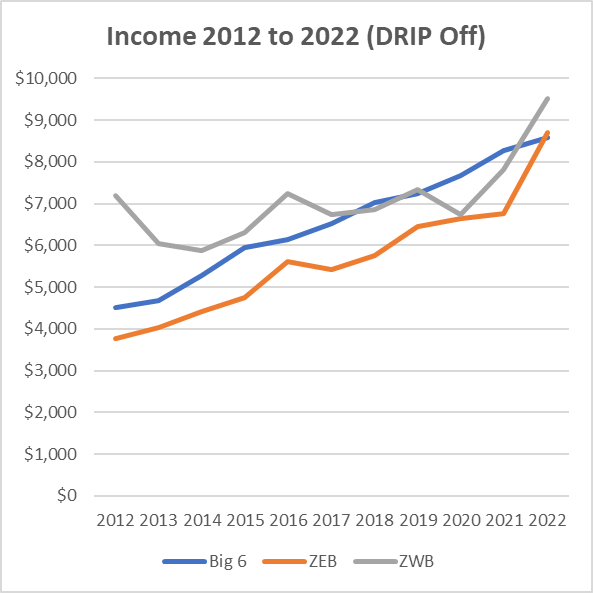
While ZWB starts out with a far greater annual income than the other two options, it shows more variability than the other two. Variability of income from year to year can be an issue for some retirees. Perhaps more importantly, the other income streams are catching up as time goes by. Direct investing shows a more consistent upward trajectory, even without any additional investment or DRIP. And this is exactly what you’d hope for with a portfolio of dividend-growth stocks. The dividend growth is what grows the income stream. That can be very important for an investor with a longer expected time horizon in retirement. Early retirees should watch out for this.

The Canadian banks generally do well over time. For portfolio growth & for growth of income. But now it’s down to personal choice. Do you prefer to trade some long-term portfolio value for the bigger income stream of the covered call approach early in retirement? Or do you like the more consistent growth of the income stream that comes from a portfolio biased towards dividend growth? There are a lot of factors that go into individual decisions. For a young investor with a long time horizon, total return is probably going to be more important than the size of the income stream starting out. It might also be more important for an early retiree. Or for a healthy retiree with a longer life expectancy. Things like leaving an inheritance, planning for home care or a retirement home, & so on, all factor into the decision making process too. Regardless, the Canadian banks have been a pretty solid investment over time & they look good in all these scenarios. Of course, as you’ll find noted on every fund’s webpage … past performance is not indicative of future results! We can’t just assume an investment will continue to do well in the future because it’s done well in the past. The banks have been great performers historically. But not all stocks or funds perform as well as the banks did here. Be sure to compare your choices for total return & income growth. And not just the size of the yield!

If you want to learn more about all this from the ground up, I’d like to suggest that you check out Double Double Your Money, available at your local Amazon store.

Important – this is not investing, tax or legal advice, it is for entertainment & educational purposes only. Opinions are my own, so do your own due diligence & seek professional advice before investing your money.


Women Suck at Investing

The title is clickbait, please bear with me & I will try to redeem myself. If you do an internet search with that same title in the search box, what you’ll find is a series of links to pieces & papers that suggest exactly the opposite is true. Women, it turns out, are generally better investors than men. Guys seem to run on testosterone-addled brains that make them do silly things when it comes to investing. So women who are investing generally outperform men. However, this is not about which gender makes for a better investor. It’s about those women who are not saving & investing for their long-term financial security.

The challenge for women as group is that fewer women are investing, as a proportion of their gender population. Those women who are not saving & investing may have exposure to greater retirement challenges. Women are more likely to face poverty in retirement than men. There is a gender pension gap that results in a great number of women surviving on lower income in retirement.

Despite all the progress with gender equality over time, it’s just not enough. There are still glass ceilings that women butt up against in the workplace. Many companies pay women less than men for doing the same job. Some women are channeled into lower paid & temporary or part-time jobs. And women tend to be the ones that take career breaks to raise children. All these things lead to a lower lifetime income. And lower lifetime income can lead to a lower retirement income from savings & pension plans, including the Canada Pension Plan, for women. With women living longer than men, this only adds to their challenges for retirement. Women, on average, will need a bigger retirement nest-egg than a man, to take them through that longer retirement phase. And many women are not saving & investing enough, early enough, to counter that predicament.

While women continue to work on fixing all those other issues of inequality, saving & investing should be a priority from the earliest working years. Don’t trust your neanderthal male partner to do it for you. We’re not that good at it! This is one area where women can seize the advantage. By starting early. Given enough time, an early start can level the playing field.

Why do I care? Because my wife is likely to outlive me by, not just years, but decades. For some of us, the challenges only come to light much later in life. And I have kids, including a daughter. I’d like them to get started early too. I wish I’d known more in my younger years.

Unfortunately, the kind of people who are reading this stuff are probably already engaged & knowledgeable. You are likely already saving & investing towards a more secure financial future. But if you have friends who are not, please encourage them to start. Investing looks like a digital casino to those unfamiliar with it. But it doesn’t have to be. And, as I’m sure you know, it’s not so intimidating once you take the time to learn a little. Please share your knowledge with those who might benefit from it. And if you have kids, regardless of gender, help them get started on the path early. Unfortunately, the urgency to get started early only becomes obvious much later in life!

If you want to help a friend get started, encourage them to read Double Double Your Money.

Important – this is not investing, tax or legal advice, it is for entertainment & educational purposes only. Opinions are my own, so do your own due diligence & seek professional advice before investing your money.

Why you NEED a TFSA?

According to the latest StatsCan data, from 2021, there are about 15 million of us that have TFSA accounts. There are about 30 million of us that are eligible to have TFSA accounts, so 50% of the adult population are not using this account. While some can’t afford to save & invest, there are still a lot of people missing out on what this account can do for them. TFSA means Tax-Free Savings Account.

Who doesn’t want something tax-free?
If you have money sitting outside this account … WHY!?!

The other funny thing with TFSAs is that a lot of people are storing cash there. I know it says “Savings” right in the name, but parking cash is not what this account is about. Inflation evaporates the value of cash. Especially with today’s high inflation rate. There are no benefits to letting cash evaporate inside a TFSA. You need to invest in something. Even if you are worried about investing in the markets, you can put your money to work in a high interest tax-free savings account (HISA), in GICs, or in one of the cash savings or HISA type ETFs. Some of these are yielding 5% at the moment. You can harvest that 5% return in a TFSA totally tax-free.

Some of these choices are more liquid than others. Being “liquid” means you can convert whatever it’s in to cash right away. And that means you could consider storing some of your emergency fund inside a TFSA. A locked-in GIC, for example, is not suitable for an emergency fund. An emergency can’t wait for a GIC to mature. The bottom line is that it’s tough enough to save, whether it be for an emergency fund or a holiday fund, but reducing the value of those savings by not getting some kind of return is a waste. And not sheltering those returns from tax only adds to that.

I know some of you are are already way ahead of the game with this. But if you have people in your life that you even remotely care for, your friends, your parents, your kids, please teach them about the value of the TFSA. It’s too big a deal to miss out on. Sure they’ll have to learn how it works & what investments are suitable under different circumstances. But it is worth the effort. If they can’t learn enough to do it alone, encourage them to see an advisor for help.

If you are not filling up your TFSA with long-term investments, use the spare room for your spare cash. Let it work tax-free for you.

If you want to learn a whole lot more about how all this stuff works, read Double Double Your Money, available here on Amazon. If you have a Kindle Unlimited subscription, you can read it for free. If you don’t have a subscription, there is a current Amazon.ca promotion that gives you the first two months free, so you really can read it for free. Please read it & share the message. Help get it out to some of the other 15 million Canadians who are missing out on the tax sheltering power of the TFSA.

Important – this is not investing, tax or legal advice, it is for entertainment & educational purposes only. Opinion are my own, do your own due diligence & seek professional advice before investing your money.
When to Avoid Dividends

The Fruits of Investing!

For a dividend investor, the answer is we never want to avoid dividends, right?
After the last post on Canadian-listed American dividend ETFs, I thought I’d provide an alternative view to one that might have suggested dividend-growth investing is the way to go.

Dividend-growth investing is very popular. I’m a fan myself. Primarily because it is a strategy that can work reasonably well for an investor with limited skills & ability to assess the potential of a stock to provide good returns. Using fewer & simpler metrics than it takes to properly evaluate a stock, it’s possible for a DIY investor to choose a portfolio of dividend-growth stocks that can perform reasonably well. And, being focused on a growing income stream, rather than on a falling share price, can help some of us ride out market downturns. The other great attraction of dividends is that as a portfolio grows, the income stream can grow &, one day, it may even match the income stream from our day job.
How cool would it be to have a portfolio that generates enough income to match your paycheque? Very cool, eh!
A retiree with a portfolio that provides a 4% yield on retirement day, might look forward to never having to sell shares. Selling shares for income can be a traumatic challenge for some retirees. And if the income stream continues to grow more than inflation, our retirees golden years might truly be golden. There’s a lot of good to be said about a portfolio of dividend-growth stocks.

But, in the world of investing, things are never simple!

Picking the right dividend-growth stocks still takes a lot of work. And it takes additional work to monitor & maintain a portfolio of individual stocks. Dividend-growth may still be a valid strategy for some. But it’s worth back-testing your stock portfolio against a dividend-growth ETF portfolio every now & then. Just to see if all the extra work produced enough extra reward. Of course the yield from such ETFs often don’t match that of a portfolio of hand-picked dividend-growth stocks. We like our bigger dividends, eh!
However, things can be different before & after retirement. And that raises some questions.


How many years ahead of retirement should we start building our dividend income stream?
Does it make sense to start early & just let the DRIP work for us ahead of retirement day?
Is it important for that income stream to grow before we retire?
But the really big question is this: should we even be focused on an income stream ahead of retirement?

Let’s take a look …

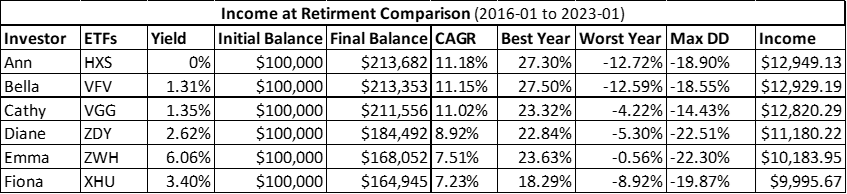
All our investors above put 100k into an ETF at the start of 2016, with a view to retiring at the end of January, 2023.
Ann & Bella are oblivious to dividends. They both followed the market index investing philosophy & went with S&P 500 Index® funds for part of their US allocation.
Ann chose Horizon’s HXS. This is a total return strategy that doesn’t pay any distribution. Unlike all the other ETFs, this one reinvests the value of the dividends inside the ETF. The income stream is zero.
Bella went with Vanguard’s VFV index fund. In this, & all other cases, distributions were automatically reinvested (the DRIP) at no extra cost.
Cathy likes the dividend-growth approach & invested in Vanguard’s VGG. She realised she might sacrifice some of the total return potential of the market, but she felt her choice was less volatile (it is, look at the Worst Year & Max DD columns) & that allowed her to sleep a little better.
Dianne was lured by the higher dividend payout of BMO’s ZDY. This ETF has a pretty good history of share price appreciation & a decent dividend growth trend. She liked that.
Emma wasn’t sure if she was into the whole FIRE thing yet but she thought that BMO’s ZWH might give her that option sooner. The juicy 6% yield from this ETF might make earlier retirement a reality for her. And the covered call strategy might offer some downside protection to boot. The Max DD is a little scary, but the worst year performance is the best of the bunch over this time period. Getting a good night’s sleep was important for Emma too.
Fiona went with a more traditional dividend approach, going with the Blackrock’s iShares® XHU offering. This is an ETF that focuses on a basket of solid, reliable, higher yielding companies in the US. A good choice for an investor who favours this approach.

Looking at the Final Balance column, I’d be pretty happy if I’d thrown a few bucks into any of these ETFs back in 2016. But what is the point of this comparison?

It’s this …

Come retirement day, we will look at things differently.
It’s not how much income was received & reinvested along the way.
It’s not how much the income stream grew prior to retirement.
It’s not about when we started to build an income stream.
It’s going to be all about the value of the portfolio on retirement day.
And how big an income stream that portfolio can buy to support our needs from that day forward.


Look at the Income column, the last one on the right. This is the income stream that would result from all the ETFs being sold off on retirement day to buy ZWH, the highest yielding ETF. The biggest income stream can be had by selling the portfolio that gave the best total return. And then buying the ETF with the greatest distribution, in this case ZWH. There is a 30% spread here, that’s significant.
Notice that in most cases, the higher yielding funds tend to have lower total return over time. That might not always be the case & it might not be the case going forward. Not even amongst this batch of ETFs. Doing your own due diligence, as always, is important.

But, from a pure numbers perspective, it matters less what happens with dividends during the accumulation years. It only matters that the portfolio grows. As much as possible. The bigger the portfolio, the bigger an income stream it can buy on retirement day. In this example, how much the income stream grew during accumulation didn’t matter. Having a bigger yield on cost didn’t matter. The only thing that mattered was that a bigger portfolio bought a bigger income stream on retirement day. For simplicity & to maximise return, all investments were considered to be inside a tax-sheltered account. There are other implications, not covered here, for selecting ETFs like this in a non-sheltered account.

Emotionally & numerically, there are many reasons that investors choose to invest differently. Seeking solutions with lower volatility, the reassurance of a growing income stream, avoiding the need to sell shares, & so on, all factor in to individual choices. All these are all important considerations, for sure. But the message here is not that we all need to abandon our chosen strategy in favour of some other promoted strategy. It’s more about giving some thought to strategies that differ from our current path. Despite the reassurances we get from like-minded investors in our favourite social media groups, it can be useful to think differently about things from time to time. We shouldn’t fall in love with one particular strategy & block out all information that conflicts with that. It might be worth taking some time to learn about different perspectives & different strategies. Keep an open mind.

By the way, I’m not suggesting that you buy any of the ETFs here. Nor am I suggesting that everything gets dumped on retirement day for one high-yielding ETF. This is just an example to illustrate why we might want to think differently about our approach from time to time. It’s just as a valid to consider switching to a basket of individual, higher-yielding, dividend-growth stocks on retirement day, for example. Or sticking the proceeds into a portfolio of your favourite high-yield funds. Do whatever floats your boat for an income stream. Believe it or not, some will stick with the growth solution that got them there & sell shares for income. But regardless of approach you choose during the accumulation years, whatever you choose to do in retirement will probably work better with a bigger portfolio. 😜

So how do you accumulate?

Important – this is not investing, tax or legal advice, it is for entertainment & educational purposes only. Opinion are my own, do your own due diligence & seek professional advice before investing your money.

The Best American ETFs for Canadians

Decisions, Decisions!

If I lived in the US, I would probably split my US exposure between the Schwab US Dividend Equity ETF (SCHD) & the Vanguard Dividend Appreciation Index Fund ETF (VIG).

Why?

For a few reasons. The first is because I like dividend-growth stocks & both those ETFs focus on companies that have the potential to create a growing income stream. Dividend-growth companies appear to hold up better than growth stocks when the markets crash. Because I’m a bit of a chicken, I tend to I favour ETFs with lower volatility than the market. The goal of choosing lower volatility investments is to take away some of the market downside when bad things happen. When a conservative investor seeks to avoid volatility, what we really mean is that we don’t want our stuff to go down. We don’t mind volatility to the upside, of course! But lower volatility ETFs usually knock off some of the highs too. These two ETFs, however, are great performers. One slightly lags the market, while the other has a slight beat. Both provide that level of performance with less volatility than an S&P 500 Index® ETF. Since 2012, they had better annual performance than the market in the worst years & their biggest drawdowns were less severe than those of the market too. The bottom line is they have provided good performance over time. And they offer the potential for reduced anxiety during the bad times. My kind of investing.

While we can buy these ETFs in Canada, there are pros & cons to a Canadian investing through the US exchanges. Some combination of laziness, currency exchange costs, & a desire to avoid additional tax reporting headaches has many Canadian investors favouring Canadian-listed ETFs for their American exposure. Can we do that & get the results provided by ETFs like SCHD & VIG. Let’s take a look.

There are ETFs from all the big providers, like Blackrock®, BMO Global Asset Management, Vanguard Canada, Horizons & others, that provide US market exposure solutions for Canadians. In Canadian dollars. An easy choice for one of the contenders is the Vanguard US Dividend Appreciation Index ETF (VGG). This one is easy because it holds just VIG, the very same US ETF mentioned above. Of course, the expense ratio (fee) is higher in Canada, but we’re used to that, eh! I would like a Canadian-listed equivalent to SCHD, but there really isn’t anything doing exactly what SCHD does up here. BMO’s ZDY is vaguely similar but the BMO Low Volatility US Equity ETF (ZLU) looks interesting too. With all the online chatter about high yield ETFs in recent years, I had to include one of those for comparison & I went with the BMO US High Dividend Covered Call ETF (ZWH). I think this is one of the better ones in this space & it merits inclusion to see if all the talk about the downside protection that this strategy offers is really true.

Let’s cut to the chase …

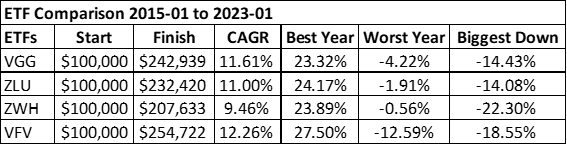
For the market benchmark comparison, I’m using Vanguard Canada’s S&P 500 Index® ETF (VFV). With everything in Canadian dollars, the variable exchange rate noise doesn’t confuse the comparison. Here we see the results of 100k invested in each of the ETFs at the start of 2015. ZWH was launched in 2014 so the data (courtesy of portfoliovisualiser.com) for this comparison starts in 2015.

What do you think of those results?

As is often the case, the low-cost market index fund wins out for total return. Over a long lifetime of investing, that 1.26% difference between the annual returns from ZLU & VFV, for example, could be huge. If you can tolerate the volatility, Mr. Buffett’s advice is looking good, the low-cost market index fund is the winner. But for more fearful investors, the lower volatility choices might help keep them in the market during times of steep decline. Jumping in & out of the market in response to market fluctuations can be a wealth killer for investors. For that reason, my choices would be VGG & ZLU in this instance. They don’t come as close to market returns as the two American ETFs we looked at earlier. But they’re good enough for me & I think I’d manage a better night’s sleep with those in my portfolio. I must be honest here, I was taken aback by how well ZLU has performed over the past 8 years. Can it sustain this level of performance? I have absolutely no idea. But I am impressed. ZWH was also surprisingly good. Though it shows the best “Worst Year” performance of the four, it had the biggest drawdown of the group, at 22.3%. That would have been a heart-stopper for me. Yet it managed to recover from that big drawdown to post pretty decent results over time. That’s a good outcome. Its total return over the period, however, lags the other two, so I would probably choose those instead. In retirement, when an income stream might be more important, ZWH might earn a place in a portfolio for some.

There’s a lot more under the hood here. Along with deciding on a US portfolio allocation percentage, an investor should consider the diversity of each fund for that US exposure. There are tax implications for US-listed vs Canadian-listed American equities in different accounts, sheltered & not. And so on. This post isn’t about any of that, it’s just an example of tailoring a portfolio to suit an investor profile that might be more, or less, risk tolerant.

What do you do for your US exposure?
And be sure to let me know if you have a suggestion for a better alternative than those above.

Important – this is not investing, tax or legal advice, it is for entertainment & educational purposes only. Opinion are my own, do your own due diligence & seek professional advice before investing your money.