DIY Financial Planning … Is it for You?

Retirement Planning Made Easy!

I’m jumping the gun on this one, but I’m so excited to have stumbled across this financial planning tool that I want to share it with you now. Funny enough, Microsoft’s Copilot chatbot introduced me to this. I asked Copilot to help with a financial plan & after providing some insights & encouragement, the first link it provided was to planeasy.ca. This led me to their financial planning platform adviice.ca. While I’ve only played with it for a few hours yet, I’m really excited about what these guys are doing. And what this platform can do for DIY investors who are also doing DIY financial planning.

One of the drivers for DIY investors to do the DIY thing is our frugal nature. We want to save on investment & advisory fees so that we keep more of our money. That may, or may not, work out well for us, but we just can’t escape the desire to be frugal. This frugal nature also extends to financial planning. Though many DIY investors recognise the value of a financial plan, we tend not to want to pay the fee for having a plan done professionally. And no wonder, it’s not difficult to find fees in the two to five thousand dollar range for having a single financial plan prepared by a professional. Despite the value, that’s still a lot of coin for a one-shot deal. I’m not sure what plan revisions would cost in subsequent years, but it’s fair to assume that as time goes by & circumstances change, it probably makes sense to have the plan updated periodically.

Enter Adviice.ca!

If you’ve watched YouTube® videos on financial planning, you’ll have seen them use software for those sexy charts & graphs that are easily modified for viewing different scenarios. We know we want this, but the software isn’t available to non-professionals in many cases. And some of us are unwilling to pay the price for the professional to do a plan. The Adviice.ca platform costs $9 for a 30 day trial. And $9 a month if you decide to keep the subscription. At these prices, that’s almost 28 years of DIY financial planning for the same cost as one $3,000 plan! There are so many threads to weaving an accumulation or retirement plan. It is very difficult to do it on a notepad or with spreadsheets. Adviice does the calculation grunt work in the background & shows the results in an easy-to-read visual format. It’s also updated to reflect current details on taxation, government income streams, etc. At this point, I haven’t played with the platform for long enough to write a review. Frankly, I’m not qualified to do a real review anyway. The best I could do is provide a DIY appraisal of what I’ve found. However, this post is more about my early enthusiastic reaction to finding it & using it.

Within 2 hours of signing up for this platform, I had a rough-tuned retirement plan done. Much of that time was spent inputting the foundational data. It took another couple of hours to learn enough about how it worked to improve on the first pass. This particular plan embraces a situation that covers another three or four years of working, reviewing different RRSP drawdown strategies, looking at the tax implications of different withdrawal rates across different account types, & so on. I still have much to learn & a lot of fine-tuning to do, but I think I’ve got a pretty respectable financial plan pulled together already. Now the beauty of this is that you can spend as long as you want fine-tuning a plan. Or, to avoid the law of diminishing returns, you can book a one hour session with an advisor at Planeasy, or with other professionals using the platform. You can do this right within the Adviice platform. And for only $499! Or you can book a more comprehensive package for $1,999.00, which could include multiple retirement scenarios, additional tuning sessions, etc. The beauty of this offering is that you can do the DIY thing at a low cost, but then you can add some professional assessment at a lower price than the typical financial planning service might cost. Along with pandering to the hands-on thing favoured by many DIY folk, this could be a cost-effective combination of DIY & professional advice.

Rather than share screenshots, which won’t capture the full scope of what this platform really does, here’s a link to a PlanEasy YouTube® video that covers one example of doing a retirement plan for a couple. It captures a lot of the features & functionality of the system. If you’ve watched financial planning videos in the past, you’ll find a lot you can relate to in this. This clip shows the software with the green PlanEasy branding, mine has the blue Adviice branding, but is otherwise identical. Though there may be some additional features on the latest version. It’s not yet a perfect solution for all scenarios. I’d like to try scenarios where I pass away earlier than my spouse, for example. You can work around most of these limitations by manually adjusting the data columns, but it looks like they are working on improving the functionality & adding features on an ongoing basis. I joined their Reddit® group (r/adviice) where you’ll see feature requests & the company’s responses to these. They are really quick to respond to questions.

The biggest limitation to the client version that I’ve seen, so far, is that we can only create one foundational data set. In other words, short of starting over, we can only do our own plan, for a single or a couple. And that’s fair enough. The advisors pay more & can obviously prepare plans for multiple clients. For those who take advantage of a session with an advisor, the advisors can then use our base plans to add their professional input on top of ours. I guess part of the reason we can get the lower cost professional oversight is because we have already done the work to build the foundational data set. We can still, however, create multiple scenarios based on our own foundational data set. That allows us to explore different accumulation & withdrawal strategies, & so on.
The other limitation is that we cannot create reports. Those are delivered to us after a session with an Adviice advisor. That too is fair. It would be possible to change the foundational data to create reports for others if this was open. Just doing the DIY thing for ourselves, we can get all the relevant info right on the screen. And we can export the plan’s data, for those who want to play with the numbers in a spreadsheet. The reports are not essential for getting value from this software.

Bottom line is that I think this is the first affordable solution that is accessible for Canadians who want to be more involved in creating their own financial plan. Not only is it more affordable to begin with, but it may offer access to professional planning & fine tuning at a more affordable price too. It is a really smart product approach from this company. I think they will find many takers at $9 a month that might otherwise never have spent a penny on financial planning. And I think many of those takers will avail of the tune-up sessions with a professional advisor. And there will be those who will take advantage of the larger, more comprehensive professional support packages too. I hate this way-overused phrase, but this product has all the feel of one of those really good win-win solutions!

If I’m sounding like I work for these guys, I apologise, but I have absolutely no affiliation. I found it last weekend & I ponied up the $9 within 10 minutes of reading about it. Within an hour of playing with it, I knew this was going to be an enjoyable experience. When I compare the number of hours I spend with calculators & spreadsheets trying to do all this, Adviice is a great option for me. However, learning anything new does require some brain activity. And it might not be suitable for everyone. Of course, we all know that we need to challenge our brains as we age. And learning to use this will certainly exercise the brain.
In my case, that might be a bonus! 😜

Despite my enthusiasm, I would also strongly caution against using this as the total solution to a problem that you might not fully understand. If you don’t know enough to have confidence in your current DIY financial plan, you might not know enough to understand if the results produced by Adviice are good enough to live by. Particularly when it comes to depending on a plan that needs to survive your retirements years. I know I’ll enjoy playing & refining a plan with these tools going forward. But I will also take advantage of a one hour session with a professional down the road. Just in case I’ve screwed it up.
Please be careful here!
It may turn out that this product is not suitable for you. But if you enjoy doing this kind of thing, & if you are spending a lot of time with spreadsheets & online calculators, I highly recommend investing the $9 to test drive it.

While I have focused on the older demographic in the course of this conversation, this is also of potential value for the young accumulator.
At long last, there is almost an app for this stuff! LOL

A more recent update on using the Adviice.ca platform can be found at DIY Financial Planning… An Update

If you want to learn more about saving & investing from the ground up, I’d like to suggest that you check out Double Double Your Money, available at your local Amazon store.

Important – this is not investing, tax or legal advice, it is for entertainment & conversation-provoking purposes only. Data may not be accurate. Check the current & historical data carefully at any company’s or provider’s website, particularly where a specific product, stock or fund is mentioned. Opinions are my own & I regularly get things wrong, so do your own due diligence & seek professional advice before investing your money.

Canadian Banks for Dividend or Covered Call Income?

Dollars & Dividends

We love our dividends in Canada. If dividends are so great, why not go for the even greater yields available with covered call ETFs? Maybe we can toss all our investments into covered call ETFs & retire early? That sounds great!
But does it work?

Maybe!

Every investing strategy has its fan base. But at the end of the day, it all comes down to how the numbers work for the individual investor. And covered call ETFs can work for some investors.

However, some features of covered call writing can be less appealing. The notion of covered call ETFs having lower volatility, for example, may be true. But volatility is a measure of an investment going up, as well as down. In general, covered calls will limit upside. If a growing stock is called away, you lose some of the upside. As investors, we don’t mind volatility if it means our investment is going up. We only fret when it goes down. Hand in hand with that is the idea that covered call writing offers some downside protection. You’ll notice the wording in the description of many funds says something like downside protection may be limited to the returns provided by the covered call premium. That’s marketing speak for “we can crash as hard as anything else but you’re at least getting that juicy covered call premium along the way”. Unfortunately, during times of growth or recovery, the capped upside often means that the growth of a covered call fund doesn’t match that of a fund holding the equities directly.

Let’s take a look at an example using only Canada’s big banks. The five largest banks in Canada all started paying dividends in the 1800s. That’s a little too far back to look at, but if you’d invested $100k in an equal-weight holding of the Big 6 banks back in January 2000, that portfolio would have grown to almost one & a half million dollars today! Investing in the large cap American or Canadian market index funds would only have returned under half a million over that time. Of course, nobody would risk going all in on just the Canadian banks. Right!?! But this kind of performance is why Canadians like their banks.

To compare the different investing strategies, I’ll use BMO’s ZEB & ZWB here. Both ETFs are designed to track the Solactive Equal Weight Canada Banks Index. And both funds are managed by BMO Global Asset Management, one of Canada’s largest ETF providers. ZEB just holds the banks. ZWB holds the same banks, but adds a covered call strategy to about 50% of the portfolio to generate a bigger income stream. These ETFs have a relatively short shared history, so we’re only looking at returns over an 11.5 year period up to the middle of this year here.

Accumulation
During the accumulation years, all dividends & distributions are reinvested, that’s the “DRIP ON” scenario in the table below. This shows the Total Return, with dividends reinvested, from a $100k investment directly in the bank stocks. And it compares that to the same $100k investment in ZEB & ZWB.

It’s probably no surprise that directly investing in the stocks produced the greatest return. The direct investment was rebalanced semi-annually, to match the index tracking guidelines used by the ETFs. While ZEB does all that work for us, the fees charged by the fund cause a little drag on the returns. Since covered call writing lops off some of the upside potential, it’s also not a surprise to see ZWB trailing the pack here. It’s CAGR & Best Year are poorer. But, it’s worth noting that it’s Worst Year is slightly worse than the other two. Fund managers do warn that covered call funds “may” provide downside protection. Sometimes, that might only be by the amount of the covered call premium. But it’s not a guarantee. Since ZWB had the biggest drop of the three, the covered call strategy didn’t provide much of a safety net during the covid crash of March 2020. It’s possible that longer periods of sideways, or slightly down, markets could have allowed ZWB to produce a better relative performance. All in all though, it’s a pretty good performance for all strategies. That’s the accumulation picture. Next we’ll look at what happens when we start spending the income.

Spending the Money
Things change when we retire & need to spend some of our savings every year. All sorts of new challenges come up. The ideal scenario for many retirees is to have their investments generate enough dividends & distributions for them to live on. No worries about having to sell shares in a down market, & so on. Here’s how these three investments deliver on the income front.

This table shows the picture for an investor who retired in 2012 & sucked out all the dividends & distributions for living expenses along the way. The holder of ZWB would have had more income over the 11.5 year period. Though overall, perhaps not the best value, since the value of the underlying portfolio didn’t grow as much as the other two. If an emergency situation forced the sale of some shares to raise capital, the other two approaches had far bigger portfolio values to draw from. Aside from the income, the positive thing about all these results is that the underlying assets continued to appreciate. All these ETFs show positive CAGR. And this is with all the dividends & distributions taken out. BMO’s limited covered call strategy, over this timeline, worked well. Any income investment that shows negative CAGR for the underlying assets (with DRIP off) might be an exposure for a retiree with a longer time horizon. The portfolio value would decline over time & that will have an impact on the income stream over the long haul too. There is one other exposure here & that is the impact of inflation. If we adjust the End Value of the portfolios in the above table, the Big 6 & ZEB are worth an inflation-adjusted amount of about $150k. The End Value of ZWH, in 2012 dollars, is just under $95k at the end. This isn’t quite accurate, as the inflation adjustment comes from US inflation data, not Canadian. But it still shows the importance of having a portfolio capable of staying ahead of inflation.

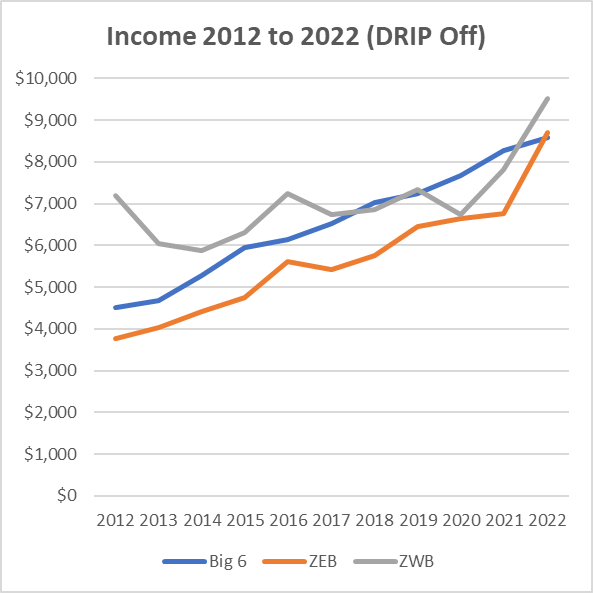
Here’s what the income streams look like for these investments …

While ZWB starts out with a far greater annual income than the other two options, it shows more variability than the other two. Variability of income from year to year can be an issue for some retirees. Perhaps more importantly, the other income streams are catching up as time goes by. Direct investing shows a more consistent upward trajectory, even without any additional investment or DRIP. And this is exactly what you’d hope for with a portfolio of dividend-growth stocks. The dividend growth is what grows the income stream. That can be very important for an investor with a longer expected time horizon in retirement. Early retirees should watch out for this.

The Canadian banks generally do well over time. For portfolio growth & for growth of income. But now it’s down to personal choice. Do you prefer to trade some long-term portfolio value for the bigger income stream of the covered call approach early in retirement? Or do you like the more consistent growth of the income stream that comes from a portfolio biased towards dividend growth? There are a lot of factors that go into individual decisions. For a young investor with a long time horizon, total return is probably going to be more important than the size of the income stream starting out. It might also be more important for an early retiree. Or for a healthy retiree with a longer life expectancy. Things like leaving an inheritance, planning for home care or a retirement home, & so on, all factor into the decision making process too. Regardless, the Canadian banks have been a pretty solid investment over time & they look good in all these scenarios. Of course, as you’ll find noted on every fund’s webpage … past performance is not indicative of future results! We can’t just assume an investment will continue to do well in the future because it’s done well in the past. The banks have been great performers historically. But not all stocks or funds perform as well as the banks did here. Be sure to compare your choices for total return & income growth. And not just the size of the yield!

If you want to learn more about all this from the ground up, I’d like to suggest that you check out Double Double Your Money, available at your local Amazon store.

Important – this is not investing, tax or legal advice, it is for entertainment & educational purposes only. Opinions are my own, so do your own due diligence & seek professional advice before investing your money.

Why you NEED a TFSA?

According to the latest StatsCan data, from 2021, there are about 15 million of us that have TFSA accounts. There are about 30 million of us that are eligible to have TFSA accounts, so 50% of the adult population are not using this account. While some can’t afford to save & invest, there are still a lot of people missing out on what this account can do for them. TFSA means Tax-Free Savings Account.

Who doesn’t want something tax-free?
If you have money sitting outside this account … WHY!?!

The other funny thing with TFSAs is that a lot of people are storing cash there. I know it says “Savings” right in the name, but parking cash is not what this account is about. Inflation evaporates the value of cash. Especially with today’s high inflation rate. There are no benefits to letting cash evaporate inside a TFSA. You need to invest in something. Even if you are worried about investing in the markets, you can put your money to work in a high interest tax-free savings account (HISA), in GICs, or in one of the cash savings or HISA type ETFs. Some of these are yielding 5% at the moment. You can harvest that 5% return in a TFSA totally tax-free.

Some of these choices are more liquid than others. Being “liquid” means you can convert whatever it’s in to cash right away. And that means you could consider storing some of your emergency fund inside a TFSA. A locked-in GIC, for example, is not suitable for an emergency fund. An emergency can’t wait for a GIC to mature. The bottom line is that it’s tough enough to save, whether it be for an emergency fund or a holiday fund, but reducing the value of those savings by not getting some kind of return is a waste. And not sheltering those returns from tax only adds to that.

I know some of you are are already way ahead of the game with this. But if you have people in your life that you even remotely care for, your friends, your parents, your kids, please teach them about the value of the TFSA. It’s too big a deal to miss out on. Sure they’ll have to learn how it works & what investments are suitable under different circumstances. But it is worth the effort. If they can’t learn enough to do it alone, encourage them to see an advisor for help.

If you are not filling up your TFSA with long-term investments, use the spare room for your spare cash. Let it work tax-free for you.

If you want to learn a whole lot more about how all this stuff works, read Double Double Your Money, available here on Amazon. If you have a Kindle Unlimited subscription, you can read it for free. If you don’t have a subscription, there is a current Amazon.ca promotion that gives you the first two months free, so you really can read it for free. Please read it & share the message. Help get it out to some of the other 15 million Canadians who are missing out on the tax sheltering power of the TFSA.

Important – this is not investing, tax or legal advice, it is for entertainment & educational purposes only. Opinion are my own, do your own due diligence & seek professional advice before investing your money.

Double Double Your Money

I started pulling information together to help my kids save & invest almost 3 years ago & the end result is this …

Double Double Your Money was released on Amazon today.

It is a guide to saving & investing that primarily targets younger investors & those just starting out on their journey. That said, I could have used something like this at a much older age myself! It might also be a useful resource for other parents looking for some ideas on how to guide their own kids towards a saving & investing program. Like all Dads, I’m trying to prevent my kids making some of the mistakes I made. As parents, we know how that usually goes. But we’re parents, so we have to keep trying, eh!

While the broad principles apply in most places, the focus is on Canada, where we can tap the value of tax-sheltered accounts like our TFSA & RRSP. The Canadian CPP & OAS programs provide some support in retirement but there’s a lot more we need to do to for a comfortable retirement. In my twenties, I couldn’t even imagine thinking about retirement. Nor do my kids. So I cover some exciting things like getting rich, becoming a millionaire on minimum wage, early retirement, FIRE, & anything that I think might suck them into saving & investing sooner!

Not to worry, there’s no silly stuff here. I’m a little too conservative & risk-averse for that. And I worry more about losing my kids money than I do my own. But the importance of building a financial strategy as early as possible is a huge deal. I hope this works to get younger investors, including my own kids, motivated enough to get things going.

You’ll find it across most Amazon markets in Kindle & hardcopy formats, & you’ll find it in the Canadian market here.

The Best American ETFs for Canadians

Decisions, Decisions!

If I lived in the US, I would probably split my US exposure between the Schwab US Dividend Equity ETF (SCHD) & the Vanguard Dividend Appreciation Index Fund ETF (VIG).

Why?

For a few reasons. The first is because I like dividend-growth stocks & both those ETFs focus on companies that have the potential to create a growing income stream. Dividend-growth companies appear to hold up better than growth stocks when the markets crash. Because I’m a bit of a chicken, I tend to I favour ETFs with lower volatility than the market. The goal of choosing lower volatility investments is to take away some of the market downside when bad things happen. When a conservative investor seeks to avoid volatility, what we really mean is that we don’t want our stuff to go down. We don’t mind volatility to the upside, of course! But lower volatility ETFs usually knock off some of the highs too. These two ETFs, however, are great performers. One slightly lags the market, while the other has a slight beat. Both provide that level of performance with less volatility than an S&P 500 Index® ETF. Since 2012, they had better annual performance than the market in the worst years & their biggest drawdowns were less severe than those of the market too. The bottom line is they have provided good performance over time. And they offer the potential for reduced anxiety during the bad times. My kind of investing.

While we can buy these ETFs in Canada, there are pros & cons to a Canadian investing through the US exchanges. Some combination of laziness, currency exchange costs, & a desire to avoid additional tax reporting headaches has many Canadian investors favouring Canadian-listed ETFs for their American exposure. Can we do that & get the results provided by ETFs like SCHD & VIG. Let’s take a look.

There are ETFs from all the big providers, like Blackrock®, BMO Global Asset Management, Vanguard Canada, Horizons & others, that provide US market exposure solutions for Canadians. In Canadian dollars. An easy choice for one of the contenders is the Vanguard US Dividend Appreciation Index ETF (VGG). This one is easy because it holds just VIG, the very same US ETF mentioned above. Of course, the expense ratio (fee) is higher in Canada, but we’re used to that, eh! I would like a Canadian-listed equivalent to SCHD, but there really isn’t anything doing exactly what SCHD does up here. BMO’s ZDY is vaguely similar but the BMO Low Volatility US Equity ETF (ZLU) looks interesting too. With all the online chatter about high yield ETFs in recent years, I had to include one of those for comparison & I went with the BMO US High Dividend Covered Call ETF (ZWH). I think this is one of the better ones in this space & it merits inclusion to see if all the talk about the downside protection that this strategy offers is really true.

Let’s cut to the chase …

For the market benchmark comparison, I’m using Vanguard Canada’s S&P 500 Index® ETF (VFV). With everything in Canadian dollars, the variable exchange rate noise doesn’t confuse the comparison. Here we see the results of 100k invested in each of the ETFs at the start of 2015. ZWH was launched in 2014 so the data (courtesy of portfoliovisualiser.com) for this comparison starts in 2015.

What do you think of those results?

As is often the case, the low-cost market index fund wins out for total return. Over a long lifetime of investing, that 1.26% difference between the annual returns from ZLU & VFV, for example, could be huge. If you can tolerate the volatility, Mr. Buffett’s advice is looking good, the low-cost market index fund is the winner. But for more fearful investors, the lower volatility choices might help keep them in the market during times of steep decline. Jumping in & out of the market in response to market fluctuations can be a wealth killer for investors. For that reason, my choices would be VGG & ZLU in this instance. They don’t come as close to market returns as the two American ETFs we looked at earlier. But they’re good enough for me & I think I’d manage a better night’s sleep with those in my portfolio. I must be honest here, I was taken aback by how well ZLU has performed over the past 8 years. Can it sustain this level of performance? I have absolutely no idea. But I am impressed. ZWH was also surprisingly good. Though it shows the best “Worst Year” performance of the four, it had the biggest drawdown of the group, at 22.3%. That would have been a heart-stopper for me. Yet it managed to recover from that big drawdown to post pretty decent results over time. That’s a good outcome. Its total return over the period, however, lags the other two, so I would probably choose those instead. In retirement, when an income stream might be more important, ZWH might earn a place in a portfolio for some.

There’s a lot more under the hood here. Along with deciding on a US portfolio allocation percentage, an investor should consider the diversity of each fund for that US exposure. There are tax implications for US-listed vs Canadian-listed American equities in different accounts, sheltered & not. And so on. This post isn’t about any of that, it’s just an example of tailoring a portfolio to suit an investor profile that might be more, or less, risk tolerant.

What do you do for your US exposure?
And be sure to let me know if you have a suggestion for a better alternative than those above.

Important – this is not investing, tax or legal advice, it is for entertainment & educational purposes only. Opinion are my own, do your own due diligence & seek professional advice before investing your money.