Beat the Market in 2023

Beating which Market!?!

Happy New Year to all & here’s to our collective success in beating the market this year. Of course, we can’t all beat the market, we need some losers to lose money so we can be winners. But in the best tradition of reading great free advice on the internet, let me tell you that while beating the market is a big deal, it’s not that hard to do.
(Make sure you don’t stop at the first chart, there is a twist to this tale! ๐Ÿ˜œ)

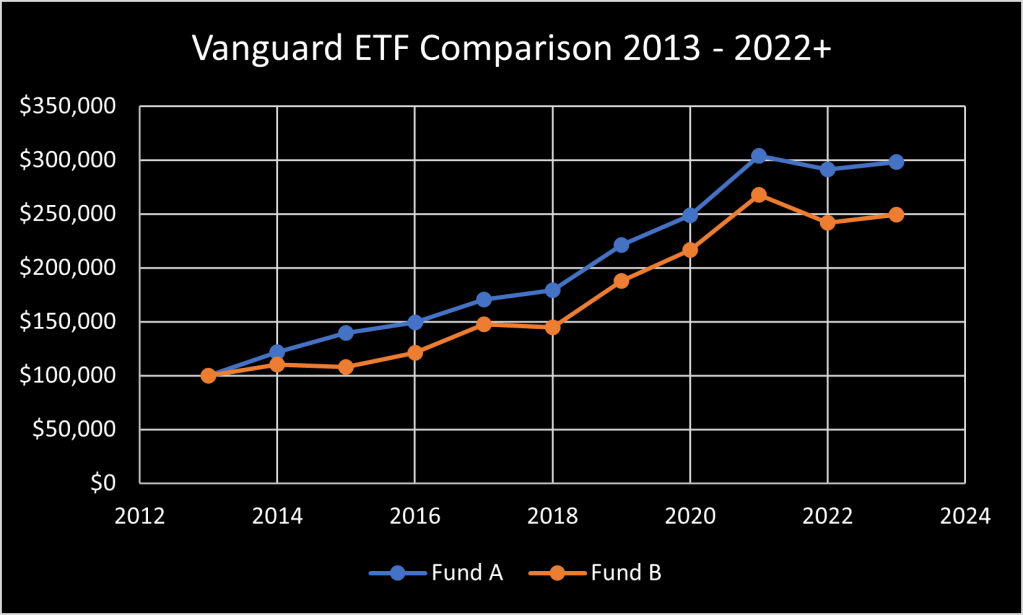
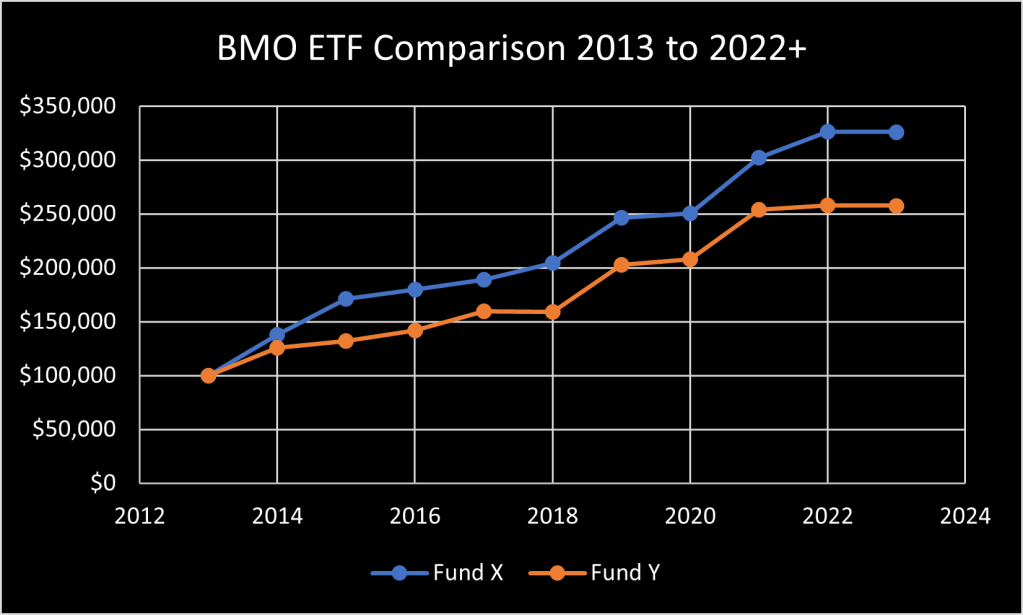
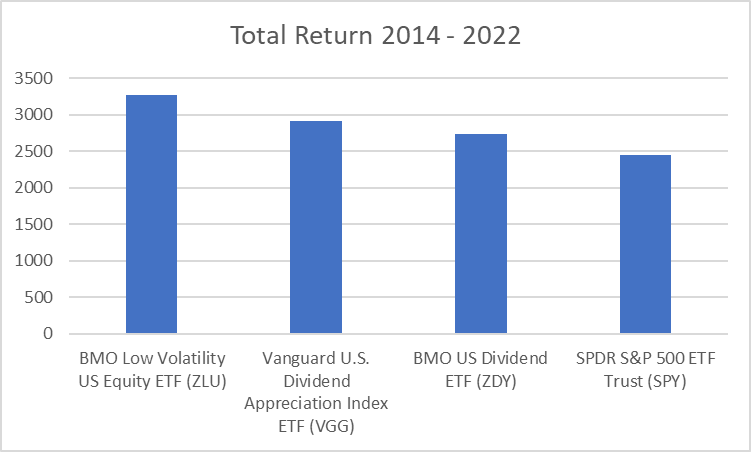
If you’d stuck a thousand bucks into these three ETFs back at the end of 2013, & reinvested the dividends along the way, you’d have beaten “the market” with any of them. Check out the chart below, the two BMO ETFs & the Vanguard Canada ETF all beat the American index tracker. Seems like a no-brainer, eh?

Of course, making a decision from this one chart would not be wise. And you’re seeing it on the internet, for cryin’ out loud! Instead, we’d have to do our due diligence, eh? Maybe read the marketing blurb on the fund’s website. Find a few online buddies that have invested in it & that want you to invest in it too. Ignorance, like misery, loves company. That is not doing due diligence!
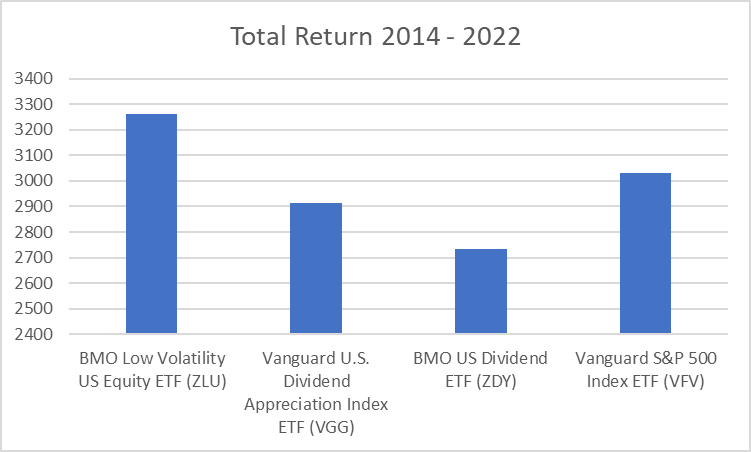
Now look at that same chart but, this time, with Vanguard’s VFV replacing SPY & you get this …

What’s going on here? Both SPY & VFV track the same index. Yet VFV is doing way better. It’s because we were comparing red apples to green apples in the first chart. SPY is in US dollars. Back at the start of this comparison, the Canadian dollar was strong for the first couple of years. The original investment in SPY was in US$, while the original investment in VFV was in Can$. As the Canadian dollar weakened over the years, VFV benefitted from holding US stocks, priced in US dollars. VFV is getting a numeric advantage because one US dollar is buying more loonies today. That makes VFV’s numbers bigger. But the benefit is only in the numbers, not in the value when compared to the current exchange rate. In fact, SPY would do a little better because of its lower fee structure. However, for a Canadian investor to buy SPY, there would be a currency exchange cost to consider too.

Only ZLU beat the index in both cases, so just buy that one, right? No, it’s not that simple. While all these ETFs are good, they only work as part of an overall investing strategy. They each hold differing numbers of stocks, with different sector exposures. They have different yields & costs. They are all focused on US stocks. Are they cheap or expensive relative to history & expectations? Besides, who knows what happens going forward. And 9 years is not a long time in investing cycles.
Which of these you choose for part of your portfolio depends on your investing philosophy. If you don’t have a personal investing philosophy, it’ll be tougher to build an investing strategy that will work with your fears & needs. This will be different for everyone. But once you know who you are as an investor, & what you are trying to achieve, you will find it easier to invest in things that might have a better chance of delivering for you. And, sometimes, that might mean we don’t need everything we hold to beat the market all the time.

This year, as with all prior years for a long time now, my new year’s resolutions include losing weight, exercising, & saving more.
Along with developing an investing philosophy that I’m comfortable with! ๐Ÿ˜œ

Best of luck for 2023. I hope it’s a good one for all of us.

Investing Ignorance is Bliss but …

It may be expensive.

In Cafรฉ Veritas!

I chatted with another older (we’re not really that old yet!) guy at my local coffee shop this morning. My coffee shop is great for that kind of thing. There’re always a couple of people within earshot that are happy to chat while we sip our morning brew. And I like to chat!

Anyhow, the conversation shifted from Christmas shopping to the state of the economy & the gloomy expectations for a recession in the new year. That led to us talking about how our portfolios were performing this year. I knew how my portfolio was performing year to date, to two places of decimal. He, on the other hand, had absolutely no idea how his portfolio was doing. He thinks he’ll get something in the mail in the new year, but his advisor told him he was doing okay when they last spoke. Since I’m tinkering with the allocations in my own portfolio, I was curious about what his advisor was recommending. My coffee buddy didn’t know. When I asked about what he was invested in, he told me it was with a professional & he really didn’t know exactly what it was in. Was it stocks, bonds, ETFs, or mutual funds? He was almost sure, maybe, that it was mutual funds. But he’s been with this guy for years. He trusts him. He’s a really nice guy. And he does great things for him. Besides, my coffee companion knows nothing about all this investing stuff. Nor does he have any idea how much he is paying for the service.

While I have no idea if he was being frank with me, if that’s the true level of his understanding, it’s a potential exposure to paying more & getting less. It’s totally okay to invest with the help of an advisor, they can bring value in all sorts of ways. But you shouldn’t do it blindfolded. The difference between a portfolio fee of 0.2% & 2.2% sounds small, it’s only 2% after all, but it can be huge over time. Given the historical market returns of about 10%, a kid with $50k invested by age 30 could see their portfolio grow to a value of about $1.6 million by age 65. Without any additional saving. Drop that rate of return to 8% because of fees every year & the portfolio would be worth about $800k at retirement. That 2% reduction means that a full 50% of the potential return goes towards fees.
A retiree planning to live by the 4% rule has to make up an additional 2% to cover fees like that.
Fees matter.
Of course, if the advisor is outperforming by at least as much as the fees being charged, that’s great. That could be exceptional value. But if not, the fees might be a potentially significant overhead.

I was just there for a coffee, so I didn’t get into it any further. I don’t want to be the guy that nobody wants to talk to in the coffee shop!

When you get your annual statement this year, slow down & look at it. Compare your asset allocations to some of the ETFs that are available on the market today. Chances are pretty good that you’ll find an ETF that matches the asset allocation in your managed portfolio. The traditional 60:40 split between stocks & bonds is replicated by all the big providers in Canada, for example. BMO has ZBAL, iShares offers XBAL & the Vanguard one is VBAL. For fees around 0.2%, these ETFs might compare very favourably against a mutual fund that does the same thing. But charges a significantly larger fee of 2%, possibly more. Or compared to an advisor that is charging 2% to put a similar portfolio together for you.

Look I’m not for a minute suggesting that you drop your advisor. Advisors bring all sorts of good things to the party too. They can structure a portfolio to minimize taxes, help with decumulation strategies, provide guidance when the markets crash, & so on. But you should learn enough to have a discussion with your advisor on the cost & value of having the advisor manage your portfolio. Performance and fees are important. They should both be part of the conversation during your annual portfolio review. Who knows, you might even be offered a discount on the fees being charged. And even if you don’t, you’ll at least have an improved understanding of the cost & value of the advice you are paying for.

Knowledge is always useful. Even when it undermines the sense of bliss a little.

Important โ€“ this is not investing, tax or legal advice, it is for entertainment & educational purposes only. Do your own due diligence & seek professional advice before investing your money

Investing Game for the Financially Illiterate

Playing at Investing

When I was a kid, investing was some kind of black art, practiced by banking types in the back offices of some tall buildings on Bay Street & Wall Street. It was not something I knew anything about. Getting a “good” interest rate on my bank account was the only way I knew to grow my savings. They didn’t grow much! The investing landscape has changed a lot since then, but some are still fearful of investing today. Because they see it as a casino-like exercise. It can feel like you are playing a game that only others, those financially literate people, can win. That kind of thinking may be dangerous to your financial health.

We can start learning how to invest by playing an investing game. The knowledge you get from playing this game may help you retire earlier, more comfortably, than if you continue to ignore it. If you can pay your bills online & if you play games on your phone, you can play this investing game. It’s just a game, we’re going to use imaginary money. It’s totally free to play. What have you got to lose?

Sign up for a free account at morningstar.ca. It is free, don’t worry. And at that price, it’s great value. Once you’ve got an account, you can create a portfolio. Let’s pretend we have $100,000 to start with. Hey, it’s a game, we’re going to enjoy it! We will invest 60% of our play money in ticker symbol VFV, Vanguard Canada’s S&P 500 Index ETF. That means $60,000 of our total play money is going into VFV. Just type VFV into the search bar of your favourite browser & you’ll get the current price, or the most recent closing price, per share in the results. Divide 60,000 by that price per share number & play-buy that number of shares in your new portfolio. Just use the whole number or, if you’re that way inclined, you can also use the numbers after the decimal point, it doesn’t matter. Either will be close enough. Next put 30% (or $30k) into BlackRock’s iShares S&P/TSX 60 Index ETF, ticker symbol XIU. Same thing: search XIU for the current price per share. Then put the remaining 10% (10k) into ZSB, BMO’s Short-Term Bond Index ETF. You’ll know you’re in the ballpark if the total portfolio value finishes up somewhere close to $100k, give or take.

That’s it, you’re playing the investing game!

Why did I choose these three funds? Warren Buffett & Jack Bogle recommend the first one for retail investors. Most professionals find it hard to beat the S&P 500 Index over time. This fund contains over 500 of America’s biggest & best companies. I’m in Canada, so I want some Canadian content too. You’ll hear different opinions on how much Canadian content we should have, but the 30% allocation to XIU will do for this game. Sometimes, like up ’til now this year, the Canadian market does better than the American market. The Canadian ETF holds 60 of Canada’s best companies. And finally, traditional advice says we ought to hold some bonds, hence the BMO ETF. The 10% bond allocation percentage is probably more suited to a younger investor. Older investors might have more bonds. We can worry about what the perfect allocation might be when it comes to investing real money. But with only play money at stake, you’ll be able to see the differences between these ETFs in action as the game plays out over time.
There are other similar funds available from other fund providers, I just chose one from each of three larger fund providers in Canada. You can explore the providers’ websites if you want to start learning more. If you are outside Canada, you might have a local Morningstar site to work with for your play portfolio. If not, any free portfolio tracker will work. Wherever you live, you will likely find a locally available equivalent to the American market fund I use here. Replace the Canadian fund with a local market fund from your own country. An Aussie might use a local Australian index fund, for example. And a local Australian bond fund. An American investor could use a Canadian or an international fund for the 30% allocation.

The great thing about this game, unlike many phone apps, is that you don’t have to play it every day to keep your streak going or keep your points count up. You can check your play portfolio every day if you like. Or you can ignore it. A year from now, if your play portfolio is down 30%, you’ll be grateful you’re only investing with play money. But what if it goes up? See what you can learn from the performance of your three ETFs along the way. Compare the results to whatever else you are storing your real money in. The game will carry on playing, regardless of the time you spend looking at it. Ten years from now, you might stumble back into your play portfolio again & who knows what you’ll learn from it by then? If nothing else, you’ll have something to compare against whatever investments your professional advisor has your real money in. If this one outperforms, you can always bring it along to your next portfolio review session & ask why. If this one underperforms, you’ll know you have a good advisor & you should bring coffee & doughnuts!

For the fearful, the uninitiated, & the doubters, this is a one-time, five-minute time investment with the potential for great educational payback. Had I done this years ago, I know the lessons I would have learned from this game would have encouraged me to learn how to invest far earlier than I did.
Play this game yourself. Suggested it to your kids. Or you savvy kids might suggest it to your parents! And to any friends that aren’t already playing.
You might even try this game if you got burned, or even if you got lucky, buying meme stocks & crypto over the past couple of years. How might this boring old play portfolio compare to such investments over time?

Important โ€“ this is not investing advice, it is for entertainment & educational purposes only. Do your own due diligence & seek professional advice before investing your money.

The Real Power of Dividends

Vacation Footwear for Ireland in October!?!

There are some strong opinions out there on which investing strategy is best. Over time, & from a pure numbers perspective, the only thing that really matters is total return. It doesn’t matter whether you get that return from capital gains, dividends, some other kind of distribution, or any combination of those. I suggest to my kids that they invest in low-cost, market index ETFs. They’ve got the time to make that work. No guarantees, of course. Going forward, maybe the American & Canadian markets will do what the Japanese market has been doing since 1989. That might not be a great outcome for them come retirement day.

The closer I get to retirement, the more I worry about running out of money during retirement. Any simulation I run with the 4% withdrawal “rule” always has a few chart lines that wipe out early. And I’m not even planning for an extravagant retirement lifestyle. Not only do I not want to run out of money during retirement, I’d like to think there would be enough left over for my kids to take my ashes back to Ireland when my time is done!

I started out with mutual funds way back. When I realised how much I was paying for underperformance, I got out of those. Then I tried picking growth stocks. I wasn’t very good at that & I lost some money. On the bright side, I didn’t have much money to begin with, so there wasn’t much to lose! Professional money managers were up next. Since I didn’t know what I was doing, I figured they would. Turns out they weren’t keeping pace with the market either & I was paying extra for that underperformance. Though I don’t blame the pros, they were creating portfolios based on my risk aversion. And I was pretty risk averse after getting burned by my own poor stock selections. With the benefit of hindsight, had I gone into index funds from the get-go, I would have fared far better. Despite the risks, that’s why I recommend index-tracking ETFs for my kids.

Now that I’m much closer to retirement, I have a different outlook. While I’m a hybrid investor now, investing in both stocks & ETFs, I have a leaning towards dividend-growth investing. It started with those 4% withdrawal simulations. If 4% was enough to live on, why not just have a portfolio that generates distributions of 4% annually? Rather than have to sell shares for income, couldn’t I just live on the dividends & distributions? Of course, you need a portfolio big enough to make that work. But that’s a whole other story! After years of messing around with the dividend-growth strategy, I finally got around to moving towards that approach a few years back. Now, instead of retiring at 83, I might be able to get out at 79! I’m kidding.

I hope! ๐Ÿ˜œ

The anti-dividend lobby tell me it’s the wrong approach. But if I were already retired, selling shares of those beaten down index funds this year would give me some serious grief. While my dividend-focused portfolio is down year to date, it’s ahead of the market by more than 13%. And that comes with my bond allocation having the worst year in the history of the bond market too. That’s not too shabby. Moreover, those dividends are on synthetic DRIP (dividends are automatically reinvested in more shares of the same equity) so that my share count is increasing at an even faster rate, as the share prices get beaten down.

While the year-to-date market-beating performance is meaningless over such a short spell, I’m more focused on the dividends than the share price. A stock down 50% is buying twice the number of shares than before the downturn. So long as the dividends aren’t cut, I’m happy picking up more shares when things are on sale. While the dividend-growth stocks may not match the long term total return of an index fund, the real power of the dividend-growth strategy is psychological!

I’m off to Ireland for a long-overdue vacation today. I have no idea what I’m hoping the market will do while I’m away. But I’m praying I’ll get there, & back, safely. And that my portfolio keeps on chugging out those dividends while I’m gone. ๐Ÿ‡ฎ๐Ÿ‡ชโ˜˜๏ธ๐Ÿป

Important – this is not investing advice, it is for entertainment & educational purposes only. Do your own due diligence & seek professional advice before investing your money.

Market Crash Lessons

What Next?

I’m trying to encourage my kids to save & invest while they are young. As usual, Dad’s advice turns to muck pretty much right off the bat. The markets tanked. I tell them, with great confidence & authority, that it’s just noise. To keep on saving & investing. That they’re just buying the good stuff on sale now. Listen to Dad.

There are lots of experts out there with advice on how to handle market losses. I must admit, I’m not one of them. I failed my biggest test back during the dot-com crash. I sold off all but one of my holdings then. The only one I held onto went to zero. All the stocks I sold would have made me money. Had I held onto them! What do you think I learned from that experience?

Stay out of the market, it’s just a lottery? Yeah, I did that for a while. Too long a while. But no, that’s not it … the lesson I seem to have learned is to be afraid of selling anything!

Nowadays, rather than chase what’s hot, I buy what’s not. Most of my investments are in bigger, bluer, dividend-growth companies. Or in ETFs that hold companies like that. But that doesn’t make a downward spiral any more enjoyable. Turns out big blue-chips can go down too. I have the same dilemma today: I don’t know if I should sell, hold, or buy more. Not knowing, I do what I do best … nothing! My stocks just sit there, showing red, & I do nothing. The automatic DRIP adds new shares on dividend pay days. I don’t need to do anything with that either.

I have neither the quant skills nor the psychic ability to figure out what happens next in the market. Instead, I’m trying to get more comfortable just doing nothing. It reminds me of the few times in my career where the future of my employment was at risk. When I lost my jobs back then, I had no other sources of income. But I survived. Between the individual stocks & ETFs I own today, I own little pieces of hundreds of companies. What are the chances they’ll all fire me at the same time & kill the dividends? Pretty slim, I think.
What are the chances that they’ll all go to zero? While there are no guarantees, that’s pretty unlikely too.

For a lazy & conflicted investor like me, it was almost a relief when I came round to thinking that doing nothing might be best. I still worry every time I see the market drop further. I wish I could just stop looking. I can’t. But, so far, I’m sticking with the do nothing strategy.

Only time will tell if if I can keep on doing that. And if that was the right thing to do. Especially for the sake of my kids! ๐Ÿ˜œ