Canadian Banks for Dividend or Covered Call Income?

Dollars & Dividends

We love our dividends in Canada. If dividends are so great, why not go for the even greater yields available with covered call ETFs? Maybe we can toss all our investments into covered call ETFs & retire early? That sounds great!
But does it work?

Maybe!

Every investing strategy has its fan base. But at the end of the day, it all comes down to how the numbers work for the individual investor. And covered call ETFs can work for some investors.

However, some features of covered call writing can be less appealing. The notion of covered call ETFs having lower volatility, for example, may be true. But volatility is a measure of an investment going up, as well as down. In general, covered calls will limit upside. If a growing stock is called away, you lose some of the upside. As investors, we don’t mind volatility if it means our investment is going up. We only fret when it goes down. Hand in hand with that is the idea that covered call writing offers some downside protection. You’ll notice the wording in the description of many funds says something like downside protection may be limited to the returns provided by the covered call premium. That’s marketing speak for “we can crash as hard as anything else but you’re at least getting that juicy covered call premium along the way”. Unfortunately, during times of growth or recovery, the capped upside often means that the growth of a covered call fund doesn’t match that of a fund holding the equities directly.

Let’s take a look at an example using only Canada’s big banks. The five largest banks in Canada all started paying dividends in the 1800s. That’s a little too far back to look at, but if you’d invested $100k in an equal-weight holding of the Big 6 banks back in January 2000, that portfolio would have grown to almost one & a half million dollars today! Investing in the large cap American or Canadian market index funds would only have returned under half a million over that time. Of course, nobody would risk going all in on just the Canadian banks. Right!?! But this kind of performance is why Canadians like their banks.

To compare the different investing strategies, I’ll use BMO’s ZEB & ZWB here. Both ETFs are designed to track the Solactive Equal Weight Canada Banks Index. And both funds are managed by BMO Global Asset Management, one of Canada’s largest ETF providers. ZEB just holds the banks. ZWB holds the same banks, but adds a covered call strategy to about 50% of the portfolio to generate a bigger income stream. These ETFs have a relatively short shared history, so we’re only looking at returns over an 11.5 year period up to the middle of this year here.

Accumulation
During the accumulation years, all dividends & distributions are reinvested, that’s the “DRIP ON” scenario in the table below. This shows the Total Return, with dividends reinvested, from a $100k investment directly in the bank stocks. And it compares that to the same $100k investment in ZEB & ZWB.

It’s probably no surprise that directly investing in the stocks produced the greatest return. The direct investment was rebalanced semi-annually, to match the index tracking guidelines used by the ETFs. While ZEB does all that work for us, the fees charged by the fund cause a little drag on the returns. Since covered call writing lops off some of the upside potential, it’s also not a surprise to see ZWB trailing the pack here. It’s CAGR & Best Year are poorer. But, it’s worth noting that it’s Worst Year is slightly worse than the other two. Fund managers do warn that covered call funds “may” provide downside protection. Sometimes, that might only be by the amount of the covered call premium. But it’s not a guarantee. Since ZWB had the biggest drop of the three, the covered call strategy didn’t provide much of a safety net during the covid crash of March 2020. It’s possible that longer periods of sideways, or slightly down, markets could have allowed ZWB to produce a better relative performance. All in all though, it’s a pretty good performance for all strategies. That’s the accumulation picture. Next we’ll look at what happens when we start spending the income.

Spending the Money
Things change when we retire & need to spend some of our savings every year. All sorts of new challenges come up. The ideal scenario for many retirees is to have their investments generate enough dividends & distributions for them to live on. No worries about having to sell shares in a down market, & so on. Here’s how these three investments deliver on the income front.

This table shows the picture for an investor who retired in 2012 & sucked out all the dividends & distributions for living expenses along the way. The holder of ZWB would have had more income over the 11.5 year period. Though overall, perhaps not the best value, since the value of the underlying portfolio didn’t grow as much as the other two. If an emergency situation forced the sale of some shares to raise capital, the other two approaches had far bigger portfolio values to draw from. Aside from the income, the positive thing about all these results is that the underlying assets continued to appreciate. All these ETFs show positive CAGR. And this is with all the dividends & distributions taken out. BMO’s limited covered call strategy, over this timeline, worked well. Any income investment that shows negative CAGR for the underlying assets (with DRIP off) might be an exposure for a retiree with a longer time horizon. The portfolio value would decline over time & that will have an impact on the income stream over the long haul too. There is one other exposure here & that is the impact of inflation. If we adjust the End Value of the portfolios in the above table, the Big 6 & ZEB are worth an inflation-adjusted amount of about $150k. The End Value of ZWH, in 2012 dollars, is just under $95k at the end. This isn’t quite accurate, as the inflation adjustment comes from US inflation data, not Canadian. But it still shows the importance of having a portfolio capable of staying ahead of inflation.

Here’s what the income streams look like for these investments …
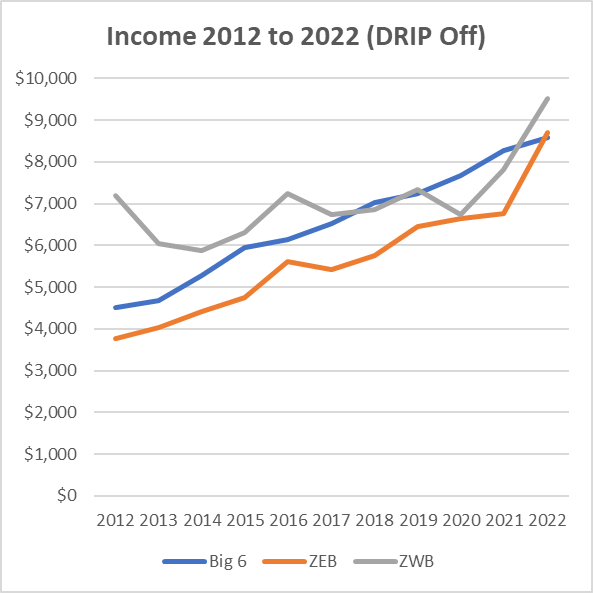
While ZWB starts out with a far greater annual income than the other two options, it shows more variability than the other two. Variability of income from year to year can be an issue for some retirees. Perhaps more importantly, the other income streams are catching up as time goes by. Direct investing shows a more consistent upward trajectory, even without any additional investment or DRIP. And this is exactly what you’d hope for with a portfolio of dividend-growth stocks. The dividend growth is what grows the income stream. That can be very important for an investor with a longer expected time horizon in retirement. Early retirees should watch out for this.

The Canadian banks generally do well over time. For portfolio growth & for growth of income. But now it’s down to personal choice. Do you prefer to trade some long-term portfolio value for the bigger income stream of the covered call approach early in retirement? Or do you like the more consistent growth of the income stream that comes from a portfolio biased towards dividend growth? There are a lot of factors that go into individual decisions. For a young investor with a long time horizon, total return is probably going to be more important than the size of the income stream starting out. It might also be more important for an early retiree. Or for a healthy retiree with a longer life expectancy. Things like leaving an inheritance, planning for home care or a retirement home, & so on, all factor into the decision making process too. Regardless, the Canadian banks have been a pretty solid investment over time & they look good in all these scenarios. Of course, as you’ll find noted on every fund’s webpage … past performance is not indicative of future results! We can’t just assume an investment will continue to do well in the future because it’s done well in the past. The banks have been great performers historically. But not all stocks or funds perform as well as the banks did here. Be sure to compare your choices for total return & income growth. And not just the size of the yield!

If you want to learn more about all this from the ground up, I’d like to suggest that you check out Double Double Your Money, available at your local Amazon store.

Important – this is not investing, tax or legal advice, it is for entertainment & educational purposes only. Opinions are my own, so do your own due diligence & seek professional advice before investing your money.


Double Double Your Money

I started pulling information together to help my kids save & invest almost 3 years ago & the end result is this …

Double Double Your Money was released on Amazon today.

It is a guide to saving & investing that primarily targets younger investors & those just starting out on their journey. That said, I could have used something like this at a much older age myself! It might also be a useful resource for other parents looking for some ideas on how to guide their own kids towards a saving & investing program. Like all Dads, I’m trying to prevent my kids making some of the mistakes I made. As parents, we know how that usually goes. But we’re parents, so we have to keep trying, eh!

While the broad principles apply in most places, the focus is on Canada, where we can tap the value of tax-sheltered accounts like our TFSA & RRSP. The Canadian CPP & OAS programs provide some support in retirement but there’s a lot more we need to do to for a comfortable retirement. In my twenties, I couldn’t even imagine thinking about retirement. Nor do my kids. So I cover some exciting things like getting rich, becoming a millionaire on minimum wage, early retirement, FIRE, & anything that I think might suck them into saving & investing sooner!

Not to worry, there’s no silly stuff here. I’m a little too conservative & risk-averse for that. And I worry more about losing my kids money than I do my own. But the importance of building a financial strategy as early as possible is a huge deal. I hope this works to get younger investors, including my own kids, motivated enough to get things going.

You’ll find it across most Amazon markets in Kindle & hardcopy formats, & you’ll find it in the Canadian market here.

When to Avoid Dividends

The Fruits of Investing!

For a dividend investor, the answer is we never want to avoid dividends, right?
After the last post on Canadian-listed American dividend ETFs, I thought I’d provide an alternative view to one that might have suggested dividend-growth investing is the way to go.

Dividend-growth investing is very popular. I’m a fan myself. Primarily because it is a strategy that can work reasonably well for an investor with limited skills & ability to assess the potential of a stock to provide good returns. Using fewer & simpler metrics than it takes to properly evaluate a stock, it’s possible for a DIY investor to choose a portfolio of dividend-growth stocks that can perform reasonably well. And, being focused on a growing income stream, rather than on a falling share price, can help some of us ride out market downturns. The other great attraction of dividends is that as a portfolio grows, the income stream can grow &, one day, it may even match the income stream from our day job.
How cool would it be to have a portfolio that generates enough income to match your paycheque? Very cool, eh!
A retiree with a portfolio that provides a 4% yield on retirement day, might look forward to never having to sell shares. Selling shares for income can be a traumatic challenge for some retirees. And if the income stream continues to grow more than inflation, our retirees golden years might truly be golden. There’s a lot of good to be said about a portfolio of dividend-growth stocks.

But, in the world of investing, things are never simple!

Picking the right dividend-growth stocks still takes a lot of work. And it takes additional work to monitor & maintain a portfolio of individual stocks. Dividend-growth may still be a valid strategy for some. But it’s worth back-testing your stock portfolio against a dividend-growth ETF portfolio every now & then. Just to see if all the extra work produced enough extra reward. Of course the yield from such ETFs often don’t match that of a portfolio of hand-picked dividend-growth stocks. We like our bigger dividends, eh!
However, things can be different before & after retirement. And that raises some questions.


How many years ahead of retirement should we start building our dividend income stream?
Does it make sense to start early & just let the DRIP work for us ahead of retirement day?
Is it important for that income stream to grow before we retire?
But the really big question is this: should we even be focused on an income stream ahead of retirement?

Let’s take a look …

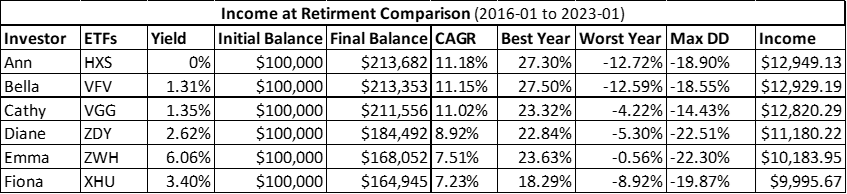
All our investors above put 100k into an ETF at the start of 2016, with a view to retiring at the end of January, 2023.
Ann & Bella are oblivious to dividends. They both followed the market index investing philosophy & went with S&P 500 Index® funds for part of their US allocation.
Ann chose Horizon’s HXS. This is a total return strategy that doesn’t pay any distribution. Unlike all the other ETFs, this one reinvests the value of the dividends inside the ETF. The income stream is zero.
Bella went with Vanguard’s VFV index fund. In this, & all other cases, distributions were automatically reinvested (the DRIP) at no extra cost.
Cathy likes the dividend-growth approach & invested in Vanguard’s VGG. She realised she might sacrifice some of the total return potential of the market, but she felt her choice was less volatile (it is, look at the Worst Year & Max DD columns) & that allowed her to sleep a little better.
Dianne was lured by the higher dividend payout of BMO’s ZDY. This ETF has a pretty good history of share price appreciation & a decent dividend growth trend. She liked that.
Emma wasn’t sure if she was into the whole FIRE thing yet but she thought that BMO’s ZWH might give her that option sooner. The juicy 6% yield from this ETF might make earlier retirement a reality for her. And the covered call strategy might offer some downside protection to boot. The Max DD is a little scary, but the worst year performance is the best of the bunch over this time period. Getting a good night’s sleep was important for Emma too.
Fiona went with a more traditional dividend approach, going with the Blackrock’s iShares® XHU offering. This is an ETF that focuses on a basket of solid, reliable, higher yielding companies in the US. A good choice for an investor who favours this approach.

Looking at the Final Balance column, I’d be pretty happy if I’d thrown a few bucks into any of these ETFs back in 2016. But what is the point of this comparison?

It’s this …

Come retirement day, we will look at things differently.
It’s not how much income was received & reinvested along the way.
It’s not how much the income stream grew prior to retirement.
It’s not about when we started to build an income stream.
It’s going to be all about the value of the portfolio on retirement day.
And how big an income stream that portfolio can buy to support our needs from that day forward.


Look at the Income column, the last one on the right. This is the income stream that would result from all the ETFs being sold off on retirement day to buy ZWH, the highest yielding ETF. The biggest income stream can be had by selling the portfolio that gave the best total return. And then buying the ETF with the greatest distribution, in this case ZWH. There is a 30% spread here, that’s significant.
Notice that in most cases, the higher yielding funds tend to have lower total return over time. That might not always be the case & it might not be the case going forward. Not even amongst this batch of ETFs. Doing your own due diligence, as always, is important.

But, from a pure numbers perspective, it matters less what happens with dividends during the accumulation years. It only matters that the portfolio grows. As much as possible. The bigger the portfolio, the bigger an income stream it can buy on retirement day. In this example, how much the income stream grew during accumulation didn’t matter. Having a bigger yield on cost didn’t matter. The only thing that mattered was that a bigger portfolio bought a bigger income stream on retirement day. For simplicity & to maximise return, all investments were considered to be inside a tax-sheltered account. There are other implications, not covered here, for selecting ETFs like this in a non-sheltered account.

Emotionally & numerically, there are many reasons that investors choose to invest differently. Seeking solutions with lower volatility, the reassurance of a growing income stream, avoiding the need to sell shares, & so on, all factor in to individual choices. All these are all important considerations, for sure. But the message here is not that we all need to abandon our chosen strategy in favour of some other promoted strategy. It’s more about giving some thought to strategies that differ from our current path. Despite the reassurances we get from like-minded investors in our favourite social media groups, it can be useful to think differently about things from time to time. We shouldn’t fall in love with one particular strategy & block out all information that conflicts with that. It might be worth taking some time to learn about different perspectives & different strategies. Keep an open mind.

By the way, I’m not suggesting that you buy any of the ETFs here. Nor am I suggesting that everything gets dumped on retirement day for one high-yielding ETF. This is just an example to illustrate why we might want to think differently about our approach from time to time. It’s just as a valid to consider switching to a basket of individual, higher-yielding, dividend-growth stocks on retirement day, for example. Or sticking the proceeds into a portfolio of your favourite high-yield funds. Do whatever floats your boat for an income stream. Believe it or not, some will stick with the growth solution that got them there & sell shares for income. But regardless of approach you choose during the accumulation years, whatever you choose to do in retirement will probably work better with a bigger portfolio. 😜

So how do you accumulate?

Important – this is not investing, tax or legal advice, it is for entertainment & educational purposes only. Opinion are my own, do your own due diligence & seek professional advice before investing your money.
The Real Power of Dividends

Vacation Footwear for Ireland in October!?!

There are some strong opinions out there on which investing strategy is best. Over time, & from a pure numbers perspective, the only thing that really matters is total return. It doesn’t matter whether you get that return from capital gains, dividends, some other kind of distribution, or any combination of those. I suggest to my kids that they invest in low-cost, market index ETFs. They’ve got the time to make that work. No guarantees, of course. Going forward, maybe the American & Canadian markets will do what the Japanese market has been doing since 1989. That might not be a great outcome for them come retirement day.

The closer I get to retirement, the more I worry about running out of money during retirement. Any simulation I run with the 4% withdrawal “rule” always has a few chart lines that wipe out early. And I’m not even planning for an extravagant retirement lifestyle. Not only do I not want to run out of money during retirement, I’d like to think there would be enough left over for my kids to take my ashes back to Ireland when my time is done!

I started out with mutual funds way back. When I realised how much I was paying for underperformance, I got out of those. Then I tried picking growth stocks. I wasn’t very good at that & I lost some money. On the bright side, I didn’t have much money to begin with, so there wasn’t much to lose! Professional money managers were up next. Since I didn’t know what I was doing, I figured they would. Turns out they weren’t keeping pace with the market either & I was paying extra for that underperformance. Though I don’t blame the pros, they were creating portfolios based on my risk aversion. And I was pretty risk averse after getting burned by my own poor stock selections. With the benefit of hindsight, had I gone into index funds from the get-go, I would have fared far better. Despite the risks, that’s why I recommend index-tracking ETFs for my kids.

Now that I’m much closer to retirement, I have a different outlook. While I’m a hybrid investor now, investing in both stocks & ETFs, I have a leaning towards dividend-growth investing. It started with those 4% withdrawal simulations. If 4% was enough to live on, why not just have a portfolio that generates distributions of 4% annually? Rather than have to sell shares for income, couldn’t I just live on the dividends & distributions? Of course, you need a portfolio big enough to make that work. But that’s a whole other story! After years of messing around with the dividend-growth strategy, I finally got around to moving towards that approach a few years back. Now, instead of retiring at 83, I might be able to get out at 79! I’m kidding.

I hope! 😜

The anti-dividend lobby tell me it’s the wrong approach. But if I were already retired, selling shares of those beaten down index funds this year would give me some serious grief. While my dividend-focused portfolio is down year to date, it’s ahead of the market by more than 13%. And that comes with my bond allocation having the worst year in the history of the bond market too. That’s not too shabby. Moreover, those dividends are on synthetic DRIP (dividends are automatically reinvested in more shares of the same equity) so that my share count is increasing at an even faster rate, as the share prices get beaten down.

While the year-to-date market-beating performance is meaningless over such a short spell, I’m more focused on the dividends than the share price. A stock down 50% is buying twice the number of shares than before the downturn. So long as the dividends aren’t cut, I’m happy picking up more shares when things are on sale. While the dividend-growth stocks may not match the long term total return of an index fund, the real power of the dividend-growth strategy is psychological!

I’m off to Ireland for a long-overdue vacation today. I have no idea what I’m hoping the market will do while I’m away. But I’m praying I’ll get there, & back, safely. And that my portfolio keeps on chugging out those dividends while I’m gone. 🇮🇪☘️🍻

Important – this is not investing advice, it is for entertainment & educational purposes only. Do your own due diligence & seek professional advice before investing your money.

Investing is so Exciting, eh!

Going to the Moon?

When I assumed control of my own portfolio during the pandemic, nobody told me how exciting it was going to be. Buying & selling stocks & ETFs, watching the numbers go up & down, checking out colourful little charts & graphs, it’s all great fun. Way more fun than getting fake coins for completing a crossword puzzle app on my phone. I must have missed my game time though, because I bought some crypto. Now I could carry on watching fake coins on an app, just like before. But without having all the pressure of figuring out which letters I needed to make a word. Crypto wasn’t that much fun though. I didn’t get the idea behind this game. So I sold them & bought these other stocks where you can win dividend coins. Every now & then, these coins just tumble in out of nowhere. Even when you have no idea what you’re doing. It’s great!

Investing is a fun game. I’m still learning & I don’t know all the rules yet. Is it better to own single stock warriors or little ETF armies? What does it mean when the numbers turn red? Am I trying to get the squiggly line to go up or down? Are we supposed to make mountain shapes with the lines? I think the overall objective of the game is to beat “the Market”. The Market is like the evil empire & if you beat the market, you get treasure.

That should be easy, no!

Why?

Because social media & 24 hour stock market channels provide an endless supply of expert advice now. And it’s free. What other game do you play that has it’s own TV channels? It’d be crazy not to take advantage of all that free wisdom, right? Though I must admit, they’re messing with my head a bit. One says buy this, the other says not. Next week, they both reverse what they said last week. Is this some clever gaming strategy? It takes a while to get used to a new game. To understand all the tricks & sly moves that get you ahead. But I have noticed that if you buy anything that a rich & famous person buys, you usually get a great result. Right now, I’m trying to figure out how to buy the right armour & weapons stocks before the famous guy does. That’s a good strategy, right?

It’s the same with all these games though. Kids learn much faster & play much better than us slightly older folk. Kids were getting rich buying these funny game company stocks. And that silly fake-money coin. While I was still trying to work out what to do with those dividend coins. I also didn’t know what bonds were. Was that like some kind of protective potion that you could drink when your stock warriors were under attack? Experts say older people should have a lot of bonds.

Anyway, I was too busy learning about how to attack the market with my stock icons, so I was late to the game buying a few bond ETFs. I know I should have spent more time looking into the powers of the bond potion but, so far, they blow. I’ll just park them in the corner for now & worry about them later. Though most of my stock icons are pretty boring too. All the exciting icons are with the high-flying gamers. This year however, they seem to be flying below my boring stocks. I’m guessing this is another strategy I haven’t figured out yet. Maybe they fly below to look for weak spots in the underbelly of my stodgy stocks? I might pick up a few of those high-flyers now. I don’t know what else to do with those dividend coins.

Back when I had advisors, the market would usually beat me. Except, sometimes, when I lost money. In years when I lost coins, they’d tell me that we (meaning the advisor & me) didn’t lose as much as the market. And that this was a very good thing. It was, I agreed. When the market was up, I didn’t think it was quite so good when the market beat “us”. But I learned that was normal & that we weren’t trying to beat the market. I’m good with that too. But I can’t believe I used to pay advisors to do all this fun stuff for me. They were having all the fun playing the game & I was paying them to play for me. It’s almost like paying someone to go out & have a nice dinner for you. And on you!

Now I have all the fun myself. I’m pretty sure I won’t beat the market either. But it costs me nothing extra to play now. And I can try to not lose as much as the market when things are down. Though I know I’ll miss those fireside consolation chats I had with my advisors when things sucked. Gaming solo can be lonely.

If I lose all my coins, I’m truly shagged. But I gotta say … so far … it’s been a whole lotta fun using a little money learning how to play the game.

Let’s see if I’m still enjoying the game as much by the time the next heroic bull emerges to battle the market.

Game on! 😜