Why you NEED a TFSA?

According to the latest StatsCan data, from 2021, there are about 15 million of us that have TFSA accounts. There are about 30 million of us that are eligible to have TFSA accounts, so 50% of the adult population are not using this account. While some can’t afford to save & invest, there are still a lot of people missing out on what this account can do for them. TFSA means Tax-Free Savings Account.

Who doesn’t want something tax-free?
If you have money sitting outside this account … WHY!?!

The other funny thing with TFSAs is that a lot of people are storing cash there. I know it says “Savings” right in the name, but parking cash is not what this account is about. Inflation evaporates the value of cash. Especially with today’s high inflation rate. There are no benefits to letting cash evaporate inside a TFSA. You need to invest in something. Even if you are worried about investing in the markets, you can put your money to work in a high interest tax-free savings account (HISA), in GICs, or in one of the cash savings or HISA type ETFs. Some of these are yielding 5% at the moment. You can harvest that 5% return in a TFSA totally tax-free.

Some of these choices are more liquid than others. Being “liquid” means you can convert whatever it’s in to cash right away. And that means you could consider storing some of your emergency fund inside a TFSA. A locked-in GIC, for example, is not suitable for an emergency fund. An emergency can’t wait for a GIC to mature. The bottom line is that it’s tough enough to save, whether it be for an emergency fund or a holiday fund, but reducing the value of those savings by not getting some kind of return is a waste. And not sheltering those returns from tax only adds to that.

I know some of you are are already way ahead of the game with this. But if you have people in your life that you even remotely care for, your friends, your parents, your kids, please teach them about the value of the TFSA. It’s too big a deal to miss out on. Sure they’ll have to learn how it works & what investments are suitable under different circumstances. But it is worth the effort. If they can’t learn enough to do it alone, encourage them to see an advisor for help.

If you are not filling up your TFSA with long-term investments, use the spare room for your spare cash. Let it work tax-free for you.

If you want to learn a whole lot more about how all this stuff works, read Double Double Your Money, available here on Amazon. If you have a Kindle Unlimited subscription, you can read it for free. If you don’t have a subscription, there is a current Amazon.ca promotion that gives you the first two months free, so you really can read it for free. Please read it & share the message. Help get it out to some of the other 15 million Canadians who are missing out on the tax sheltering power of the TFSA.

Important – this is not investing, tax or legal advice, it is for entertainment & educational purposes only. Opinion are my own, do your own due diligence & seek professional advice before investing your money.

Double Double Your Money

I started pulling information together to help my kids save & invest almost 3 years ago & the end result is this …

Double Double Your Money was released on Amazon today.

It is a guide to saving & investing that primarily targets younger investors & those just starting out on their journey. That said, I could have used something like this at a much older age myself! It might also be a useful resource for other parents looking for some ideas on how to guide their own kids towards a saving & investing program. Like all Dads, I’m trying to prevent my kids making some of the mistakes I made. As parents, we know how that usually goes. But we’re parents, so we have to keep trying, eh!

While the broad principles apply in most places, the focus is on Canada, where we can tap the value of tax-sheltered accounts like our TFSA & RRSP. The Canadian CPP & OAS programs provide some support in retirement but there’s a lot more we need to do to for a comfortable retirement. In my twenties, I couldn’t even imagine thinking about retirement. Nor do my kids. So I cover some exciting things like getting rich, becoming a millionaire on minimum wage, early retirement, FIRE, & anything that I think might suck them into saving & investing sooner!

Not to worry, there’s no silly stuff here. I’m a little too conservative & risk-averse for that. And I worry more about losing my kids money than I do my own. But the importance of building a financial strategy as early as possible is a huge deal. I hope this works to get younger investors, including my own kids, motivated enough to get things going.

You’ll find it across most Amazon markets in Kindle & hardcopy formats, & you’ll find it in the Canadian market here.

The Best American ETFs for Canadians

Decisions, Decisions!

If I lived in the US, I would probably split my US exposure between the Schwab US Dividend Equity ETF (SCHD) & the Vanguard Dividend Appreciation Index Fund ETF (VIG).

Why?

For a few reasons. The first is because I like dividend-growth stocks & both those ETFs focus on companies that have the potential to create a growing income stream. Dividend-growth companies appear to hold up better than growth stocks when the markets crash. Because I’m a bit of a chicken, I tend to I favour ETFs with lower volatility than the market. The goal of choosing lower volatility investments is to take away some of the market downside when bad things happen. When a conservative investor seeks to avoid volatility, what we really mean is that we don’t want our stuff to go down. We don’t mind volatility to the upside, of course! But lower volatility ETFs usually knock off some of the highs too. These two ETFs, however, are great performers. One slightly lags the market, while the other has a slight beat. Both provide that level of performance with less volatility than an S&P 500 Index® ETF. Since 2012, they had better annual performance than the market in the worst years & their biggest drawdowns were less severe than those of the market too. The bottom line is they have provided good performance over time. And they offer the potential for reduced anxiety during the bad times. My kind of investing.

While we can buy these ETFs in Canada, there are pros & cons to a Canadian investing through the US exchanges. Some combination of laziness, currency exchange costs, & a desire to avoid additional tax reporting headaches has many Canadian investors favouring Canadian-listed ETFs for their American exposure. Can we do that & get the results provided by ETFs like SCHD & VIG. Let’s take a look.

There are ETFs from all the big providers, like Blackrock®, BMO Global Asset Management, Vanguard Canada, Horizons & others, that provide US market exposure solutions for Canadians. In Canadian dollars. An easy choice for one of the contenders is the Vanguard US Dividend Appreciation Index ETF (VGG). This one is easy because it holds just VIG, the very same US ETF mentioned above. Of course, the expense ratio (fee) is higher in Canada, but we’re used to that, eh! I would like a Canadian-listed equivalent to SCHD, but there really isn’t anything doing exactly what SCHD does up here. BMO’s ZDY is vaguely similar but the BMO Low Volatility US Equity ETF (ZLU) looks interesting too. With all the online chatter about high yield ETFs in recent years, I had to include one of those for comparison & I went with the BMO US High Dividend Covered Call ETF (ZWH). I think this is one of the better ones in this space & it merits inclusion to see if all the talk about the downside protection that this strategy offers is really true.

Let’s cut to the chase …

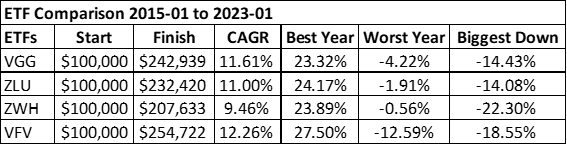
For the market benchmark comparison, I’m using Vanguard Canada’s S&P 500 Index® ETF (VFV). With everything in Canadian dollars, the variable exchange rate noise doesn’t confuse the comparison. Here we see the results of 100k invested in each of the ETFs at the start of 2015. ZWH was launched in 2014 so the data (courtesy of portfoliovisualiser.com) for this comparison starts in 2015.

What do you think of those results?

As is often the case, the low-cost market index fund wins out for total return. Over a long lifetime of investing, that 1.26% difference between the annual returns from ZLU & VFV, for example, could be huge. If you can tolerate the volatility, Mr. Buffett’s advice is looking good, the low-cost market index fund is the winner. But for more fearful investors, the lower volatility choices might help keep them in the market during times of steep decline. Jumping in & out of the market in response to market fluctuations can be a wealth killer for investors. For that reason, my choices would be VGG & ZLU in this instance. They don’t come as close to market returns as the two American ETFs we looked at earlier. But they’re good enough for me & I think I’d manage a better night’s sleep with those in my portfolio. I must be honest here, I was taken aback by how well ZLU has performed over the past 8 years. Can it sustain this level of performance? I have absolutely no idea. But I am impressed. ZWH was also surprisingly good. Though it shows the best “Worst Year” performance of the four, it had the biggest drawdown of the group, at 22.3%. That would have been a heart-stopper for me. Yet it managed to recover from that big drawdown to post pretty decent results over time. That’s a good outcome. Its total return over the period, however, lags the other two, so I would probably choose those instead. In retirement, when an income stream might be more important, ZWH might earn a place in a portfolio for some.

There’s a lot more under the hood here. Along with deciding on a US portfolio allocation percentage, an investor should consider the diversity of each fund for that US exposure. There are tax implications for US-listed vs Canadian-listed American equities in different accounts, sheltered & not. And so on. This post isn’t about any of that, it’s just an example of tailoring a portfolio to suit an investor profile that might be more, or less, risk tolerant.

What do you do for your US exposure?
And be sure to let me know if you have a suggestion for a better alternative than those above.

Important – this is not investing, tax or legal advice, it is for entertainment & educational purposes only. Opinion are my own, do your own due diligence & seek professional advice before investing your money.


When Stock Charts Lie

Picking Winners from Stock Charts? Don’t do that!

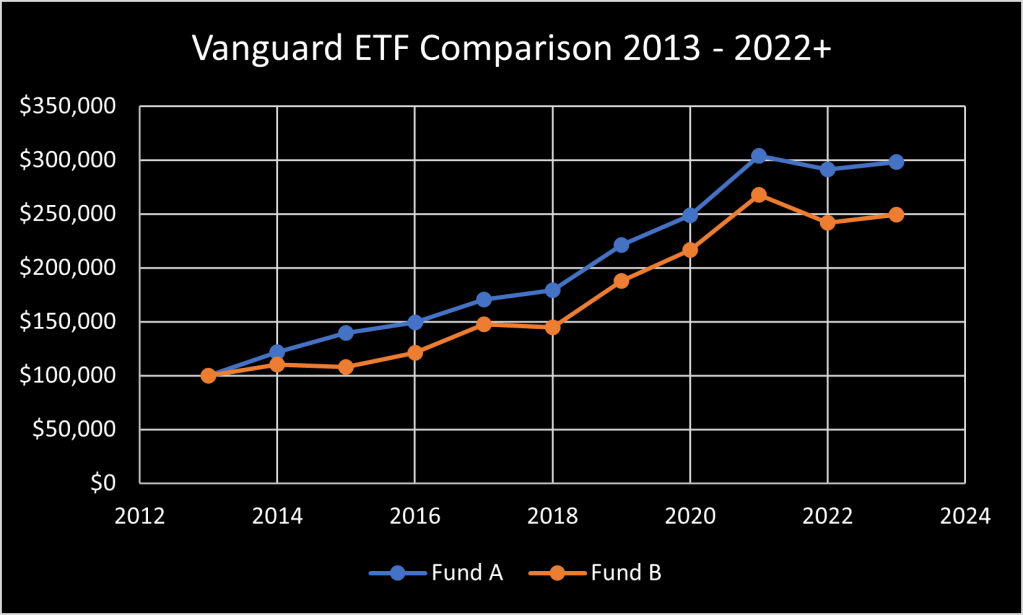
I’m not a very sophisticated investor. When it comes to choosing between two stocks or ETFs, I like to look at pictures. Let me use a couple of funds from one of my favourite fund companies, Vanguard, by way of example. Look at the chart below, which fund would you choose?
Seems like a no-brainer, it’s the blue one all the way, eh? Over the course of 9 years or so, Fund A has outperformed Fund B. Fund B managed to turn 100k into about 250k. But Fund A turned that same 100k into almost 300k. All these charts are with dividends reinvested.

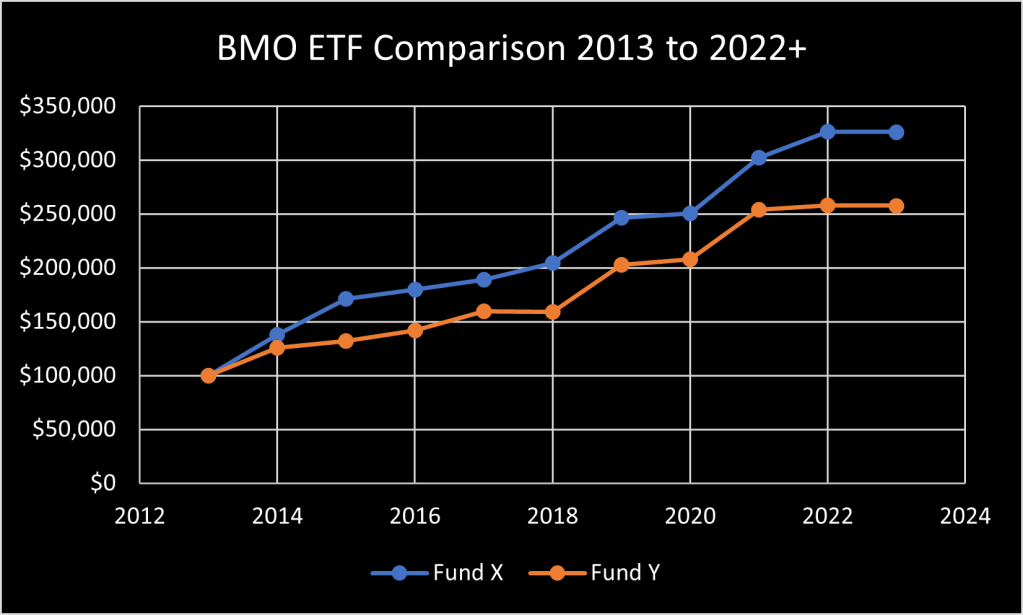
Let’s look at one more, this time from another of my favourite fund companies, BMO Global Asset Management. Similar story here, Fund X is crushing Fund Y. While Fund Y turned 100k into more than 250k, Fund X managed to return over 325k during that same time. Another no-brainer choice, eh?

No, it’s not quite as simple as that.
In fact, the ETFs used in each of these charts are, for all intents & purposes, identical.
So why are the charts suggesting otherwise?

The difference mainly comes from the currency of purchase & the differences in exchange rates over time.
Fund B in the Vanguard chart is VIG, an American-listed dividend appreciation fund & Fund A is a Canadian-list fund, VGG, which only holds … wait for it … VIG, the exact fund that plotted the chart for Fund B. VIG is purchased in US dollars, while VGG is purchased in Canadian dollars.
Fund X is BMO’s Low Volatility US Equity ETF, ticker ZLU, listed on the Canadian exchange. While Fund Y is the US dollar version of exactly the same fund, ticker ZLU-U, also listed on the Canadian exchange. Yes, you can buy funds on the Canadian exchange in US dollars. The apparent outperformance of the funds listed in Canadian dollars is due to the general decline of the value of Canadian dollar against the greenback over those years. The value of the companies in both funds is identical but the numerical value in US or Canadian dollars changes with changes in the currency exchange rate. Back in 2013 you could swap a loonie for about 97 cents American. Today, it’s about 74 cents. That makes for a bigger number in Canadian dollars at the end of the chart. But the relative value is far closer than the charts suggest. If you were cashing in your portfolio to buy a condo in Florida today, your loonies would be exchanged for fewer US dollars than in 2013. Nobody can predict the future of the exchange rate any better than the direction of the stock market but there’s another way to think about it. When the Canadian dollar is strong, Canadians love to go cross-border shopping. Same thing with buying American equities! 😜

So, if you need this kind of market exposure in your portfolio, which funds should you buy?

Simple question but there are a lot of things going on here so the answer is not so simple. The American VIG comes with a 0.06% fee, while the Canadian version charges 0.30%. The Canadian fee is 5 times larger. Though it still looks small, small fees can make a difference over time. The BMO funds both have an MER of 0.33%, so that’s a wash. As Canadians, we’re used to paying more than our American cousins for a lot of things &, unfortunately, that includes fund fees. So why not buy the American-listed fund instead? Again, not so simple. Doing that involves currency exchange fees. Along with the potential for additional tax reporting & liability concerns, of particular concern with larger holdings. To top it off, there are foreign withholding taxes to consider. These can be protected by collecting dividends from American-listed equities inside an RRSP or RRIF, they can be offset in a taxable account, but they are not recoverable in a TFSA. Nor within any tax-sheltered account if the American dividends are coming from a Canadian-listed ETF holding American dividend paying companies. These are all topics for another day but the message for today is this … don’t make your investing decisions based on a random chart you see online. And especially not on the charts above. It’s just not that simple.

Now, you shouldn’t let this paralyse you either. If you’re just starting out, there is nothing wrong with sticking with the path of least resistance. There are no guarantees it will be the same going forward but if past market performance is anything to go by, having an allocation to Canadian-listed Canadian-dollar funds that track an American index should serve you well. If you are saving & investing small amounts regularly, & if you expect to be doing that for many years, you can dollar-cost-average your way through the fluctuations of the currency exchange rate, in addition to those of the market. It’s usually not wise to wait for the “right” currency exchange rate. A lot of market growth potential can be missed while waiting for the right time to invest. If you happen to get a bonus cheque that you want to invest in US equities right when the Canadian dollar is at par, that’s great. Nothing wrong with a bit of luck either! There are other reasons why we might prefer to hold a position in US-listed or US-denominated equities but, in general, any of these funds might work for a part of the US market exposure in a portfolio.
As your portfolio grows, you will almost certainly need some professional advice down the road. Especially when it comes to taxes.

Let me modify the title a bit here: the charts are not purveying lies but they can be deceptive. Do not rely on simple charts to tell the whole story. Charts are more like a good mystery novel. There are so many nuances that you need to dig deeper in order to figure out the plot before you get to the end. And even when you do that, you should always try to prepare for a surprise ending!

Important – this is not investing, tax or legal advice, it is for entertainment & educational purposes only. Opinion are my own, do your own due diligence & seek professional advice before investing your money. Sometimes, I get stuff wrong! Please let me know if you spot any errors, of commission or omission, along the way.

Funny Numbers – The Rule of 72

The Rule of 72

After looking at the magic of compound growth in the last post, the Rule of 72 is another easy way to figure out what compounding does. Back in the 1400s, an Italian friar, Luca Pacioli, came up with this neat little rule.

Here’s how it works …

Divide 72 by the rate of return percentage on your investment to find out how many years it will take for your money to double. If you have an annual rate of return of 10%, divide 72 by 10 & your money will double in 7.2 years. A return of 3% means it’ll take 24 years for the double. One percent means it’ll take 72 years & so on. It’s not as accurate as a proper compound growth calculator, & it’s not accurate at extremes. But it’s close enough for quick mental math while you’re chatting about your amazing portfolio performance with your buddies over a latte. Of course, like many things in the investing world, there is opportunity for it to mislead us.

You could use the historical average rate of return of the American stock market to calculate what you might earn going forward, for example. That historical 10% rate of return may, or may not, continue into the future. But hoping that an index fund will double our money, on average, every 7.2 years is not a bad assumption to justify going into a low-cost index-tracking fund. Especially for anyone with a very long time to go before retirement. There are other funds out there with big yields. Many of them exceed that 10% market return rate. Wow! A 10 or 15% yield and the potential for capital appreciation, are you kidding me? The funds aren’t but, sometimes, we kid ourselves. A 15% distribution may come with a declining share value over time, for example. You can’t automatically assume that the 15% yield number will double your money every 4.8 years (72 divided by 15), forever. If it did, we’d all be in that one!

If the share value has a downward trend, the 15% yield delivers an ever-downward amount of distribution too. When comparing two funds, regardless of the distribution percentage, it is important to understand the total return potential over time. The yield percentage is not the total return. There may be a time & place that will work for some high yield exposure in a portfolio. But it’s good to understand what you’re getting into. Whenever you are tempted by a high yielding fund, compare the historical returns against a market fund or your favourite ETF. Don’t mistake yield for return. A 15% yield doesn’t always, indeed seldom does, give you back all your money in 4.8 years & then go on to give market beating performance thereafter. While historical performance of any fund is no guarantee of future performance, comparing the total return percentage is a more useful metric for comparing two such different strategies.
And that total return percentage is the number you need to plug into the Rule of 72.

Use the online tools at sites like Portfolio Visualizer, StockCharts & the fund comparison tools at the BMO & Vanguard Canada sites to get a bigger & better picture of the historical performance of different funds. And use the Rule of 72 for total return estimates.
Though you can use it for dividend growth rates too. But that’s a story for another day.

PS … If you do know of a fund that delivers 15% total return consistently, please message me. And don’t tell anyone else ’til I rejig my portfolio!

Important – this is not investing, tax or legal advice, it is for entertainment & educational purposes only. Do your own due diligence & seek professional advice before investing your money.